

FOR IMMEDIATE RELEASE — September 30, 2026 | Source: Acumen Research and Consulting
Global Artificial Organs Market to Reach USD 63.31 Billion by 2035, Growing at 8.2% CAGR
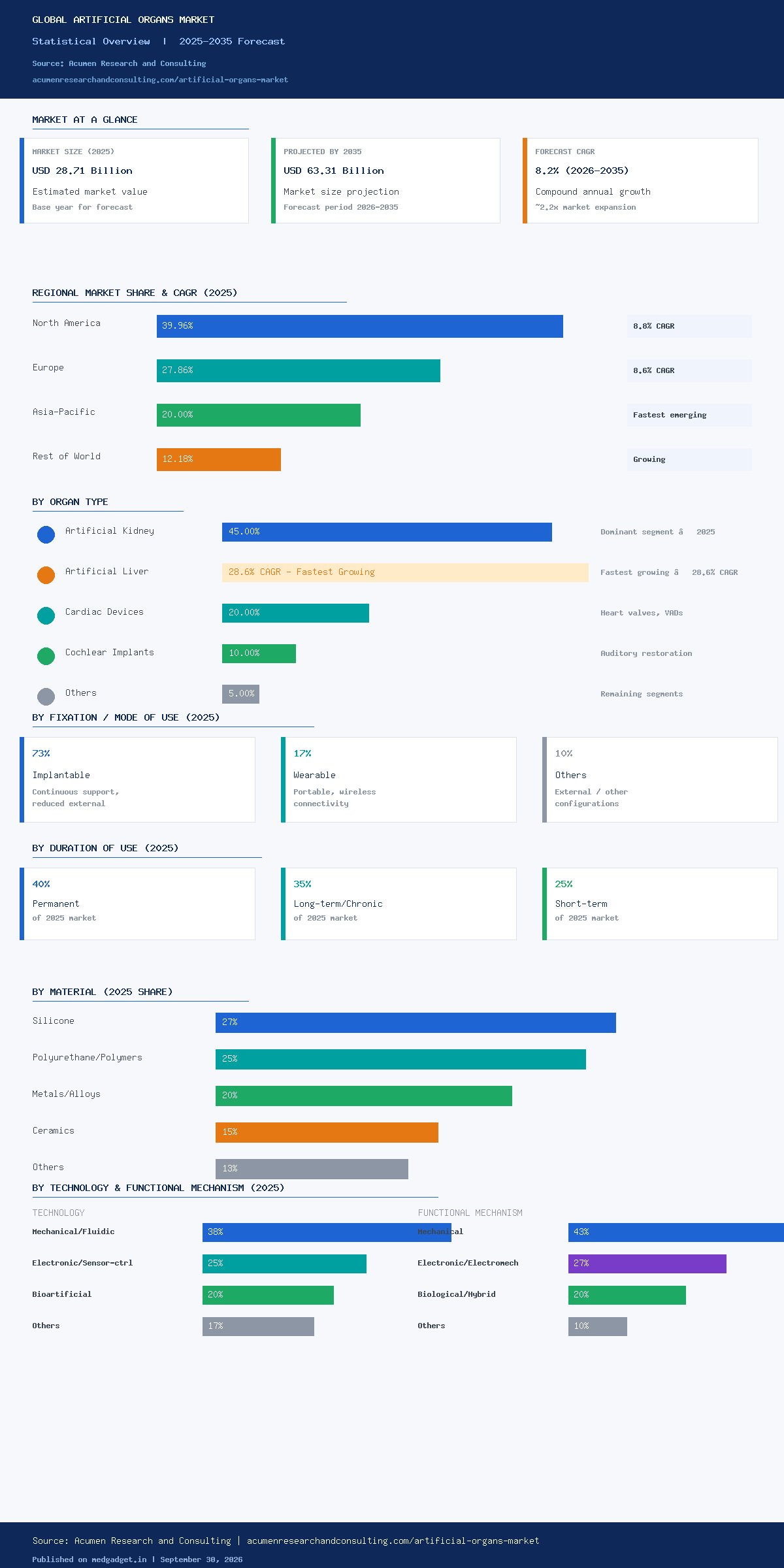
The global artificial organs market was valued at USD 28.71 billion in 2025 and is projected to surpass USD 63.31 billion by 2035, expanding at a compound annual growth rate (CAGR) of 8.2% during the forecast period of 2026 to 2035, according to data published by Acumen Research and Consulting. This substantial market expansion reflects an accelerating convergence of aging demographics, rising chronic disease prevalence, and technological advancement in implantable and wearable organ-replacement devices across global healthcare systems.
What Is Driving the Artificial Organs Market?
Artificial organs are devices engineered to replicate or support the biological functions of failing natural organs. They range from implantable cardiac assist devices and cochlear implants to wearable kidney support systems and next-generation bioartificial livers. Demand is structurally driven by a persistent imbalance between the global supply of donor organs and the number of patients who need organ replacement — a gap that continues to widen as chronic conditions such as kidney disease, liver failure, and heart failure affect more people each year.
Technological progress is equally important. The integration of miniaturized sensors, wireless connectivity, advanced biomaterials, and AI-driven control systems is producing a new generation of artificial organs that are smaller, more responsive, and more biocompatible than earlier devices. These advances are expanding the eligible patient population and improving long-term outcomes, which in turn is driving adoption and supporting market growth.
Market Size: From USD 28.71 Billion in 2025 to USD 63.31 Billion by 2035
According to Acumen Research and Consulting, the artificial organs market stood at USD 28.71 billion in 2025 and is on track to more than double to USD 63.31 billion by 2035. The 8.2% CAGR over the 2026–2035 forecast period places this sector well ahead of average medical device industry growth rates, underscoring both the depth of unmet clinical need and the commercial viability of organ replacement technologies at scale. For context, that pace of expansion implies the market nearly doubles in size over ten years — a reflection of durable demand from an aging global population and the maturation of technologies that were experimental a decade ago.
Regional Breakdown: North America Leads, Europe Close Behind
North America dominated the artificial organs market in 2025 with a 39.96% revenue share, a position supported by advanced healthcare infrastructure, the highest per-capita healthcare expenditure globally, sophisticated medical technology adoption rates, and a deep base of research and development capabilities concentrated in the United States and Canada. The region is projected to grow at an 8.8% CAGR from 2026 to 2035, maintaining its leadership position throughout the forecast period, according to Acumen Research and Consulting.
Europe ranked as the second-largest regional market, accounting for 27.86% of global revenue in 2025, and is expected to grow at an 8.6% CAGR from 2026 to 2035, making it the second-fastest-growing region as well. Europe’s performance is driven by established universal healthcare systems that provide strong reimbursement pathways for medical devices, a rapidly aging population across Germany, France, Italy, and the United Kingdom, a mature medical research ecosystem, and growing adoption of innovative organ-replacement technologies across both hospital and outpatient settings.
Asia-Pacific represents the most significant growth opportunity beyond the near term, driven by Japan’s aging society, China’s vast and underserved patient base, and India’s rapidly developing medical device manufacturing and clinical capacity. These markets collectively are expected to contribute meaningfully to the total market expansion through 2035, though Acumen Research and Consulting’s detailed regional data highlights North America and Europe as the clear volume and revenue leaders in 2025.
By Organ Type: Artificial Kidney Dominates; Artificial Liver Growing Fastest
The artificial kidney segment held the largest share of the artificial organs market at 45.00% in 2025, according to Acumen Research and Consulting. This dominance reflects the sustained and high-volume demand for renal replacement therapy globally — driven by the epidemic prevalence of chronic kidney disease (CKD) and end-stage renal disease (ESRD) — combined with well-established clinical infrastructure for dialysis and the recurring nature of kidney support requirements that creates a predictable, large-scale demand base for device manufacturers.
The artificial liver segment is identified as the fastest-growing organ-type segment, projected to register a 28.6% CAGR from 2026 to 2035. This exceptional growth rate reflects the rising clinical need for advanced support systems for patients with severe acute and chronic liver dysfunction, combined with accelerating development activity across bioartificial liver technologies, cell-based systems, filtration-based approaches, and detoxification device architectures. The artificial liver market remains earlier in its commercialization cycle than the artificial kidney segment, which means that base effects amplify the growth rate — but the underlying clinical demand and innovation pipeline are both substantial and real.
By Mode of Use: Implantable Organs Command 73% of the Market
Implantable artificial organs dominated the market by fixation and mode of use, accounting for 73.00% of revenue in 2025, according to Acumen Research and Consulting. Implantable devices hold this position because they provide continuous physiological support without requiring the patient to interact with or carry external equipment, improving quality of life and treatment adherence. The category encompasses cochlear implants, cardiac assist devices, implantable artificial kidneys in development, and a range of structural heart devices.
Externally worn and wearable artificial organs held the second-largest share at 17.00% in 2025. This segment is growing in strategic importance, powered by advances in miniaturized sensors, portable power systems, wireless connectivity, and compact device architectures that are making it feasible to deliver organ support in ambulatory, home, and community settings rather than requiring continuous hospital or clinic-based treatment. The wearable kidney and wearable pancreas categories are among the most active development areas within this segment.
By Duration of Use: Permanent Devices Lead, Long-Term Chronic Close Behind
By intended duration of use, permanent artificial organs accounted for the largest share at 40.00% in 2025, reflecting the significant patient population with irreversible organ dysfunction who require durable, dependable solutions capable of providing indefinite replacement or support. These are patients for whom no natural recovery of organ function is expected and for whom transplantation is either unavailable or contraindicated.
Long-term and chronic artificial organs represented the second-largest segment with a 35.00% share in 2025, supported by the growing number of patients who require prolonged organ assistance for months or years while managing chronic organ malfunction or awaiting transplantation. Together, permanent and long-term chronic devices account for 75% of the market by duration — a striking illustration of how much of the artificial organ landscape is oriented toward sustained, ongoing patient support rather than acute or short-term intervention.
By Material: Silicone Leads at 27%, Polyurethane Second at 25%
Silicone dominated the artificial organs market by material with a 27.00% share in 2025, according to Acumen Research and Consulting. Silicone’s leadership is attributable to its well-established profile of flexibility, durability, chemical stability, and biocompatibility — properties that have made it a foundational material in artificial organ and medical device applications for decades. Its ability to maintain performance across a wide range of physiological conditions and its long safety record in implantable applications underpin its continued dominance.
Polyurethane and other polymer-based materials held the second-largest material share at 25.00% in 2025, driven by the engineering flexibility that polymer chemistry provides. Manufacturers can tune properties such as stiffness, elasticity, tensile strength, degradation resistance, and surface chemistry to match the specific mechanical and biological requirements of different organ applications — a versatility that makes the polymer category increasingly attractive as device designs become more sophisticated and performance requirements more demanding.
By Technology: Mechanical Leads at 38%, Electronic Sensor-Controlled Second at 25%
Mechanical and fluidic technology dominated the artificial organs market by technology type with a 38.00% market share in 2025, reflecting its established role across the widest range of artificial organ systems. Mechanical and fluidic approaches underpin the pumping, filtering, directing, and regulating of biological fluids in everything from ventricular assist devices to dialysis systems — the mature backbone of the artificial organ technology landscape.
Electronic and sensor-controlled technology held the second-largest technology share at 25.00% in 2025, supported by the increasing integration of sensors and electronic control systems that allow artificial organs to continuously monitor physiological conditions and respond more precisely and dynamically to patient requirements. This segment represents the direction of travel for the industry as a whole — as device intelligence increases, even traditionally mechanical categories are incorporating sensor arrays and responsive control algorithms.
By Functional Mechanism: Mechanical at 43%, Electronic/Electromechanical at 27%
Mechanical artificial organs dominated by functional mechanism with a 43.00% share in 2025, owing to the mature technological foundation and established clinical track record of mechanical mechanisms — pumps, valves, and filters — that replicate essential physiological functions across the heart, kidney, and vascular system. Electronic and electromechanical artificial organs held the second-largest share at 27.00% in 2025, driven by the integration of sensors, processors, actuators, and control circuits that enable greater adaptability to changing body conditions. Together these two categories account for 70% of the functional mechanism landscape, with biologically-based and hybrid systems representing the remaining and fastest-evolving portion.
Key Companies in the Artificial Organs Market
The global artificial organs competitive landscape includes a range of large medical device multinationals and specialist companies. Notable participants identified by Acumen Research and Consulting include Boston Scientific Corporation, Organovo Holdings Inc., Terumo Corporation, HeartWare, Cochlear Ltd., ABIOMED, Edwards Lifesciences Corporation, Asahi Kasei Medical Co. Ltd., Berlin Heart, and Thoratec Corporation, among others. These organizations operate across cardiac assist devices, heart valves, cochlear implants, dialysis systems, and next-generation bioprinted tissue technologies — representing the full spectrum of organ systems addressed by the current commercial market.
What This Means for Patients, Clinicians, and the Healthcare System
For patients living with organ failure, the growth of the artificial organs market translates directly into a broader and improving set of therapeutic options. Implantable devices are becoming more durable and less invasive to place. Wearable technologies are enabling organ support outside of clinical settings, reducing the treatment burden that has historically required patients to attend dialysis centers multiple times per week or remain hospitalized. Bioartificial approaches — particularly in liver support — are beginning to bridge the gap between purely mechanical devices and biological transplants.
For clinicians and healthcare systems, the market data from Acumen Research and Consulting points to a sector where investment in artificial organ technologies is increasingly supported by clinical evidence and cost-effectiveness data — not just by early-stage promise. The dominance of permanent and long-term chronic use categories (75% of the market by duration) signals that payers and health systems are committing to these technologies as standard-of-care interventions for defined patient populations, not experimental alternatives.
Conclusion
The global artificial organs market is on a clear and sustained growth trajectory. At USD 28.71 billion in 2025, growing at 8.2% annually toward a projected USD 63.31 billion by 2035, the sector reflects the convergence of demographic need, technology maturation, and expanding clinical evidence. North America leads with a 39.96% share and 8.8% CAGR; Europe follows closely at 27.86% and 8.6% CAGR. The artificial kidney remains the dominant segment at 45% share, while the artificial liver’s 28.6% projected CAGR signals the next major growth frontier. Implantable devices account for 73% of the market by mode of use, and silicone leads materials at 27% share — data points that collectively paint the picture of a market that is both large and still accelerating.
About the Data Source
All statistics cited in this press release are sourced exclusively from Acumen Research and Consulting. The full artificial organs market report is available at https://www.acumenresearchandconsulting.com/artificial-organs-market. Acumen Research and Consulting is a global market intelligence firm covering healthcare, pharmaceuticals, technology, and other sectors.
Disclaimer: This press release is for informational and editorial purposes only. It does not constitute investment, financial, or medical advice. All market data and statistical figures are attributed to and sourced from Acumen Research and Consulting.