

Does a single corneal treatment hold up for years? New Glaukos Epioxa clinical results say it does, at least in a small group of patients followed for three years. Glaukos reported on 7 October 2026 that after one Epioxa treatment, maximum corneal curvature (Kmax) stayed improved by 1.9 diopters from baseline at year three, and that some eyes also gained lines of vision. The data come from a long-term extension of a Phase 3 trial, and they add to the evidence for epithelium-on corneal cross-linking in keratoconus.
Key Takeaways
- Durable flattening: Kmax was improved by a sustained 1.9 diopters from baseline at three years after a single treatment.
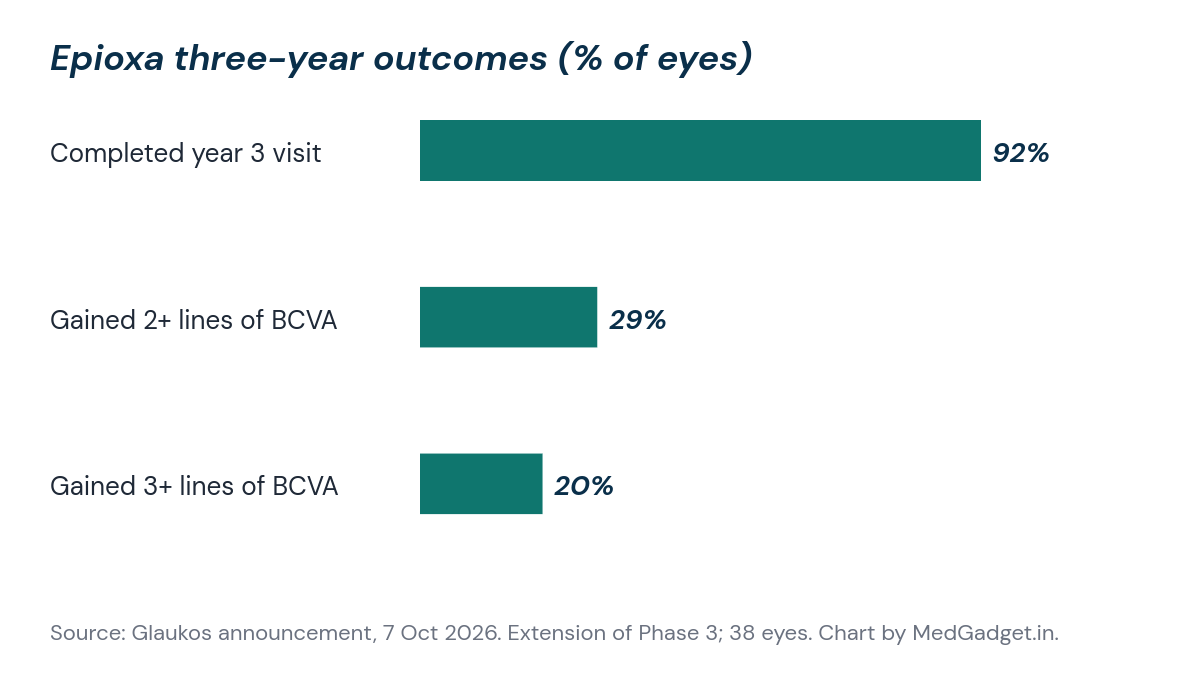
- Vision gains: 29 percent of treated eyes gained two or more lines of best-corrected visual acuity (BCVA), and 20 percent gained three or more lines.
- Safety: through three years, no serious adverse events, no treatment-related adverse events and no discontinuations due to adverse events were reported.
- Small study: the extension covered 38 eyes from 35 people, and it does not appear to have a control group.
- Who it is for: adults and children aged 13 and older with keratoconus, per the product label described by the company.
What is keratoconus, and why does cross-linking matter?
Keratoconus is a progressive eye disease in which the clear front surface of the eye, the cornea, thins and bulges into a cone shape. Vision becomes blurred and distorted, often starting in the teens or twenties, and glasses may stop being enough. The condition is described by the company as rare and significantly underdiagnosed and undertreated. The US National Eye Institute offers a clear overview in its keratoconus guide.
Corneal cross-linking aims to stop the cone from worsening by strengthening the collagen fibres of the cornea. A light-activated riboflavin (vitamin B2) solution is applied, and ultraviolet light creates new bonds between fibres. The goal is stabilisation first and, in some patients, a modest improvement in shape and sight.
How is Epioxa different?
Traditional cross-linking removes the thin outer layer of the cornea, the epithelium, so that riboflavin can soak in. That is effective but can be painful and slow to heal. Epioxa is an epi-on treatment: the epithelium stays in place, so the procedure is incision-free. According to Glaukos, it uses riboflavin 5’-phosphate solution (Epioxa HD 0.239 percent and Epioxa 0.177 percent), supplemented with oxygen and activated with pulsed ultraviolet light using the O2n System and Boost Goggles. The company says this design is meant to reduce pain, streamline the procedure and shorten recovery. Visit Glaukos for product background.
What did the three-year corneal cross-linking study find?
The new data come from extension study GLK-202-03, which followed patients treated in the Phase 3 pivotal trial GLK-202-02 for up to three years with no additional treatment. Thirty-eight study eyes from 35 subjects were included, and 92 percent of eyes completed the year-three visit. Details are in the company announcement.
| Outcome at 3 years | Result reported by Glaukos |
|---|---|
| Kmax change from baseline | Sustained improvement of 1.9 diopters |
| Gained 2 or more lines of BCVA | 29% of treated eyes |
| Gained 3 or more lines of BCVA | 20% of treated eyes |
| Eyes completing year 3 visit | 92% |
| Serious adverse events | None reported |
Note what is missing. The release does not give the average letter change or the share of eyes that simply stayed stable without gaining vision. It also does not describe a comparison group at three years, so the results cannot be separated from the natural course of the disease without reference to the original trial. In our assessment, the headline value of the data is durability: in a condition that normally worsens, holding the gain for three years is the clinically important result.
What about safety?
Glaukos reports no serious adverse events, no treatment-related adverse events and no discontinuations because of adverse events through three years of follow-up. The product label lists conjunctival hyperaemia (eye redness) as the most common reaction, in 31 percent of eyes, and other effects in 5 to 25 percent of eyes, including corneal haze, light sensitivity, punctate keratitis, eye pain and dry eye. Caution is advised in patients with a history of herpetic keratitis, and the product is contraindicated in people hypersensitive to benzalkonium chloride or other ingredients, and in aphakic or pseudophakic patients without a UV-blocking intraocular lens.
Why this matters for the ophthalmology market
Cross-linking has been the standard way to halt keratoconus progression, but many patients and surgeons avoid the epithelium-off version because of pain and recovery time. An approved epi-on option that holds up over several years strengthens the case for earlier treatment, before vision is badly affected. Glaukos describes Epioxa as the only FDA-approved treatment of its kind, a company claim we have not independently verified. Chief executive Thomas Burns said the results reinforce the potential of Epioxa to provide durable clinical benefits and called it a transformative treatment advancement.
For readers following this year’s ophthalmology clinical trial news and approvals, see our coverage of the medical device section and the story on another recent FDA clearance.
What patients should know
- Keratoconus can change quickly in young people, so regular corneal imaging is important.
- Treatment choices depend on how advanced the disease is; some patients need contact lenses or other procedures in addition.
- Ask your eye specialist whether epi-on cross-linking suits your cornea and history.
- Do not rub your eyes; eye rubbing is linked to keratoconus progression.
Frequently asked questions
What did the Glaukos three-year Epioxa data show?
A sustained 1.9 diopter improvement in Kmax, with 29 percent of eyes gaining two or more lines of vision and 20 percent gaining three or more lines, and no serious adverse events.
How many patients were in the extension study?
Thirty-eight eyes from 35 subjects, with 92 percent completing the year-three visit.
Is Epioxa an epi-on treatment?
Yes. The corneal epithelium is not removed, so the procedure is incision-free, according to Glaukos.
Who can receive Epioxa?
Adults and pediatric patients aged 13 and older with keratoconus, according to the labelling described by the company.
Does cross-linking cure keratoconus?
No. It aims to stop progression and can improve corneal shape in some patients. Other vision correction may still be needed.
How we reported this: this article is based on the Glaukos announcement of 7 October 2026 and public eye health references linked above. Results are company-reported topline findings from an extension study. Statements marked as our assessment are opinion. Last updated 8 October 2026. This is general information, not medical advice.