

Could a smart ring one day replace the blood pressure cuff? Happy Health says it is a step closer. The company announced that its Happy Ring received FDA clearance for cuffless blood pressure measurement, which it describes as calibration-free and a first for a wearable. Reports place the announcement on 5 October 2026. Here is what that means, what is still unknown and why clinicians will want to see the validation data.
Key Takeaways
- The news: Happy Health says its ring is FDA-cleared for blood pressure measurement without a cuff and without user calibration.
- The claim: the company describes itself as the first to receive such a clearance. This is company-reported.
- What is missing: public details on study size, accuracy, intended-use wording and availability were not available to us at the time of writing.
- Why it matters: hypertension is widespread and often undetected, and a wearable could make repeat measurement easier.
- Our view: promising, but the proof will be in the clearance documents and real-world performance.
What did Happy Health announce?
Happy Health, the company behind the Happy Ring, says the FDA has cleared the ring to measure blood pressure without an inflatable cuff and without periodic calibration against a conventional monitor. The company’s chief executive, Dr Dustin Freckleton, reportedly called it blood pressure’s “CGM moment,” comparing it with the way continuous glucose monitors changed diabetes care. Further coverage links the clearance to the company’s existing FDA-cleared work in at-home sleep apnea diagnosis and to a network of physicians who can review the data.
The ring is not new to regulators. In October 2024 the FDA cleared the device under K240236 for retrospective remote monitoring of physiological parameters in adults, using sensors for sleep, blood oxygen, pulse, motion, temperature, brain activity and electrodermal activity. Blood pressure was not part of that clearance, which is why this announcement is a meaningful expansion. You can look up clearance records in the FDA 510(k) database and read about the company at Happy Health.
What we could and could not verify
Because the full clearance paperwork is not yet easy to find, we separated what is supported from what is not.
| Detail | Status |
|---|---|
| FDA clearance for blood pressure on the ring | Announced by the company; reported on 5 October 2026 |
| Cuffless and calibration-free claim | Company-reported |
| “First” to receive such a clearance | Company-reported, not independently verified |
| Earlier ring clearance (K240236, October 2024) | Verified in public regulatory listing; did not cover blood pressure |
| Validation study size and accuracy | Not available to us |
| Exact intended use and patient population | Not available to us |
| Price and availability | Not available to us |
We will update this article if the company publishes the study results or the FDA posts the decision summary.
How can a ring measure blood pressure without a cuff?
Cuffless devices do not squeeze an artery. They estimate pressure from signals such as the pulse wave measured by light sensors, and then use algorithms to convert those signals into numbers. Traditionally, such estimates drift over time and need recalibration against a cuff. A “calibrationless” claim means the company says its algorithm gives readings without that step. The company has not, in the material we reviewed, explained the method in detail, so we cannot say how it handles factors such as motion, skin tone, temperature or medication.
In our assessment, those factors are where cuffless technology is usually challenged, so independent validation across diverse users will be the real test.
Why does blood pressure monitoring need new tools?
High blood pressure is among the most common and most preventable drivers of heart attack, stroke and kidney disease. According to the WHO hypertension fact sheet, an estimated 1.28 billion adults aged 30 to 79 live with it, and nearly half of them do not know it. Only about one in five has it under control.
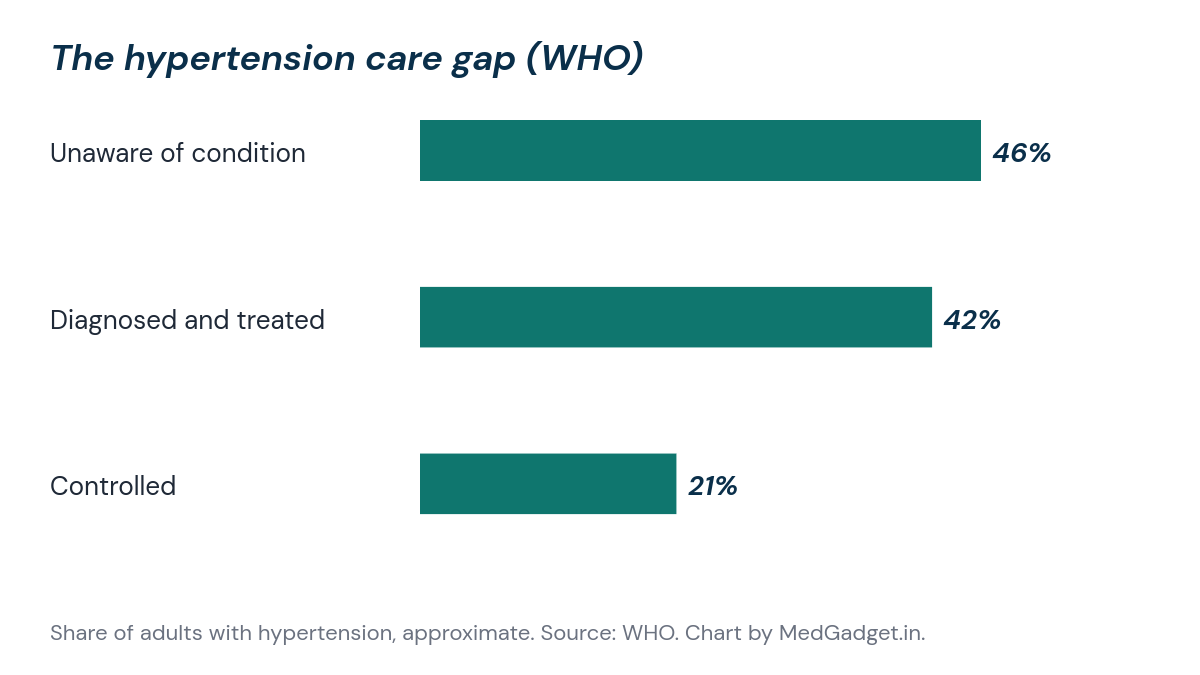
The problem is partly measurement. A single clinic reading can miss white-coat effects, and home cuffs depend on people remembering to use them correctly. A wearable that takes readings during daily life could, in theory, reveal patterns such as night-time hypertension that a cuff check misses. The same logic is behind other home cardiac tools, such as the device covered in our report on HeartBeam’s 3D ECG.
What should patients and doctors keep in mind?
- Do not stop a cuff yet. Until you know the intended use and accuracy data, do not change medication based on ring readings.
- Ask about validation. Look for studies against a reference method and results across different body types and skin tones.
- Check the label. A clearance defines what the device may be used for, which may be narrower than marketing suggests.
- Share data with a clinician. Trends are most useful when interpreted alongside symptoms and history.
What does this mean for the wearable market?
Smart rings and watches already track sleep, heart rate and oxygen. Blood pressure has been the elusive metric because it is clinically important and technically hard. If the Happy Ring’s claim holds, competitors will face pressure to seek similar clearances, and health systems may start asking whether wearable readings can support remote hypertension programmes. Whether insurers reimburse such monitoring is a separate question that is not addressed in the announcement. For more on devices and regulation, see our medical device news.
Frequently asked questions
Is the Happy Ring FDA-cleared for blood pressure?
Happy Health says so, and the announcement was reported on 5 October 2026. The detailed clearance documents were not available to us.
Does it need a cuff to calibrate?
According to the company, no. It describes the measurement as cuffless and calibration-free.
Is it the first in the world?
That is the company’s claim. We have not independently confirmed it.
Can I use it to diagnose hypertension?
That depends on the intended use stated in the clearance, which we could not confirm. Diagnosis should always involve a clinician.
When can I buy it?
Pricing and availability were not disclosed in the material we reviewed.
How we reported this
This article relies on reports of the company’s announcement, a public FDA clearance listing for the earlier device and the WHO fact sheet linked above. Company claims are labelled as such and gaps are stated openly. Statements marked as our assessment are opinion. Last updated 7 October 2026. This is general information and not medical advice.