

One of medtech’s longest-serving chief executives is handing over the keys. Stryker announced on 6 October 2026 that Stryker new CEO Spencer Stiles, currently President and Chief Operating Officer, will succeed Kevin Lobo as chief executive on 1 January 2027. Lobo, who has led the company for 14 years, will not leave: he becomes Executive Chair of the board. The company describes the move as the result of a planned succession process.
Key Takeaways
- Who: Spencer Stiles becomes CEO; Kevin Lobo becomes Executive Chair of the Board.
- When: effective 1 January 2027, when Stiles also joins the board.
- Lobo’s record: CEO since October 2012 and Chair since July 2014; annual net sales grew from $8.7 billion in 2012 to more than $26 billion in 2026, according to the company.
- Stiles’s profile: a 27-year Stryker veteran who ran Orthopaedics, including robotics, and enterprise M&A strategy.
- Not a departure: despite headlines saying Lobo steps down, he stays on in a senior board role.
Who is Spencer Stiles?
Stiles joined Stryker’s Endoscopy business in 1999 and has since held leadership roles across Orthopaedics, MedSurg and Neurotechnology. He became President and Chief Operating Officer in January 2026. Before that he was Group President, Orthopaedics, overseeing Joint Replacement, Trauma and Extremities, and Digital, Robotics and Enabling Technologies, as well as international regions and enterprise M&A strategy. According to the company he was closely involved in the acquisition of Wright Medical and the separation of Stryker’s spinal implants business. See the company’s own pages at Stryker.
That résumé points to continuity. A leader who ran the robotics and digital unit and led acquisition strategy is well placed to extend two of Stryker’s defining themes: robotic-assisted surgery and a steady stream of deals.
What did Kevin Lobo achieve in 14 years?
Lobo joined Stryker in 2011 as a group president and became CEO in October 2012. During his tenure, the company says annual net sales roughly tripled, from $8.7 billion in 2012 to more than $26 billion in 2026, and Stryker completed more than 60 acquisitions, including Mako, the maker of the robotic-arm technology behind its joint replacement robotics. The company also says its products help more than 150 million patients a year.
| Metric | Figure reported by Stryker |
|---|---|
| CEO tenure | October 2012 to 31 December 2026 (14 years) |
| Annual net sales, 2012 | $8.7 billion |
| Annual net sales, 2026 | More than $26 billion |
| Acquisitions under Lobo | More than 60, including Mako |
| Patients reached each year | More than 150 million |
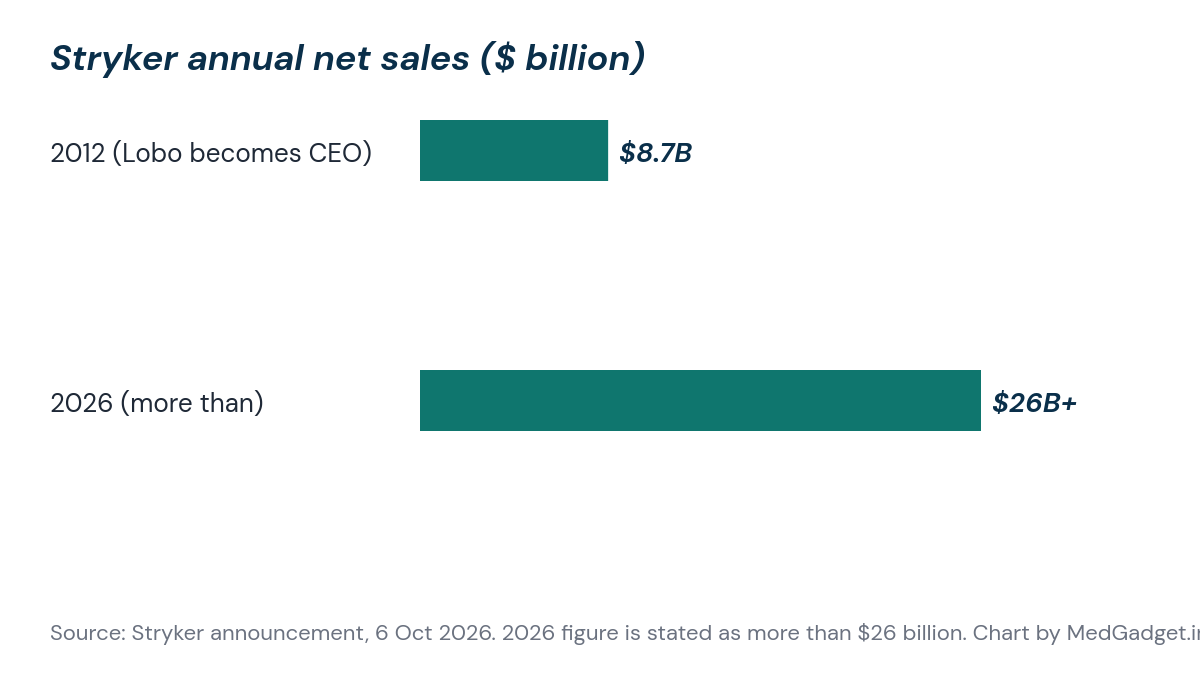
By our own arithmetic, the sales figures imply growth of about 3.0 times over the period, or roughly 8 percent a year compounded over 14 years. That is a calculation from the company’s numbers, not a figure stated in the announcement.
Why a planned succession matters
Sheri McCoy, Stryker’s Lead Independent Director, described the announcement as the result of a long-term succession planning process and said the board is confident Stiles can build on the company’s momentum. Lobo called his time as CEO an incredible honor and praised Stiles’s ability to set direction and execute strategy. Stiles said he was honored to be named and grateful to the board and to Lobo. Lobo becoming Executive Chair gives the new CEO a predecessor close at hand, a structure investors often prefer for stability. It can also blur lines of authority if roles are not clearly defined, a risk worth watching.
Succession in large medical device companies is rarely abrupt. Boards tend to groom internal candidates for years, rotating them through operating units so they understand the product lines, the regulators and the hospital customers. Stiles fits that pattern: he has worked in endoscopy, orthopaedics, medical-surgical and neurotechnology businesses, and he moved into the chief operating officer role less than a year before the CEO announcement. That sequencing gives the market, employees and customers time to see the new leader in an operating role before he takes the top job.
What it means for Stryker robotics and acquisitions
Stryker is one of the leading names in surgical robotics, and robotic-assisted procedures have become a central battleground in orthopaedics. Because Stiles has overseen Digital, Robotics and Enabling Technologies, we expect continued investment in that area. Readers interested in the market can see our analyses of the AI-assisted surgery market and the AI in neurosurgery market.
On acquisitions, the numbers speak: more than 60 deals in 14 years. In our assessment, that appetite is unlikely to fade under a CEO who led enterprise M&A strategy and the Wright Medical integration. The announcement, however, mentioned no new deals or strategy shifts, so any forecast about the next acquisition is speculation. For more on how large medtech companies are reshaping their footprints, read our report on BD’s $19 billion US plan or browse the medical device news section.
What should investors and hospital customers watch?
- Priorities: the first earnings calls under Stiles, for hints on robotics, spine and capital allocation.
- Role clarity: how the Executive Chair and CEO divide responsibilities, including who leads investor and government engagement.
- Integration: whether acquisitions continue at the same pace or shift toward larger deals.
- Customers: any change in how Stryker prices and supports its robotic systems for hospitals.
What we do not know
- Strategy changes: no new priorities were announced alongside the succession.
- Compensation and terms: not disclosed in the material we reviewed.
- Market reaction: we do not report share price movement, which is volatile and not tied to the announcement in the sources we saw.
Frequently asked questions
Who is Stryker’s new CEO?
Spencer Stiles, currently President and COO, becomes CEO on 1 January 2027.
Is Kevin Lobo leaving Stryker?
He steps down as CEO but becomes Executive Chair of the Board.
How long was Kevin Lobo CEO?
He has been CEO since October 2012, about 14 years by the end of 2026.
What is Spencer Stiles’s background?
He joined Stryker in 1999 and has led Orthopaedics, including robotics and enterprise M&A strategy, before becoming President and COO in January 2026.
What does the change mean for Stryker MedTech strategy?
The company signalled continuity. No new strategy was announced.
How we reported this: this article is based on Stryker’s succession announcement of 6 October 2026. Financial figures are company-reported. The growth multiple and annual rate are our own arithmetic. Statements marked as our assessment are opinion. Last updated 8 October 2026. This is general information and not investment advice.
[…] other leadership and deal news in the sector, see our reports on the Stryker chief executive transition, the Viatris and Pacira acquisition, the STERIS and Xodus Medical deal and BD’s $19 billion US […]
[…] Still, a new entrant has to win surgeons one case at a time. Training, instrument availability and clinical evidence matter as much as the sales team, and CMR is a relatively late arrival to the US. In our assessment, the real test will be how many US hospitals sign for Versius in the first year after the agreement takes effect. For leadership context at the buyer, see our report on the Stryker chief executive succession. […]