

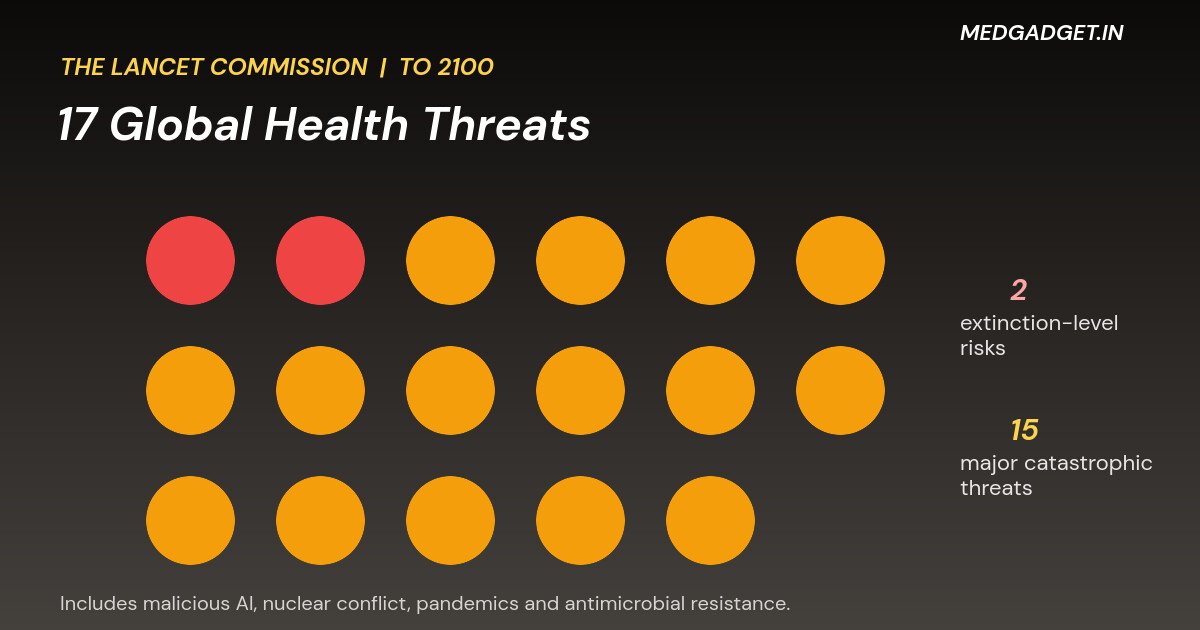
The new Lancet global health threats 2026 assessment names 17 threats that could do the most damage to human health by 2100, led by two low-probability but potentially extinction-level risks: the malicious use of artificial intelligence, including AI-enabled bioweapons, and nuclear conflict. The work, from The Lancet Commission on 21st Century Global Threats to Health, was reported on 11 October 2026.
The list is not only about distant catastrophes. It also includes air pollution, high blood pressure, obesity and smoking, which already cause large health losses today. This article explains what the commission looked at, the 17 threats, the key numbers, and what the authors say governments should do.
Lancet global health threats 2026: key points
- Who: a 35-expert commission co-chaired by Prof Christopher Murray of the Institute for Health Metrics and Evaluation at the University of Washington.
- What: 17 threats over the next 75 years, to 2100, ranked by healthy years of life lost.
- Biggest risks: malicious AI and nuclear conflict, which the report says carry risks of extinction.
- Key numbers: about 10.4 billion years of healthy life lost to malicious AI in one theoretical estimate, up to 1.5 billion from aid cuts, and 1.89 billion that could be saved by limiting warming to about 1.8°C.
- Next step: findings are to be presented at the World Health Summit in Berlin, and the analysis is to be updated every year.
How the Lancet global health threats 2026 report was built
The commission estimated future health losses in disability-adjusted life years, or DALYs. One DALY is one year of healthy life lost to illness, disability or early death. For several threats, the researchers modelled best-case and worst-case paths and compared them with current trends.
A threat made the list if it could cause a large global health burden and if realistic actions exist to reduce it. Murray said the work began about three years ago with three assumed big risks: conflict, climate and pandemics. The group ended up with a much longer list.
The 17 Lancet global health threats 2026, grouped
The reports we reviewed list the same 17 threats. We have grouped them below for readability; the grouping is ours and not the commission’s.
Extinction-level risks
- Malicious use of artificial intelligence, including AI-enabled bioweapons.
- Nuclear conflict, including nuclear famine.
Conflict, climate and environment
- Climate breakdown.
- Conventional conflict.
- Air pollution.
Infection and resistance
- Naturally occurring pandemics.
- Antimicrobial resistance, which the World Health Organization (WHO) fact sheet on antimicrobial resistance calls one of the top global public health threats.
Chronic disease and lifestyle
- High blood pressure.
- Obesity.
- Smoking.
- High alcohol use.
- Poor mental health.
- Unhealthy ageing.
Social and economic drivers
- Childhood malnutrition.
- Declining overseas aid.
- Income inequality.
- Low educational attainment.
AI public health risks in the Lancet global health threats 2026 report
The commission puts malicious AI at the top of its risk list for one reason: scale. Its theoretical estimate is about 10.4 billion healthy years of life lost by 2100, though the authors stress that no malicious AI event of truly global scale has happened, and that forecasts diverge widely. By our calculation, that figure is roughly seven times the 1.5 billion estimated for aid cuts, but the two numbers rest on very different kinds of evidence and should not be compared as like with like.
The Lancet editorial that accompanies the report says the scale of harm, should such threats be realised, “would inflict an apocalypse on humanity”. The authors also describe the likelihood of the extinction-level events as low. Our own reporting on health technology, including physical AI in healthcare, shows the other side of the same technology, which is why governance matters.
Future pandemic threats and the other major numbers
Naturally occurring pandemics are one of the 15 “major catastrophic threats”, which reports describe as each capable of causing more than 1 billion cumulative DALYs by 2100. Other headline numbers include:
- Climate: limiting warming to about 1.8°C instead of 4.4°C could prevent about 1.89 billion years of healthy life lost.
- Aid cuts: steep falls in international health aid could cost up to 1.5 billion DALYs before 2100, nearly 70% of them in sub-Saharan Africa.
- Regional patterns: non-communicable conditions such as obesity and poor mental health weigh most in wealthier regions, low educational attainment in poorer ones, and child malnutrition in sub-Saharan Africa.
Recent outbreaks show why preparedness is part of the list. Our reports on the Ebola outbreak that reached Kenya and BRICS plans for joint disease surveillance show how quickly local events become cross-border health issues.
What the commission recommends in the Lancet global health threats 2026 report
- Invest in anticipation, prevention and preparedness before threats become crises.
- Strengthen health systems and invest in technological innovation.
- Treat the threats as connected, not as separate problems.
Commission member Ibrahim Abubakar of University College London said the aim is to show where action brings real benefit and not simply to frighten people. Murray said the striking finding is that humanity still has the agency to act.
Limits of the Lancet global health threats 2026 coverage
We have not read the full commission paper. Our account draws on public summaries of the report and the accompanying editorial, and we could not confirm the exact journal issue or online publication date. Different summaries describe the time horizon as 75 years or as this century, and describe the “1 billion DALY” threshold as applying to the 15 non-extinction threats. Check the original report in The Lancet or the Institute for Health Metrics and Evaluation for the commission’s exact wording and methods.
Our assessment of the Lancet global health threats 2026 list
In our assessment, the most useful feature of the Lancet global health threats 2026 report is not the headline about extinction. It is the long list of everyday risks, such as blood pressure, smoking and obesity, that sit next to the dramatic ones and are easier to act on. A reader should take two lessons from it: low-probability risks deserve serious governance, and high-probability risks deserve funding now.
For related coverage, browse our healthcare services section.
What to watch next after the Lancet global health threats 2026 report
- Presentation of the findings at the World Health Summit in Berlin.
- Responses from governments on AI governance and aid funding.
- The first annual update of the 17-threat assessment.
- Release of the full report and data for independent scrutiny.
Frequently asked questions
What are the Lancet global health threats 2026?
They are 17 threats identified by The Lancet Commission on 21st Century Global Threats to Health as the biggest risks to human health to 2100.
Which Lancet global health threats 2026 are the most serious?
Malicious use of AI and nuclear conflict, which the commission says carry risks of extinction, although it rates them as low probability.
Does the Lancet global health threats 2026 report predict extinction?
No. It describes extinction-level outcomes as possible but unlikely, and it stresses that action can reduce the risks.
What is a DALY?
A disability-adjusted life year, equal to one year of healthy life lost to illness, disability or early death.
Who led the commission?
Prof Christopher Murray co-chaired it, with a total of 35 experts involved.
How we reported this: we relied on public summaries of The Lancet Commission on 21st Century Global Threats to Health and its accompanying editorial, published around 11 October 2026, and on public WHO and Lancet pages. We have not read the full paper. Figures labelled as ours are our own calculations or groupings. Last updated: 12 October 2026. This article is news reporting and not medical advice.
[…] Cancer in Young People India: Patients as Young as 15 Lancet Global Health Threats 2026: 17 Alarming Risks by 2100 Pope Leo XIV Lung Surgery: Early Nodule, 1-Week Recovery Kenya Ebola Outbreak October 2026: 0 […]