

Kenya has confirmed its first Ebola case and its first Ebola death, a traveller who arrived in Nairobi from the Democratic Republic of Congo (DRC) and died within days. Officials say contact tracing is under way for dozens of people, including passengers and crew on the patient’s flight. The case matters well beyond Kenya: it shows how an outbreak that began in eastern Congo in May is now crossing borders and even continents, according to reports of the figures so far.
Kenya Ebola case: what we know so far
- First case, first death: Kenyan officials, including Health Minister Aden Duale as reported, confirmed the country’s first Ebola case and death.
- The patient: a Kenyan citizen who had lived in the DRC for years (reports differ on whether it was 7 or 11).
- Route: by road through Beni to Kampala in Uganda, then by air to Nairobi around 3 October, per reports.
- Contacts: 28 contacts plus 23 passengers and 4 crew from the flight are being traced and monitored for 21 days.
- Open question: reports differ on whether the Bundibugyo strain was confirmed or only “Ebola virus” was stated.
How did the patient reach Nairobi?
The reported journey is the part of this story that worries public health teams most. The patient travelled overland from the DRC through the Beni area, continued to the Ugandan capital Kampala and then boarded a flight to Nairobi. After arrival the patient became ill, was tested at Nairobi Hospital and was confirmed positive. The patient died late on Monday 5 October and was reported buried on Tuesday. Exact timings vary between reports, so we use approximate dates.
| Stage | Reported detail |
|---|---|
| Origin | Eastern DRC, long-term resident (Kenyan citizen) |
| Road leg | Through Beni to Kampala, Uganda |
| Flight | Kampala to Nairobi, around 3 October |
| Diagnosis | Positive test at Nairobi Hospital |
| Outcome | Died late Monday 5 October; buried Tuesday |
Please note these details come from official statements as relayed in reports; we could not locate the full Ministry of Health statement at the time of writing. Updates should be checked on the Kenya Ministry of Health website.
Which Ebola virus is it?
This is the one detail where accounts conflict. One report says laboratory testing confirmed the Bundibugyo virus; another refers only to Ebola virus. The difference matters. As far as we know, licensed Ebola vaccines and treatments target the Zaire species, while Bundibugyo has no licensed vaccine, which makes containment through tracing and isolation even more important. Until health authorities publish the species result, treat the strain as unconfirmed.
How big is the wider outbreak?
The outbreak in the DRC was declared on 15 May. Reports cite roughly 8,400 to 8,500 confirmed cases and more than 4,000 deaths, a case fatality rate close to 48 percent in the more detailed figure, and describe contact tracing that covers only about three-quarters of contacts. Outside the DRC, cases have been reported in Uganda (about 20), France (1) and now Kenya (1). We use these numbers as reported; they are changing quickly and should not be treated as final.
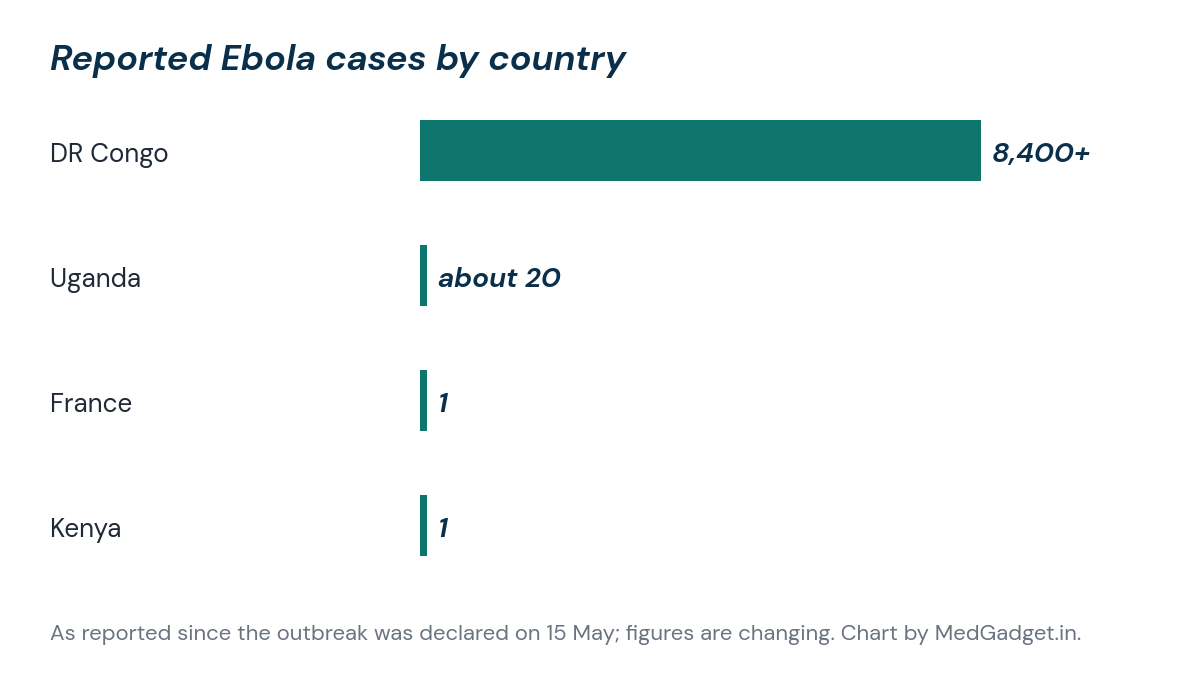
In our assessment, the most worrying number is not the case count but the tracing gap. When a quarter of contacts are not being followed, every missed contact is a possible new chain of infection. For background on how the crisis developed, see our earlier report, UN warns the DR Congo Ebola outbreak is massive and will take months to fight.
How is Kenya responding?
Kenya says it has screened more than 652,000 travellers, tested 267 suspected samples and trained around 5,000 health workers. Those preparations were put to the test within days. The World Health Organization delivered about 1,000 tests and 1,000 personal protective equipment kits, and the Africa Centres for Disease Control sent a support team, according to the reports. WHO’s Regional Director for Africa, Dr Mohamed Janabi, has urged countries to strengthen preparedness. Uganda, meanwhile, has reportedly kept its border with the DRC closed since May.
Should people in Kenya or travellers be worried?
The risk to the general public is generally low, because Ebola does not spread like a respiratory virus. According to the WHO fact sheet and the CDC Ebola page, it spreads through direct contact with the blood or body fluids of a person who is sick or has died of the disease, and through contaminated materials. People are not contagious before symptoms begin.
Symptoms usually appear 2 to 21 days after exposure and start with fever, fatigue, muscle pain, headache and sore throat, followed by vomiting, diarrhoea and, in some patients, bleeding. That 21-day window explains why contacts are monitored for three weeks.
Practical steps
- If you have a fever and have been in an affected area or in contact with a sick person, call your national health line and seek care rather than self-medicating.
- Avoid contact with the body fluids of anyone who is ill and with the bodies of people who died of suspected Ebola. Funeral rituals have driven spread in earlier outbreaks.
- Wash hands with soap and water or use alcohol-based sanitiser, and follow instructions at screening points.
- Rely on official updates rather than social media rumours.
Why this matters for global health security
Ebola outbreaks tend to be contained when cases are found early, contacts are traced and patients are isolated. Cross-border travel tests all three. A single case by air from a country with thousands of infections is a warning about the speed at which geography stops being a barrier. Outbreaks of other infections show the same lesson, as in our coverage of the Pennsylvania measles outbreak.
Frequently asked questions
Is this the first Ebola case in Kenya?
Kenyan officials describe it as the country’s first confirmed Ebola case and first Ebola death.
How many people are being monitored?
Reports mention 28 contacts, plus 23 passengers and 4 crew from the flight, with a 21-day monitoring period.
Is Ebola airborne?
No. Ebola spreads through direct contact with body fluids of symptomatic people or the deceased, not through casual contact.
Is there a vaccine?
A vaccine exists for the Zaire species. As far as we know, none is licensed for Bundibugyo, so the strain question is important.
Where can I find reliable updates?
Check the Kenya Ministry of Health, the WHO and the CDC pages linked in this article.
How we reported this
This article draws on public reports of statements by Kenyan and WHO officials, plus the WHO and CDC reference pages linked above. Several figures differ between accounts and are presented as reported; we could not obtain the primary Ministry statement. The assessment of tracing gaps is our opinion. Last updated 7 October 2026. This is general information, not medical advice. If you feel unwell, contact local health services.