


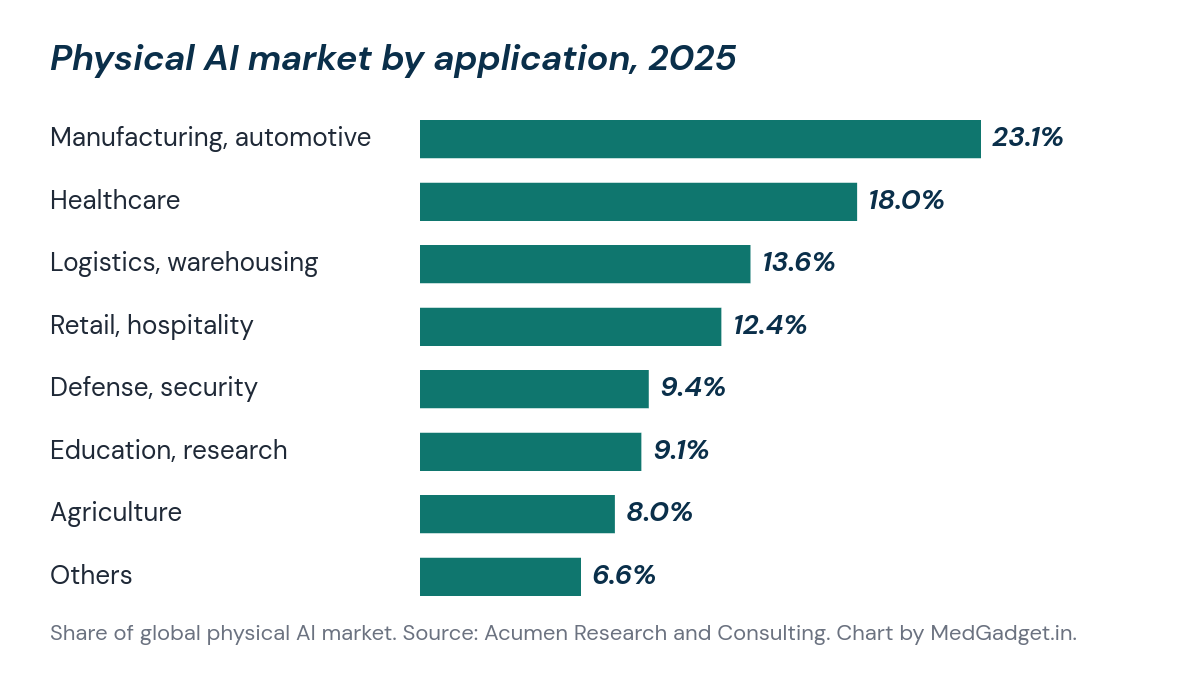
Healthcare is now the fastest-growing place for machines that can see, move and act in the real world. According to Acumen Research and Consulting, physical AI in healthcare already accounts for about 18 percent of a global physical AI market valued at USD 5,021.2 million in 2025, and the sector is forecast to reach USD 82,790.9 million by 2035. Hospitals are no longer asking whether robots and embodied intelligence belong in care; they are asking where to deploy them first.
Key Takeaways
- Market size: the global physical AI market was USD 5,021.2 million in 2025 and is projected to hit USD 82,790.9 million by 2035, a compound annual growth rate (CAGR) of 32.8 percent from 2026 to 2035 (Acumen Research and Consulting).
- Healthcare share: healthcare held 18 percent of 2025 applications and is described as the fastest-growing application segment.
- What drives it: robotic-assisted surgery, rehabilitation and patient-assistance devices, AI diagnostic platforms, ageing populations and hospital staff shortages.
- What holds it back: high deployment costs, integration complexity, and safety, liability and ethical concerns.
- Our view: the biggest near-term gains will come from narrow, well-defined tasks rather than general-purpose humanoid nurses.
What is physical AI in healthcare?
Physical AI refers to artificial intelligence that is built into machines operating in the physical world: robots, drones, exoskeletons and smart devices that sense their surroundings, make decisions and take action. In a hospital this can mean a surgical system that adjusts its movements in real time, a rehabilitation robot that adapts to a patient’s effort, or a mobile robot that delivers supplies without human guidance. It differs from software-only AI, such as a tool that reads scans, because it closes the loop between thinking and doing.
The distinction matters for regulators and buyers. Software can be updated overnight; a machine that touches a patient must also be mechanically safe, reliable and accountable when something goes wrong.
How big is the market, and where does healthcare fit?
The figures below come from the Acumen Research and Consulting market report, last updated on 4 September 2026. They are research projections, not audited results, and should be read as estimates.
| Indicator | Figure |
|---|---|
| Global market size, 2025 | USD 5,021.2 million |
| Forecast market size, 2035 | USD 82,790.9 million |
| CAGR, 2026 to 2035 | 32.8% |
| Healthcare share of applications, 2025 | 18% (fastest-growing application) |
| Largest region, 2025 | North America, 40.6% share |
| Fastest-growing region | Asia-Pacific, 34.6% CAGR |
By our own arithmetic, an 18 percent share of the 2025 market implies healthcare physical AI revenue of roughly USD 900 million that year. That is a back-of-envelope calculation using the report’s figures, not a number the report states. Manufacturing and automotive remains the largest application at 23.1 percent, but healthcare is catching up fastest.
Trend 1: Surgical robots are getting smarter
Robot-assisted surgery is the most visible example of physical AI in healthcare. The technologies powering it are the same ones that lead the wider market: computer vision accounted for 42.4 percent of the market in 2025, while reinforcement learning, at 15.3 percent, is the fastest-growing technology, per the report. In practice, vision helps a system recognise tissue and instruments, and learning methods help it refine movements from experience. The FDA’s list of AI-enabled medical devices shows how many such products are already cleared in the United States.
Trend 2: Rehabilitation robots and exoskeletons
Rehabilitation is a natural fit because therapy is repetitive, measurable and in short supply. Exoskeletons and prosthetics held 8.8 percent of the physical AI market in 2025, according to the report, and the research firm lists rehabilitation among the main growth opportunities. A robot can deliver thousands of consistent repetitions, record progress objectively and adjust difficulty, leaving therapists to focus on judgement and motivation.
Trend 3: Hospital logistics and service robots
Not every valuable robot touches a patient. Service robots held 14.3 percent of the market and mobile robots and drones 12.3 percent. In hospitals, such machines can carry linen, specimens and medicines, disinfect rooms and guide visitors. In our assessment, logistics is likely to scale faster than clinical robotics because the risk is lower, the return on investment is easier to measure and approvals are simpler.
Trend 4: Care for an ageing population
The report identifies elderly care, rehabilitation and assisted living as key opportunities. The reason is demographic: the World Health Organization notes that the world’s population is ageing rapidly, which raises demand for long-term care at the same time as many countries face workforce shortages. Physical AI will not replace caregivers, but it can lift patients, monitor falls, remind people to take medicines and provide companionship.
Trend 5: Intelligence moves onto the device
On-device deployment accounted for 51.7 percent of the market in 2025, while cloud-based systems, at 48 percent, are growing fastest. Healthcare cares about both. Processing on the device cuts latency, which is critical when a robot is moving near a patient, and keeps sensitive data inside the hospital. Cloud links allow fleets of machines to share updates and learn collectively. Advances in sensors and edge AI, which the report names as a key driver, make that hybrid approach practical.
Trend 6: Cobots work alongside clinicians
Collaborative robots, or cobots, held 12.2 percent of the market and are its fastest-growing robot type. Designed to share space safely with people, they suit clinical settings where a machine must assist rather than replace. Examples include a robotic arm that steadies instruments, positions patients or prepares samples in a laboratory. Pharmacies and labs in India and elsewhere are also looking at automation to handle volume. For related technology coverage see our Healthcare IT news.
Trend 7: Humanoid and social robots for patient engagement
Humanoid and social robots accounted for 13.8 percent of the market. Their role in healthcare is more experimental: greeting patients, supporting children with autism therapy, or keeping older adults engaged. The evidence is still emerging, and we would caution against expecting general-purpose humanoid helpers on wards any time soon. Companies named in the report, including SoftBank Robotics Group, Agility Robotics, Boston Dynamics, NVIDIA and Toyota Motor Corporation, show that large technology and industrial players are investing heavily in this field.
What are the challenges?
The report highlights two restraints: high deployment costs with complex integration, and safety, liability and ethical concerns around autonomous systems. Both are real. A hospital must fit a robot into its workflows, electronic records and infection control routines, and it must know who is responsible if a machine errs. The WHO guidance on the ethics and governance of AI for health stresses transparency, accountability and human oversight, principles that apply with extra force when a machine can physically harm someone.
- Cost and integration: upfront investment and staff training can delay returns.
- Safety and liability: clear rules are needed for shared responsibility between manufacturers, hospitals and clinicians.
- Data and bias: models trained on limited populations may perform unevenly.
- Access: advanced systems risk widening the gap between well-funded and under-resourced hospitals.
What it means for India and the Asia-Pacific region
Asia-Pacific is projected to be the fastest-growing region, with a 34.6 percent CAGR, and held a 30.6 percent share in 2025, according to the report. For Indian hospitals and medtech start-ups, that points to rising demand for locally affordable robotics, rehabilitation devices and AI-assisted diagnostics. Our coverage of AI-driven discovery and the AI-led insurer Angle Health shows how quickly artificial intelligence is reshaping health business models, and our look at home cardiac monitoring shows the same shift in devices.
Frequently asked questions
What is physical AI in healthcare?
It is AI embedded in machines that act in the physical world, such as surgical robots, exoskeletons, service robots and smart assistive devices.
How fast is the physical AI market growing?
Acumen Research and Consulting projects a CAGR of 32.8 percent from 2026 to 2035, taking the market from USD 5,021.2 million in 2025 to USD 82,790.9 million.
What share does healthcare hold?
Healthcare accounted for 18 percent of applications in 2025 and is the fastest-growing application segment, per the report.
Will robots replace doctors and nurses?
Unlikely in the foreseeable future. In our assessment, the technology will take over repetitive and physically demanding tasks while clinicians keep responsibility for judgement and patient relationships.
Which region is leading?
North America had the largest share at 40.6 percent in 2025, while Asia-Pacific is growing fastest.
How we reported this
Market statistics in this article come from the Acumen Research and Consulting physical AI market report (updated 4 September 2026), which is a research forecast and not an audited figure. The USD 900 million healthcare estimate is our own arithmetic. Trend descriptions and statements marked as our assessment are our interpretation. Regulatory and public health context is drawn from the FDA and WHO pages linked above. Last updated 7 October 2026. This article is for general information only.