

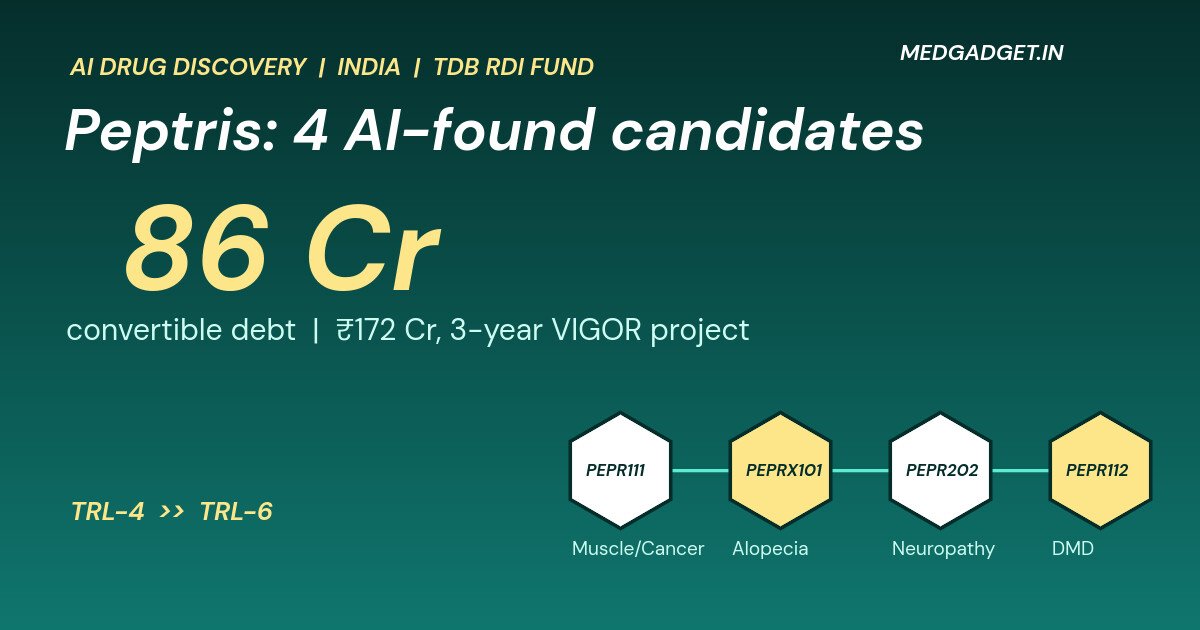
AI drug discovery India has won a notable vote of confidence from the government. On 12 October 2026, the Ministry of Science and Technology announced that the Technology Development Board (TDB) will provide ₹86 crore to Peptris Technologies, a Bengaluru start-up, to move four AI-discovered drug candidates closer to clinical trials. The support takes the form of optionally convertible debt and comes from the Research Development and Innovation (RDI) Fund.
This report explains what the money is, what the four candidates are, what stage they have reached and, just as important, what has not been disclosed. It relies on the ministry statement as reported in public coverage and on the company’s earlier funding announcements. We have not seen the funding agreement itself.
AI drug discovery India: the ₹86 crore deal at a glance
- Amount: ₹86 crore of financial support.
- Instrument: optionally convertible debt, which can later convert into equity. It is not a grant and not a plain loan.
- Funder: the TDB, which works under the Department of Science and Technology (DST), through the RDI Fund.
- Project: VIGOR, titled “Advancing AI-Discovered Molecules from Bench to Clinic.”
- Total project cost: ₹172 crore over three years.
- Goal: to advance four candidates from technology readiness level 4 (TRL-4) to TRL-6.
By our calculation, the ₹86 crore is exactly half of the ₹172 crore project cost. The reports we reviewed do not say who supplies the other half, so we do not assume it is Peptris’s own money.
Four candidates behind the AI drug discovery India push
- PEPR111: neuromuscular disorders and oncology.
- PEPRX101: alopecia.
- PEPR202: neuropathy.
- PEPR112: Duchenne muscular dystrophy (DMD).
These are internal programme codes. Public coverage does not describe the molecule types, the biological targets or any laboratory or animal data for them, so outsiders cannot yet judge how strong the science is. A spread across muscle, nerve, skin and cancer indications is wide for an early-stage company, and we would expect the programmes to be prioritised as data arrive.
The indications also differ greatly in difficulty. Duchenne muscular dystrophy is a rare, serious genetic muscle-wasting disease where regulators often accept small, specialised trials, while alopecia and neuropathy are far more common conditions where larger studies and a crowded field of existing treatments are likely. That mix could help the company, since a rare-disease programme and a mass-market programme carry very different costs and timelines, but it also stretches a young team.
What VIGOR will pay for in AI drug discovery India
According to the coverage, the money is for advanced preclinical studies, validation work needed for an Investigational New Drug (IND) application, formulation development, and preparation of clinical trials, with trial initiation subject to regulatory requirements. In India, clinical trial permissions are handled by the Central Drugs Standard Control Organisation (CDSCO).
In plain terms, TRL-4 to TRL-6 means moving a candidate from validation in the laboratory to demonstration in a setting closer to real use. The scale is borrowed from engineering and is applied loosely to drugs, so the real milestones are the studies and filings, not the number.
How the RDI Fund and the TDB fit into AI drug discovery India
The TDB is a statutory body under the DST that has long backed Indian companies commercialising home-grown technology. According to coverage of the RDI Fund’s first open call in February 2026, the TDB issued that call for projects at TRL-4 and above, aimed at private enterprises and start-ups in strategic sectors. The Peptris award is therefore a sign of the call turning into actual money for a life-sciences company, though we have not seen how many awards have been made so far.
The choice of optionally convertible debt matters. It gives the board a claim that can become equity if the project succeeds, which protects public money better than a grant, while leaving the company free of the pressure of an immediate equity sale.
Peptris: an AI drug discovery India start-up since 2019
Peptris Technologies was founded in 2019 in Bengaluru by Narayanan Venkatasubramanian, Shridhar Narayanan, Anand Budni and Amit Mahajan. Its platform combines unsupervised learning with generative AI to design molecules that are suitable as drugs, and the company pairs this with global contract research organisations for experimental validation and development.
In February 2026, it raised a ₹70 crore Series A co-led by IAN Alpha Fund and Speciale Invest, after a pre-seed round in 2023, taking its total funding before this support to more than ₹78 crore. By our estimate, the new support lifts the capital available to roughly ₹164 crore, but that adds equity to convertible debt and is only an indication of scale.
Why AI drug discovery India needs this kind of capital
The hardest stretch for a young drug company is the gap between a promising computational result and a candidate ready for a regulator. Start-ups often run out of money there. In our assessment, state-backed convertible debt aimed squarely at that gap is a pragmatic choice, because it funds the costly validation work without asking the company to sell a large equity stake early.
It also fits a wider pattern. Government schemes are already backing drug research, as in our report on the PRIP scheme backing 41 pharma and medtech projects, while abroad AI-led companies are raising far larger sums, as in our coverage of Anew Labs’ $290 million raise. Readers can find more in our biotechnology section.
A word of caution is needed for AI drug discovery India. Money is not evidence. Candidates found by AI must still pass the same safety and efficacy tests as any other drug, and being funded says nothing about whether they will work.
What is still unknown about AI drug discovery India’s newest project
- The targets, molecule types and preclinical results for each candidate.
- The conversion, interest and repayment terms of the convertible debt.
- Who funds the remaining ₹86 crore of the project cost.
- When any candidate might enter first-in-human trials.
- What the acronym VIGOR stands for, which the reports we reviewed do not explain.
What to watch next in AI drug discovery India
- Publication of preclinical data for the four candidates.
- Any IND filing or clinical trial application with the CDSCO.
- Further RDI Fund awards to drug and biotech companies.
- A follow-on round or partnership for Peptris.
Frequently asked questions
What is the new AI drug discovery India funding?
The TDB is providing ₹86 crore in optionally convertible debt to Peptris Technologies under the RDI Fund for a three-year, ₹172 crore project.
Which therapies does the AI drug discovery India project cover?
Neuromuscular disorders and oncology, alopecia, neuropathy and Duchenne muscular dystrophy, through four candidates named PEPR111, PEPRX101, PEPR202 and PEPR112.
Is the AI drug discovery India support a grant?
No. It is optionally convertible debt, which can later convert into equity.
Are the drugs close to approval?
No. They are being prepared for IND-enabling studies and trials, and no clinical results have been reported.
How we reported this: we relied on the ministry statement of 12 October 2026 as reported in public coverage, and on the company’s February 2026 funding announcements. We did not see the funding agreement. Figures labelled as ours are our own calculations. Last updated: 12 October 2026. This article is news reporting and not medical or investment advice.