

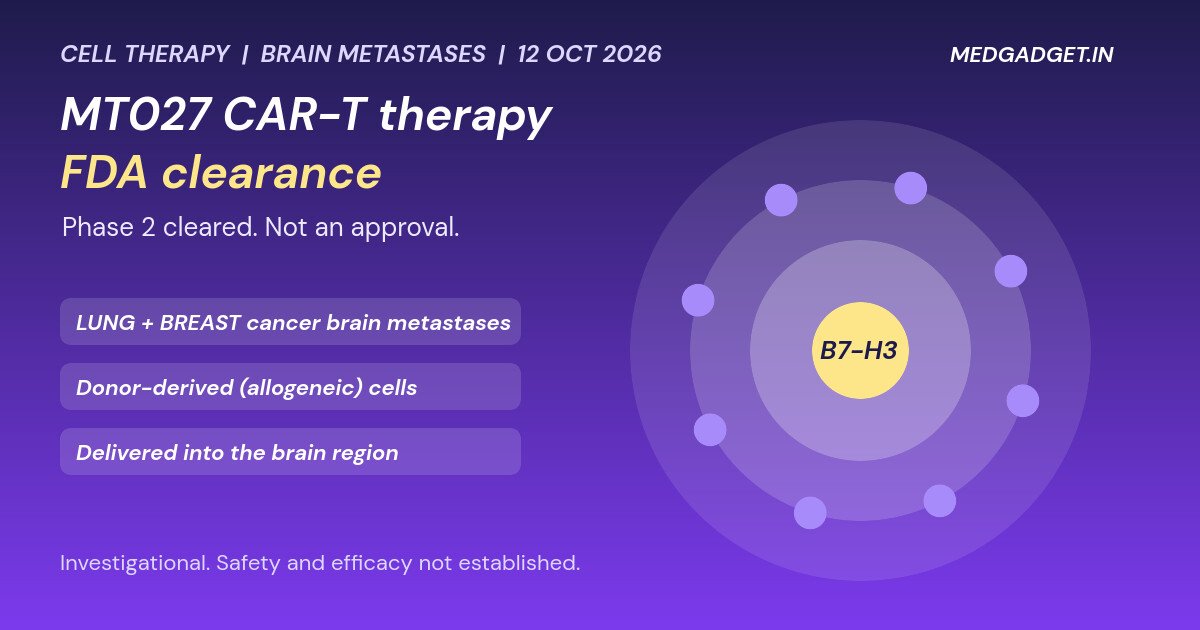
The MT027 CAR-T therapy FDA clearance announced on 12 October 2026 allows T-MAXIMUM Pharmaceutical to begin a Phase 2 study of its experimental cell therapy in people whose lung or breast cancer has spread to the brain. MT027 is an allogeneic, or donor-derived, CAR-T therapy that targets a protein called B7-H3 and is delivered directly into the brain region. This is permission to run a clinical trial. It is not marketing approval, and it does not show that the treatment works.
Here is what the company has said, what data exist so far, where the sources disagree, and what the announcement leaves out.
Key takeaways from the MT027 CAR-T therapy FDA clearance
- What was cleared: a Phase 2 study of MT027 in brain metastases from lung and breast cancer, per the company. The release did not name the filing type, though trial clearances like this normally come through an investigational new drug application.
- Not approval: MT027 is investigational, and its safety and effectiveness have not been established.
- Second Phase 2: the company says a Phase 2 study in recurrent glioblastoma was already cleared.
- Evidence so far: a handful of patients in early studies, mostly presented at a conference.
- Missing details: the design, size, endpoints, sites and start date of the new trial were not disclosed in the material we reviewed.
What the MT027 CAR-T therapy FDA clearance covers
T-MAXIMUM describes itself as a clinical-stage cell therapy company focused on universal CAR-T treatments for solid tumours inside the skull, including recurrent glioblastoma and brain metastases. Its announcement calls the two cleared Phase 2 studies a dual-indication portfolio, which is the company’s own characterisation. MT027 carries a B7-H3 target, comes from donor cells rather than each patient’s own, and is made with what the company calls a fully non-viral gene-editing process. It says that process was locked before the Phase 2 stage. We could not verify those manufacturing claims independently.
The company also states that MT027 has orphan drug and fast track designations. The release is inconsistent on scope, and the boilerplate ties those designations to high-grade glioma and recurrent or progressive glioblastoma, not to brain metastases. Readers should not assume the new indication carries them.
How CAR-T therapy for brain tumours works: science behind the MT027 CAR-T therapy FDA clearance
CAR-T therapy engineers immune cells to recognise a marker on cancer cells. Approved versions treat certain blood cancers, and the FDA’s list of approved cellular and gene therapy products shows how few exist. Solid tumours are harder, and the brain adds further obstacles. B7-H3 is a protein found on many tumour types, which is why it is an attractive target, and delivering cells directly into the brain, rather than through the bloodstream, is an approach intended to reach tumours behind the blood-brain barrier. Donor-derived cells could make a treatment available off the shelf instead of manufactured per patient, but they carry a risk of graft-versus-host disease, in which the transplanted cells attack the patient’s tissues.
Evidence behind the MT027 CAR-T therapy FDA clearance
The data come from small early studies, and the company has said results from small numbers of patients may not predict results in larger studies. According to the company, five heavily pretreated people with lung cancer brain metastases completed treatment with MT027, and three had measurable disease. No Grade 3 or higher adverse events and no graft-versus-host disease were reported. Most events were mild to moderate immune-type reactions.
Sources differ on the efficacy details. The company’s release describes two partial responses among the three evaluable patients. Another account of the same conference data describes one partial response with about 80% tumour shrinkage and two with stable disease, one of whom had a 46% reduction and was progression-free for more than eight months. We cannot reconcile the two without the original presentation, so the safest reading is that the signals were encouraging in a very small group. The same account notes the early study plans to enrol nine people across two dose cohorts, and the data were a conference presentation, not a peer-reviewed paper.
The company also cites a related product, MT026, in five people with recurrent high-grade glioma, reporting one complete and three partial responses and no Grade 3 or higher treatment-related events in a published study. That is a different product. One account says it targets a different protein, IL-13Rα2, and it should not be read as evidence for MT027.
The glioblastoma trial alongside the MT027 CAR-T therapy FDA clearance
The more detailed design in the public record is for the glioblastoma study, listed on the ClinicalTrials.gov entry for the glioblastoma study (NCT07386002). It is reported to be targeting 40 patients with recurrent or progressive grade 4 IDH-wildtype glioblastoma, with the first six in a safety run-in and injections on days 1 and 15 of 28-day cycles. We have not seen equivalent detail for the brain metastases trial, and in our assessment it is unwise to assume the two share a design.
Why brain metastases matter for the MT027 CAR-T therapy FDA clearance
The company cites estimates that about 20% of people with cancer may develop brain metastases, rising to 20% to 40% in advanced solid tumours, and that 200,000 to 300,000 people are newly diagnosed in the US each year. Those are the company’s figures. General information on metastatic cancer is available from the National Cancer Institute. Treatment options for brain metastases typically include surgery, radiation and drugs, and new approaches are needed, particularly for people whose cancer has progressed after other treatment. The MT027 CAR-T therapy FDA clearance is therefore noteworthy as a trial step. It is far from proof of benefit.
What the MT027 CAR-T therapy FDA clearance leaves unanswered
- Trial size, randomisation, control arms and endpoints.
- Dose, number of injections and delivery route in the new study.
- Eligibility, sites, start date and registry listing.
- Any data in breast cancer brain metastases, since the company reported none for MT027.
- Durability of responses and survival in the early patients.
- Independent verification of the company’s manufacturing and safety claims.
The clearance route is explained in the FDA’s description of the investigational new drug process. For other recent oncology trial reports, see our coverage of the Bristol Myers RYZ101 Phase 3 trial, the pulmonary fibrosis Phase 3 trial and rising gastrointestinal cancer among young Indians, or browse more biotechnology news.
Frequently asked questions
What is the MT027 CAR-T therapy FDA clearance?
The FDA has cleared T-MAXIMUM, per the company, to start a Phase 2 study of MT027 in brain metastases from lung and breast cancer.
Is MT027 approved after the MT027 CAR-T therapy FDA clearance?
No. It is investigational, and safety and effectiveness have not been established.
What does MT027 target?
B7-H3, a protein found on many tumour types. MT027 is an allogeneic CAR-T therapy delivered into the brain region.
Does the MT027 CAR-T therapy FDA clearance mean the treatment works?
No. It permits a clinical trial. Early data came from very small groups.
When will the new trial start?
The announcement did not give a start date, size or sites.
How we reported this: we relied on the company’s announcement of 12 October 2026, a separate account of the conference data and the public trial registry. Company claims are labelled as such. Last updated: 13 October 2026. This article is news reporting and not medical advice.
[…] it does not shorten the evidence the FDA requires. We make the same point in our coverage of the FDA clearance for the MT027 CAR-T trial, where permission to study a product is also not permission to sell […]
[…] value that depends on clinical proof still to come rather than on any near-term product. See also MT027 CAR-T Therapy FDA Clearance: Phase 2 Brain Trial for another CAR-T development. More in our pharmaceutical […]