

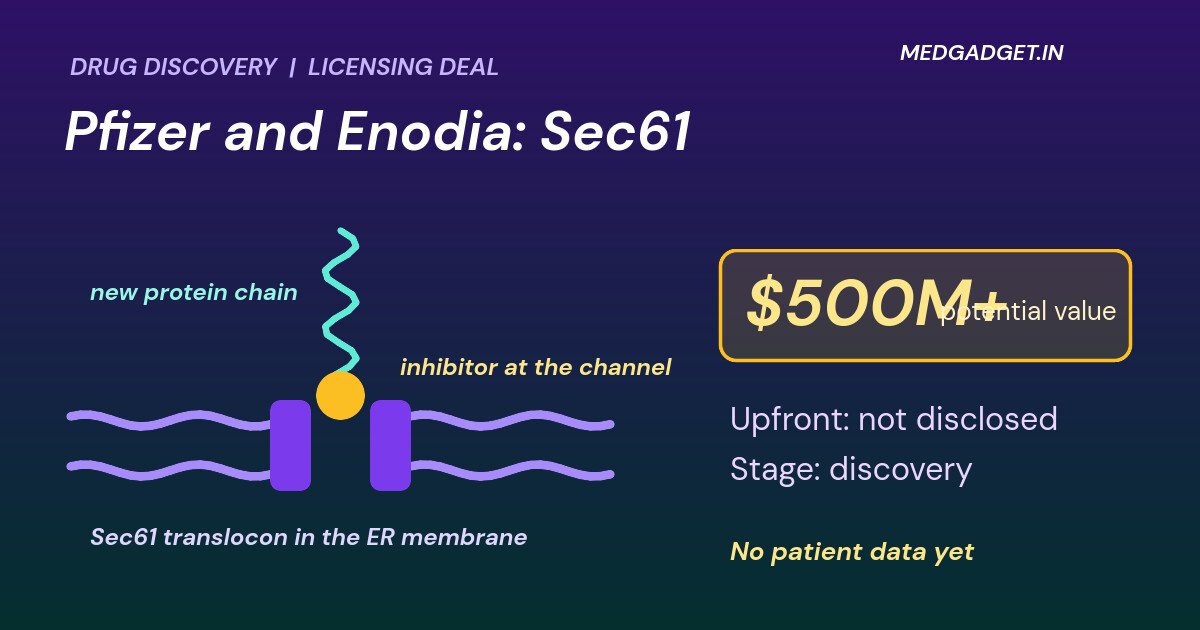
The Pfizer Enodia Therapeutics deal puts the drugmaker into one of the newest areas of drug discovery. On 13 October 2026, Enodia Therapeutics announced a research collaboration and licence agreement with Pfizer to find and develop small-molecule inhibitors of the Sec61 translocon, a cellular channel that disease-related proteins pass through as they are made. The total potential value is more than $500 million, but the upfront payment was not disclosed and most of the money depends on future milestones.
The work is at the discovery stage. No medicine from this agreement has been tested in patients, so there is no evidence of benefit yet. Here is what the companies announced, what Sec61 is, how the approach relates to other protein-targeting drugs and what remains unknown.
Pfizer Enodia Therapeutics deal: the terms
- Structure: a research collaboration and licence agreement.
- Upfront payment: received by Enodia; amount not disclosed.
- Milestones: Enodia is eligible for research, development and sales milestones; amounts not disclosed.
- Royalties: tiered royalties on net sales; rates not disclosed.
- Total potential value: more than $500 million, according to the companies.
- Enodia’s role: discovery work to screen, optimise and develop Sec61 inhibitor candidates against multiple collaboration targets.
- Pfizer’s role: after the collaboration term, all clinical, manufacturing, regulatory and commercial activities.
- Targets and diseases: not named.
Enodia’s chief executive, Yves Ribeill, said the company has built a broad platform for selective modulation of the Sec61 translocon and looks forward to combining its work with Pfizer’s expertise and clinical resources.
What Sec61 means for the Pfizer Enodia Therapeutics deal
Many proteins that cells secrete or place in their outer membrane are made on a cell structure called the endoplasmic reticulum and must cross its membrane to mature. The Sec61 translocon is the channel they pass through. The idea behind this deal is that a small molecule that selectively narrows or blocks the channel for certain proteins could stop disease-driving proteins from being made in working form, while sparing the many proteins the cell needs. Enodia says its approach inhibits disease-driving proteins during their synthesis while preserving essential physiological functions.
The difficulty is selectivity. Sec61 handles a large share of the cell’s proteins, so an inhibitor that is too broad can be toxic. Reports note that researchers have studied Sec61 for years but struggled to design safe inhibitors, which is why a company that has mapped several inhibitor families is attractive to a larger partner.
Is it a protein degrader?
The headline description of this deal as next-generation protein degraders needs care. In the companies’ words, Enodia’s medicines “degrade disease-driving proteins at the point of synthesis,” and trade coverage groups Sec61 work with the protein degradation field. But it works differently from the better-known degraders, which tag proteins that already exist so the cell destroys them. Sec61 inhibitors act earlier, on production. The release did not explain how channel blockade leads to degradation in each case, so we describe it as a related but distinct approach.
The link to Lilly and Gate Bioscience
The agreement comes about a week after Eli Lilly expanded its deal with Gate Bioscience to over $870 million for a related approach; see our report on Lilly’s expanded Gate Bioscience deal. Trade reports say both companies target Sec61 and that this is the second large pharma agreement in the area in a short time. The headline values are not like-for-like: each depends on different terms, targets and milestones, and neither company has disclosed what it paid upfront in a way that allows comparison.
Who Enodia is
Enodia is a biotechnology company built on research from the Institut Pasteur and created by the venture studio Argobio. Trade reports say it was co-founded by Institut Pasteur scientist Caroline Demangel, launched last year and raised a seed round of €20.7 million in January, co-led by Pfizer Ventures. If accurate, Pfizer already had a financial stake in the company before this agreement. The company focuses on inflammation, immunology and oncology, with possible work in virology. Reports also say it paid Kezar Life Sciences $1 million upfront in March for a Sec61 inhibitor designed to selectively block PD-1 expression; we have not verified that.
Reading the $500 million figure in the Pfizer Enodia Therapeutics deal
Headline values in licensing deals are ceilings. They count every possible milestone as if it were reached, and most experimental drugs never get there. Because the upfront payment is undisclosed, the money Enodia is certain to receive is not public. For comparison, see our report on Novo Nordisk’s up to $1.4 billion deal with Orbis Medicines. The size of a deal says something about a company’s interest, but not about whether a drug will work.
What we do not know about the Pfizer Enodia Therapeutics deal
- Which proteins or diseases the collaboration targets.
- The size of the upfront payment and the split of milestones.
- How long the research phase lasts before Pfizer takes over.
- Whether the inhibitors can be made selective and safe enough for patients.
- When any candidate could enter a clinical trial.
Our assessment
In our assessment, the Pfizer Enodia Therapeutics deal is a modest, early bet on a promising but unproven mechanism. Pfizer pays little that we can see and keeps the commercial rights if a candidate succeeds. That is a sensible way to enter a field in which a rival has also just moved. But Sec61 inhibition has a history of toxicity concerns, and the value of the platform will become clear only when a candidate shows selectivity and safety in people, which is years away. For more on licensing activity, see our report on Novartis’s licence with Abogen, or browse our pharmaceutical coverage.
What to watch next after the Pfizer Enodia Therapeutics deal
- Disclosure of the collaboration targets and diseases.
- Preclinical data on selectivity and safety.
- Further Sec61 deals by other large drugmakers.
- A first clinical trial, which is not expected soon.
Frequently asked questions
What is the Pfizer Enodia Therapeutics deal?
A research collaboration and licence agreement to develop small-molecule Sec61 inhibitors, with a total potential value of more than $500 million.
How much is the Pfizer Enodia Therapeutics deal worth upfront?
The upfront amount has not been disclosed.
Is the Pfizer Enodia Therapeutics deal value guaranteed?
No. It is a potential total that depends on future milestones and royalties.
What is Sec61?
A channel in the endoplasmic reticulum membrane through which many newly made proteins pass.
Has the Pfizer Enodia Therapeutics deal produced a treatment?
No. The work is at the discovery stage and nothing has been tested in patients.
How we reported this: we relied on Enodia’s 13 October 2026 announcement and on trade reporting of the deal and its context. We did not see the agreement. Last updated: 14 October 2026. This article is news reporting and not investment or medical advice.