

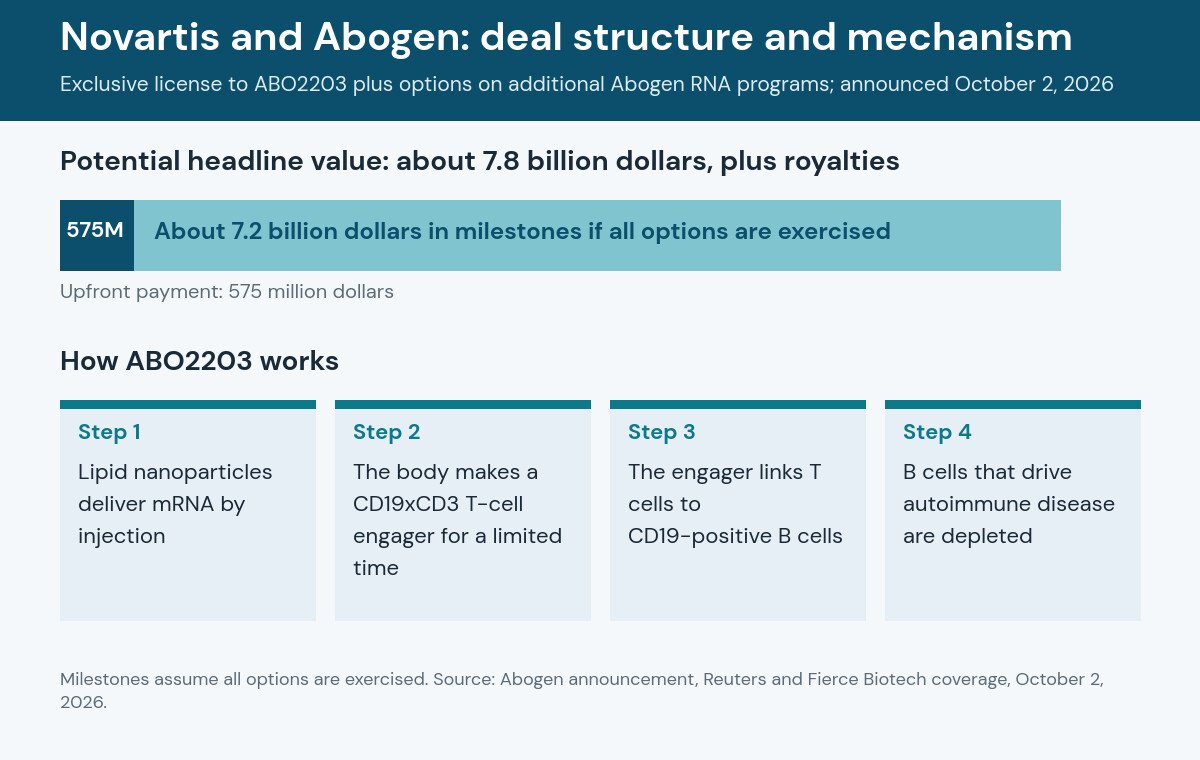
The Novartis Abogen deal gives the Swiss drugmaker global rights to ABO2203, an experimental mRNA-encoded T-cell engager for autoimmune diseases, plus options on more RNA programs. Abogen, based in Suzhou, China, said on October 2, 2026 that it will receive $575 million upfront and could earn about $7.2 billion more in milestone payments if all options are exercised and milestones are met, a potential total near $7.8 billion, plus royalties on future sales.
Reuters said the agreement underscores Novartis’s growing focus on an emerging field. The transaction is subject to customary closing conditions, including required regulatory clearances, according to Abogen’s announcement.
Key Takeaways: Novartis Abogen Deal
- Abogen gets $575 million upfront and could receive about $7.2 billion in milestones if all options are exercised, plus royalties on future sales.
- Novartis receives an exclusive worldwide license to ABO2203 and exclusive options on a number of next-generation programs from Abogen’s RNA platform.
- ABO2203 is a lipid-nanoparticle mRNA that makes the body’s own cells produce a CD19xCD3 T-cell engager to deplete disease-driving B cells.
- Evidence so far comes from early, investigator-led studies in autoimmune disease and B-cell lymphoma.
- The deal comes weeks after Novartis paused an autoimmune CAR-T program over three deaths, Fierce Biotech reported.
What Is ABO2203?
ABO2203 is an experimental mRNA-encoded CD19xCD3 T-cell engager from Abogen. Instead of infusing a manufactured protein, it delivers mRNA in lipid nanoparticles so the patient’s own cells briefly produce the engager, which links T cells to CD19-positive B cells to deplete them. Abogen says it is the first mRNA-encoded T-cell engager to enter clinical evaluation for autoimmune diseases.
Novartis Abogen Deal at a Glance
| Term | Detail |
|---|---|
| Upfront payment | $575 million |
| Potential milestones | About $7.2 billion if all options are exercised and milestones achieved |
| Headline potential value | About $7.8 billion |
| Royalties | Potential royalties on future product sales |
| Rights | Exclusive worldwide license to ABO2203, plus exclusive options on other Abogen RNA programs |
| Lead asset | ABO2203, an mRNA-encoded CD19xCD3 T-cell engager |
| Target diseases | Autoimmune diseases driven by B cells, such as lupus and rheumatoid arthritis |
| Status | Subject to customary closing conditions, including regulatory clearances |
The $7.8 billion figure is the sum of the upfront payment and the maximum milestones, which depend on Novartis exercising all its options. Royalties would come on top of that total.
How ABO2203 Works
ABO2203 uses mRNA, delivered in lipid nanoparticles, to instruct cells to make a bispecific antibody-like molecule that binds CD3 on T cells and CD19 on B cells. The aim is to deplete the B cells that drive autoimmune conditions such as lupus and rheumatoid arthritis, which Reuters noted is the target of the program, and to allow an immune reset.
Fierce Biotech noted that engaging CD19 and CD3 is a proven mechanism in blood cancer, pioneered by Amgen’s Blincyto, and that making the engager in the body gives gradual systemic exposure that may avoid toxicities tied to high drug concentrations. Researchers who published data in immune thrombocytopenia said ABO2203 could be given in outpatient settings as a subcutaneous injection without lymphodepletion or premedication, and could cost less than an in vivo CAR-T.
What the Early Clinical Data Show
Abogen’s partner, Ruijin Hospital, began a Phase 1 trial in refractory autoimmune diseases in 2024, registered as NCT06747156, with safety as its primary focus and an estimated enrollment of 66. A separate Phase 1 trial in relapsed or refractory B-cell non-hodgkin lymphoma, NCT07072169, is recruiting.
In the immune thrombocytopenia report, Fierce Biotech said the results showed rapid, complete depletion of CD19-positive B cells in blood and bone marrow and complete platelet responses. In our assessment, these are small, early, investigator-led studies. Larger controlled trials will need to confirm efficacy, durability and safety before ABO2203 can be judged against CAR-T therapies or other T-cell engagers.
Why Novartis Is Making the Deal
Novartis’s Fiona Marshall, President of Biomedical Research, said achieving effective and durable immune reset remains an important goal across many autoimmune diseases, and that mRNA-encoded T-cell engagers could complement existing approaches by enabling in vivo production of these molecules.
The deal lands in a crowded race. Evidence that CD19 CAR-T therapies help people with hard-to-treat autoimmune disease has spurred companies to test in vivo CAR-Ts and bispecific T-cell engagers that aim to deplete B cells by different routes, Fierce Biotech reported. Reuters added that Abogen’s approach uses mRNA technology similar to that validated beyond infectious disease by the Moderna and Merck personalized melanoma vaccine data in August, and that the deal could help Abogen compete globally.
What Comes Next for the Novartis Abogen Deal
The transaction must first clear customary closing conditions and regulatory reviews. After that, Novartis can decide which of Abogen’s next-generation RNA programs to option, and the size of the milestone payments will depend on those choices and on development, regulatory and commercial success. In the announcements reviewed, the companies did not give timelines for later-stage trials or name the autoimmune indications Novartis will prioritize.
What the Deal Means for Patients
ABO2203 is investigational and is only being tested in clinical trials. Patients with autoimmune disease should discuss approved treatments and any clinical-trial options with their own clinician. For related coverage of healthcare dealmaking and innovation, read our reports on Novo Holdings’ backing of ForYou Medical, Anew Labs’ $290 million raise and Novo Nordisk’s oral cardiometabolic deal with Orbis, or browse our pharmaceutical news.
Frequently Asked Questions About the Novartis Abogen Deal
How much is the Novartis Abogen deal worth?
Abogen receives $575 million upfront and could earn about $7.2 billion in milestones if all options are exercised and milestones are met, for a potential total near $7.8 billion, plus royalties on future sales.
What is ABO2203?
ABO2203 is an investigational mRNA-encoded CD19xCD3 T-cell engager for autoimmune diseases. It directs the body’s cells to make the engager so that disease-driving B cells are depleted.
How is an mRNA T-cell engager different from CAR-T therapy?
CAR-T therapies are made by engineering a patient’s own cells outside the body. An mRNA-encoded engager is an injectable that instructs cells in the body to make the engager for a limited time. Both aim to deplete B cells, and researchers say ABO2203 could be given in outpatient settings, though that has not been proven in large trials.
Is ABO2203 approved?
No. ABO2203 is experimental and is being studied in early-stage clinical trials in autoimmune disease and B-cell lymphoma.
Who is Abogen Biosciences?
Abogen is a clinical-stage RNA biotechnology group based in Suzhou, China, with a platform spanning mRNA design, lipid-nanoparticle formulation and large-scale manufacturing.
How we reported this: this article is based on Abogen’s announcement, Reuters coverage, trade reports and trial registry entries linked above. The $7.8 billion total is the sum of the disclosed upfront and maximum milestone amounts. Last updated October 2, 2026. It is for information only and is not medical or investment advice.
[…] deal-making around the sector shows the same appetite for T-cell engagers: see our reports on the Novartis–Abogen T-cell engager licence, the CSL–Alentis partnership and the Lilly–Gate Bioscience collaboration for related […]