

Eli Lilly has expanded its research and licensing collaboration with California biotech Gate Bioscience, adding a further drug target to a partnership aimed at proteins that conventional medicines struggle to reach. The companies say the total potential value of the agreement could exceed US$870 million, depending on milestones. The Lilly Gate Bioscience collaboration was announced on 5 October 2026 in a company announcement from Gate.
Key Takeaways
- Lilly and Gate have expanded a 2025 agreement to add one target, with an opportunity to add a second, according to the company.
- The total potential value of the agreement could exceed US$870 million, contingent on milestones. The upfront payment and royalty rates were not disclosed.
- Gate uses its “Molecular Gates” platform to design oral small molecules that stop a target protein from being made properly, so it is degraded.
- Lilly takes on late-stage preclinical and clinical development, manufacturing and commercialisation, with an exclusive worldwide licence.
- This is a discovery-stage deal. No drug from it has entered human trials, and the targets have not been named.
What Did Lilly and Gate Agree?
Gate and Lilly first signed an agreement in 2025 to use Gate’s discovery engine to design molecular gate medicines against targets chosen by Lilly. The new agreement adds one target and gives Lilly the opportunity to add a second. Gate says it will receive an upfront payment, a further payment if the second target is selected, and research funding. It is also eligible for payments on preclinical, clinical and commercial milestones, plus tiered royalties on global net sales.
| Term | Detail |
|---|---|
| Partners | Eli Lilly and Gate Bioscience (Brisbane, California) |
| Announced | 5 October 2026 (expands a 2025 agreement) |
| Scope | One added target, with an opportunity to add a second |
| Total potential value | More than US$870 million, contingent on milestones |
| Upfront payment | Disclosed as paid, amount not disclosed |
| Other payments | Research funding, preclinical, clinical and commercial milestones |
| Royalties | Tiered, on global net sales (rates not disclosed) |
| Technology | Molecular Gates: oral small molecules that block Sec61 passage and degrade the target |
| Lilly role | Late-stage development, manufacturing, commercialisation; exclusive worldwide licence |
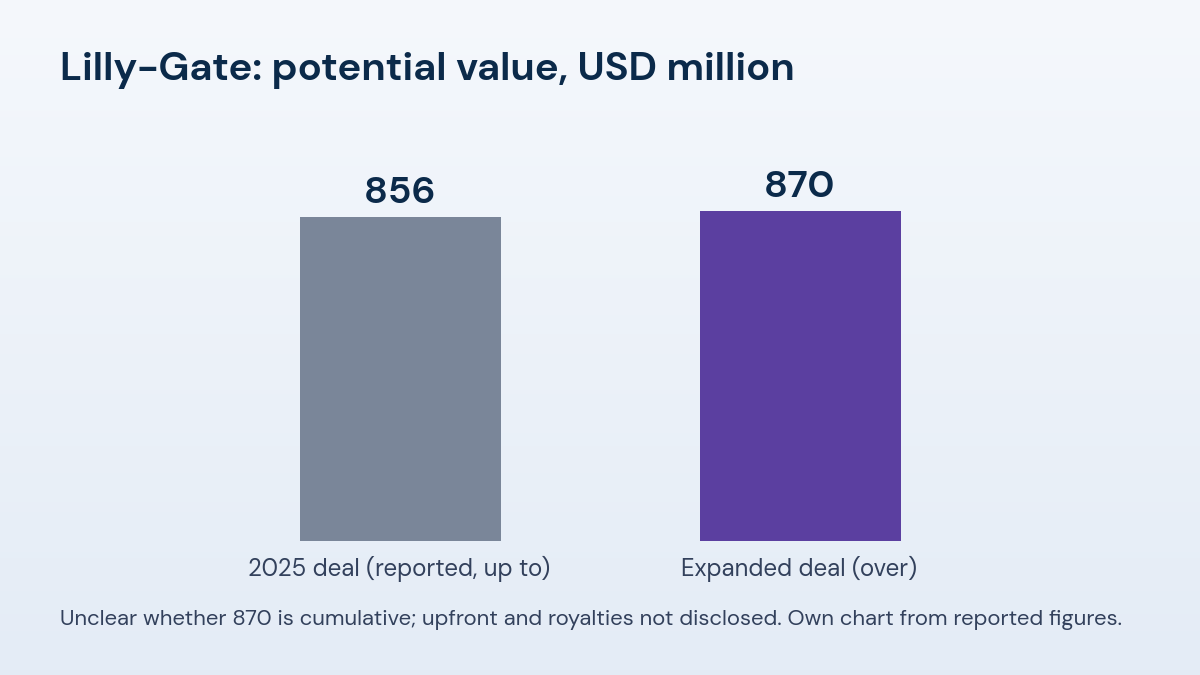
One point is unclear. The announcement describes the “total potential value of the agreement” as exceeding US$870 million but does not separate the 2025 terms. Reports of the original deal put its potential value at up to US$856 million. If the two figures are cumulative, then by our own arithmetic the expansion adds only about US$14 million or more in headline value, which would be small. If the US$870 million applies to the expansion alone, the picture is very different. The companies have not clarified this, so we treat the headline as a ceiling for the expanded agreement as a whole and not as new money.
How Do Molecular Gates Work?
Many disease-causing proteins are hard to drug because they lack the pockets that small molecules normally bind. Gate’s approach, as the company describes it, targets the Sec61 channel, a gateway that newly made proteins use to enter the cell’s secretory pathway. A molecular gate is an orally available small molecule that blocks a particular protein’s passage through that channel, which causes the protein to be degraded. The company says this could address about 4,000 potential targets across immunology, neuroscience and cardiometabolic disease.
That figure and the underlying science are company claims. Gate’s chief executive and co-founder, Jordi Mata-Fink, said the existing collaboration with Lilly has shown that its engine can systematically deliver selective molecular gates against difficult-to-drug proteins. We have not seen the data behind that statement.
Who Does What?
- Gate Bioscience: runs discovery of the molecular gates against Lilly-nominated targets. The company is based in Brisbane, California, and is backed by investors including Forbion, Versant Ventures, Andreessen Horowitz, GV, ARCH Venture Partners and Lilly itself.
- Lilly: holds an exclusive worldwide licence and handles later-stage preclinical and clinical development, manufacturing and commercialisation.
The structure is typical of early pharma partnerships. The biotech carries the high-risk early research, and the large company funds the expensive late stages, in exchange for payments that rise only if the science works. Most programmes at the discovery stage never reach patients; see the FDA overview of drug discovery and development for how long that path is.
What Is Not Yet Known
- The upfront payment, milestone sizes and royalty tiers.
- The identity of the targets and the diseases they relate to.
- Whether the US$870 million headline includes the 2025 agreement.
- How far the first molecular gates have progressed, and when any candidate might enter clinical trials.
Related Coverage
For more on pharma partnerships and deals, see our reports on the CSL–Alentis partnership, Everest Medicines’ VELSIPITY manufacturing plan and Axogen’s BioCircuit acquisition.
Our Assessment
In our assessment, the expansion is a vote of confidence in Gate’s platform from a partner that already knows the technology, because Lilly returned to add a target rather than moving on. But the headline number overstates what is certain. With no disclosed upfront payment and an unclear baseline against the 2025 terms, the deal tells us more about Lilly’s interest in protein-degradation approaches than about near-term returns. The real test will be the first clinical candidate.
Frequently Asked Questions
What did Lilly and Gate Bioscience announce?
An expansion of their 2025 collaboration, adding one target with an opportunity for a second, with total potential value above US$870 million.
How much will Gate receive upfront?
The upfront amount was not disclosed.
What is a molecular gate?
An orally available small molecule that blocks a target protein from passing through the Sec61 channel, so the protein is degraded, according to Gate.
Is there a drug in trials yet?
Gate’s lead programmes were not disclosed in the announcement, and no candidate from this deal has entered human trials.
Who commercialises any resulting medicine?
Lilly, which holds an exclusive worldwide licence. Gate is eligible for tiered royalties on global net sales.
How we reported this: details come from Gate Bioscience’s announcement of 5 October 2026 and related reports. Deal values, technology claims and market figures are company-reported, and the comparison with the 2025 deal is our own calculation. This is not medical or investment advice. Last updated 6 October 2026.