

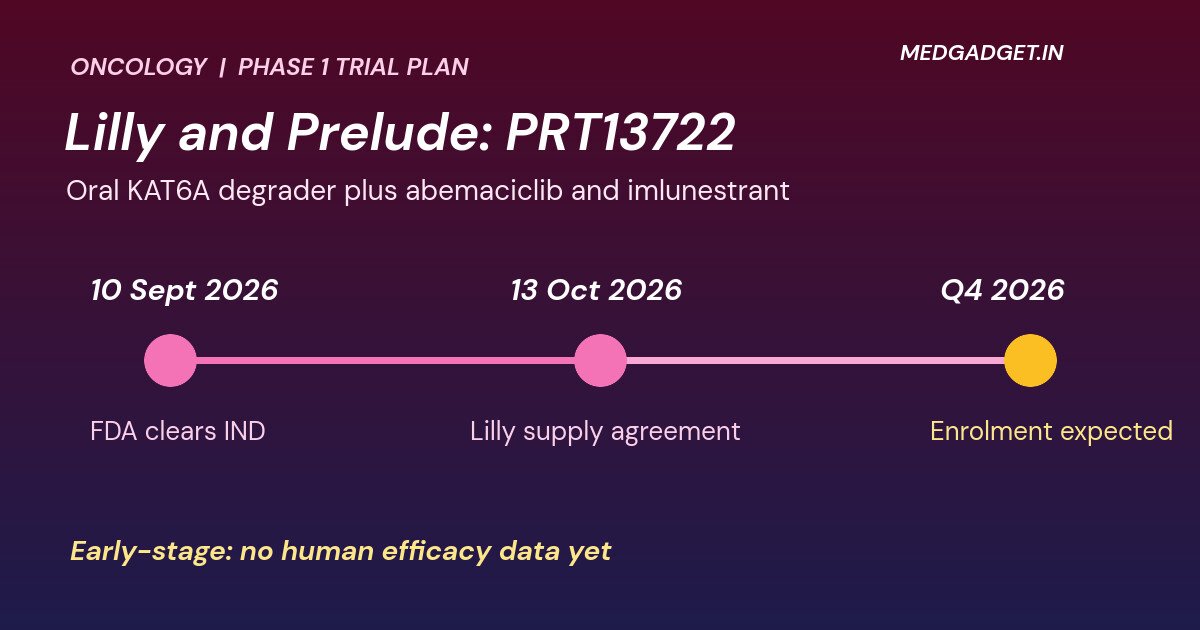
The Eli Lilly Prelude breast cancer trial is a planned early-stage study that will test a new kind of drug alongside two medicines Lilly already sells. On 13 October 2026, Prelude Therapeutics announced a clinical trial collaboration and supply agreement with Eli Lilly. Lilly will provide abemaciclib and imlunestrant for a Phase 1 trial of Prelude’s experimental pill PRT13722 in people with hormone receptor-positive, HER2-negative breast cancer.
This is a trial plan, not a result. PRT13722 has not yet been given to a patient, and nothing in the announcement shows that it works in people. Here is what the agreement covers, what the drug is meant to do, and what readers should keep in mind.
Key takeaways
- Prelude and Lilly signed a clinical trial collaboration and supply agreement; no financial terms were disclosed.
- Lilly supplies abemaciclib (Verzenio) and imlunestrant (Inluriyo); Prelude runs the trial and keeps global rights to PRT13722.
- PRT13722 is an oral KAT6A-selective degrader; the evidence so far is preclinical.
- Enrolment is expected to begin in the fourth quarter of 2026.
What the Eli Lilly Prelude breast cancer trial agreement covers
Under a clinical trial collaboration and supply agreement, one company provides its approved drugs to another company’s study so the two can be tested together. It is not an acquisition, a licence or an investment. Prelude says it holds full global development and commercial rights to PRT13722, a wholly owned programme, and the release does not disclose financial terms.
The combination cohorts will sit inside Prelude’s Phase 1 trial of PRT13722 in HR-positive, HER2-negative breast cancer. Prelude says the study will begin with monotherapy dose escalation and move quickly into combination cohorts. The two Lilly drugs in the plan are:
- Abemaciclib (Verzenio): an oral CDK4/6 inhibitor used in HR-positive, HER2-negative breast cancer.
- Imlunestrant (Inluriyo): an oral estrogen receptor antagonist. For the approved use of the two drugs together, see our report on the FDA approval of Inluriyo plus Verzenio in ESR1-mutated advanced breast cancer.
What is PRT13722 in the Eli Lilly Prelude breast cancer trial?
KAT6A is a protein that helps switch on genes that some estrogen receptor-positive breast cancers rely on. Prelude describes KAT6 as a clinically validated target, and it describes PRT13722 as a first-in-class, highly selective, orally available degrader of KAT6A. A degrader does not just block a protein; it directs the cell to destroy it.
The company’s argument is that removing KAT6A while sparing the related protein KAT6B may give better efficacy, tolerability and combinability than dual KAT6A/B inhibitors. Its chief medical officer has said that dual inhibitors showed overlapping toxicities that may limit use in earlier treatment lines. These are Prelude’s claims, based on laboratory work.
What the data behind the Eli Lilly Prelude breast cancer trial show
At the American Association for Cancer Research meeting in April 2026, Prelude reported preclinical data. According to the company, PRT13722 disrupted KAT6A pathways more completely than dual inhibitors, produced durable complete tumour regressions in mouse models used on its own, and showed synergy with endocrine therapy, CDK4/6 inhibitors and PI3K inhibitors, including in models with ESR1 mutations. It also reported a better blood-safety profile than the dual inhibitor prifetrastat.
Mouse models are a starting point. Many drugs that shrink tumours in animals fail in people, so these findings have not established clinical effectiveness in humans.
The FDA clearance came first
The Eli Lilly Prelude breast cancer trial is new, but regulatory permission to test the drug is not. Prelude announced on 10 September 2026 that the FDA had cleared its investigational new drug (IND) application for PRT13722. That clearance lets a first-in-human study begin; it is not approval to sell the drug. The earlier announcement described an open-label, multicentre trial that will assess safety, tolerability, pharmacokinetics, pharmacodynamics and antitumour activity in adults with locally advanced or metastatic disease, alone and with other therapies. Enrolment is expected to begin in the fourth quarter of 2026.
Why Lilly’s role in the Eli Lilly Prelude breast cancer trial matters
Supplying two marketed drugs helps a smaller company run combinations that would otherwise be costly and slow to arrange. For Lilly, it gives early access to a possible partner for its breast cancer portfolio without committing capital. Lilly has not announced any right to the drug, and the release gives no sign that it holds one. Readers following Lilly’s early-stage dealmaking can also see our report on Lilly’s expanded Gate Bioscience deal.
Our assessment
In our assessment, the Eli Lilly Prelude breast cancer trial is a sensible, low-risk step for both companies, but its importance should not be overstated. A supply agreement signals that a large company finds the idea worth testing, not that it expects success. The real test is the first human data: whether selective KAT6A degradation is safe, avoids the blood-count problems seen with dual inhibitors, and adds benefit on top of current treatments. That will take years. For related coverage, browse our pharmaceutical reports, and see our report on the Pfizer and Enodia licensing deal for another early-stage collaboration.
What to watch next in the Eli Lilly Prelude breast cancer trial
- The first patient dosed in the Phase 1 trial, expected after enrolment opens in the fourth quarter.
- Early safety and dose data, especially blood counts.
- Which combination cohorts open first.
- Any further disclosure of terms between the two companies.
Frequently asked questions
What is the Eli Lilly Prelude breast cancer trial?
It is a planned Phase 1 trial of Prelude’s oral KAT6A degrader PRT13722, including cohorts combined with Lilly’s abemaciclib and imlunestrant, in HR-positive, HER2-negative breast cancer.
Is the Eli Lilly Prelude breast cancer trial drug approved?
No. It is investigational and has not been given to patients yet.
When will the Eli Lilly Prelude breast cancer trial start?
Prelude expects enrolment to begin in the fourth quarter of 2026.
Did Lilly invest in Prelude?
The announcement describes a trial collaboration and supply agreement. No financial terms or investment were disclosed.
What does a KAT6A degrader do?
It is designed to make cancer cells destroy the KAT6A protein, which some hormone receptor-positive breast cancers depend on. Whether this helps patients is not yet known.
For background on breast cancer types and treatment, see the National Cancer Institute.
How we reported this: we relied on Prelude’s 13 October 2026 announcement and its September 2026 IND clearance announcement. We did not see the agreement. Last updated: 14 October 2026. This article is news reporting and not medical advice.