

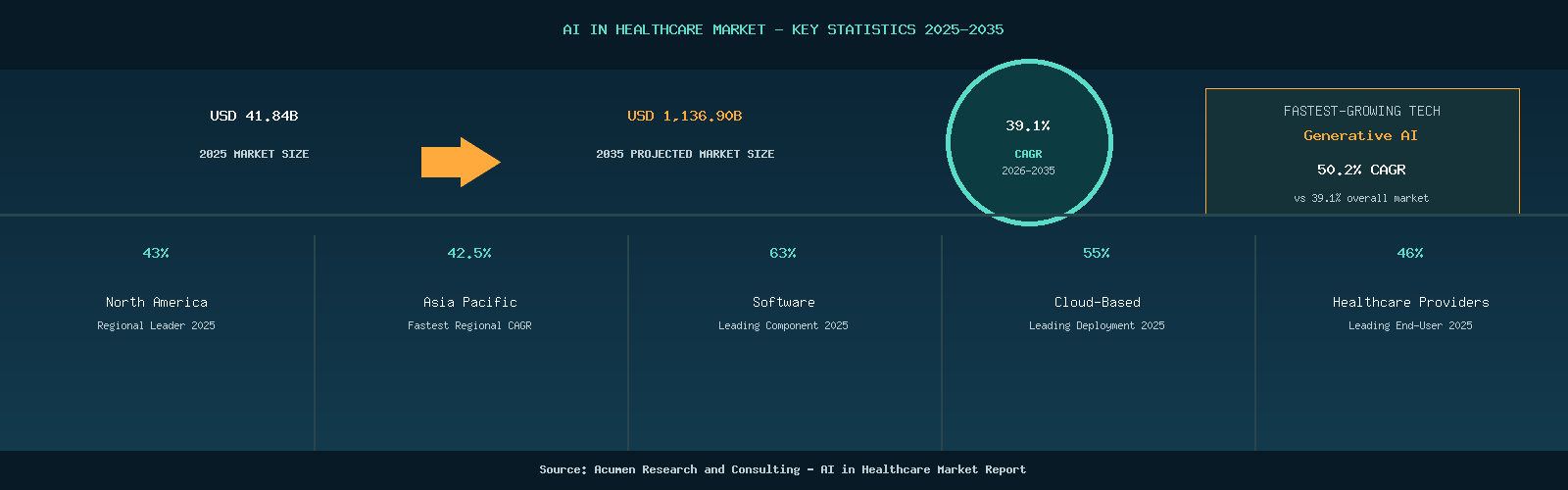
The AI in healthcare market is no longer a story about pilot projects and cautious experimentation. It is now one of the fastest-growing corners of the global technology economy, and new research suggests it is only just getting started. According to a market analysis from Acumen Research and Consulting, the global AI in healthcare market was valued at USD 41.84 billion in 2025 and is projected to surge to roughly USD 1,136.90 billion by 2035, growing at a compound annual growth rate of 39.1 percent over the forecast period. That trajectory would see the market expand more than 27-fold in a single decade, a pace that puts healthcare AI among the fastest-growing technology categories anywhere in the world right now.
To put that growth in perspective: a market worth $41.84 billion today would need to roughly double every two years, consistently, for a decade, to reach the report’s 2035 projection. Few technology sectors sustain that kind of compounding for that long. What’s driving it, according to the research, is a convergence of forces: healthcare systems under mounting cost pressure, a global shortage of clinical staff, an explosion in medical data that has outgrown human analytical capacity, and a new generation of generative AI tools that are being adopted faster than almost anything that came before them in healthcare technology.
AI in Healthcare Market Size: The Numbers Driving the Hype
The headline figures are striking on their own, but the segment-level detail is where the real story sits. The full breakdown, along with methodology and segmentation, is available in the complete report from Acumen Research and Consulting, which forms the basis of the statistics in this article.
By region, North America led the market with a 43 percent share in 2025, a position the report attributes to the region’s advanced healthcare infrastructure and heavy investment from major technology companies already embedded in the sector. Europe followed with a 25 percent share, driven by healthcare digitization efforts and government-backed innovation programs across the continent. But it’s Asia Pacific that stands out as the region to watch: it’s projected to grow at the fastest CAGR of any region, 42.5 percent, through the forecast period, fueled by rapid healthcare modernization and a wave of government initiatives specifically promoting AI-enabled healthcare ecosystems.
That regional pattern tells a familiar story in global technology adoption: mature markets hold the lead in absolute dollars today, while faster-growing, earlier-stage markets close the gap over the next decade. If Asia Pacific’s 42.5 percent CAGR holds, the region’s share of the global market is likely to look meaningfully different by 2035 than it does today.
Machine Learning Built the Market. Generative AI Is About to Take Over.
Look at the technology layer underneath the market, and a clear handoff is underway. Machine learning currently anchors the market, holding a 30 percent share in 2025, largely thanks to its extensive, well-established use in disease diagnosis. It’s the technology that has quietly powered years of incremental AI adoption in radiology, pathology, and risk scoring.
But the growth story belongs to generative AI. The report projects generative AI will grow at a CAGR of 50.2 percent through the forecast period, comfortably the fastest of any technology segment tracked, as healthcare organizations increasingly adopt large language models and AI-driven drug discovery platforms. That’s a notably different kind of AI than the pattern-recognition systems that have dominated the market to date; generative models don’t just classify or flag, they draft, summarize, and generate novel candidates, from clinical documentation to potential drug compounds. If that 50.2 percent pace holds, generative AI will likely have shifted from a niche technology layer to one of the market’s dominant forces well before 2035.
Software Is the Backbone, But Services Are the Growth Story
By component, software is unambiguously the market’s foundation. The segment held a commanding 63 percent share in 2025, reflecting the fact that AI software platforms, the actual diagnostic engines, clinical decision tools, and data platforms, serve as the backbone of virtually every healthcare AI deployment.
Services, by contrast, are where the momentum is building. The services segment is expected to grow at a notable 39.1 percent rate over the forecast period, roughly in line with the overall market’s growth rate, as healthcare organizations increasingly seek external expertise to actually implement AI systems. That distinction matters: buying AI software and successfully deploying it inside a hospital’s existing clinical workflows are two very different challenges, and the services growth rate suggests health systems are leaning heavily on outside expertise to bridge that gap.
Why Hospitals Are Prioritizing Cloud Despite Data-Security Concerns
By deployment model, cloud-based solutions dominated with a 55 percent share in 2025. That might come as a mild surprise given healthcare’s historical caution around cloud storage of sensitive patient data, but the report frames it differently: hospitals, government agencies, and large healthcare institutions are prioritizing cloud specifically because of data security, regulatory compliance, and the direct control it can offer over sensitive patient information, not despite those concerns. Modern cloud infrastructure, with dedicated healthcare compliance frameworks, has evidently cleared much of the trust barrier that once favored on-premises systems.
Who’s Actually Using This Technology: Providers vs Pharma vs Everyone Else
The end-user breakdown clarifies who is actually writing the checks for all this AI infrastructure. Healthcare providers, hospitals and specialty care facilities, dominate the market with a 46 percent share in 2025, driven by rising adoption of AI-powered diagnostics, clinical decision support systems, patient monitoring technologies, and workflow automation. This tracks with a broader industry shift toward preventive, technology-enabled diagnostics, where earlier and more consistent detection increasingly depends on AI-assisted imaging and screening tools rather than manual review alone.
Pharmaceutical and biotechnology companies represent the second-largest end-user segment, at 22 percent share in 2025, as AI increasingly accelerates drug discovery, clinical trial optimization, biomarker identification, and precision medicine development, some of the most computationally intensive and highest-value applications of AI anywhere in healthcare.
Clinical AI Dominates, But the Administrative Opportunity Is Quietly Massive
By application, clinical AI is the clear leader, holding 42 percent of the market in 2025. That dominance reflects growing demand for accurate disease diagnosis, personalized treatment planning, predictive healthcare analytics, and improved clinical outcomes, the applications most directly tied to patient care itself.
Operational and administrative AI holds the second-largest application share, at 20 percent, as healthcare organizations increasingly turn to AI to automate billing, claims processing, appointment scheduling, workforce management, and other resource-intensive administrative functions. It’s a less visible use case than diagnostic AI, but arguably just as consequential: administrative overhead has long been one of the largest, least glamorous cost centers in healthcare systems worldwide, and AI-driven automation targeting that overhead directly addresses the cost pressures cited as a core driver of this market’s growth.
What’s Fueling This 39.1% Growth Curve
Pull back from the segment-level detail, and a coherent growth story emerges. Healthcare systems everywhere are contending with the same basic tension: rising patient demand and data volume on one side, and constrained clinical staffing and budgets on the other. AI, across its various forms, from machine learning diagnostics to generative drug discovery to administrative automation, offers a way to expand capacity without proportionally expanding headcount or spend.
That tension is compounding with a second force: the sheer volume of healthcare data now being generated has outgrown what human clinicians and analysts can manually process, making algorithmic tools less a convenience than a practical necessity for health systems trying to extract value from their own data. And a third factor, the rapid maturation of generative AI specifically, has expanded what “AI in healthcare” even means, moving well beyond pattern recognition into tools that can draft clinical notes, propose novel drug candidates, and summarize research literature at a scale no human team could match.
What This Growth Actually Means for Patients
Market-size figures can feel abstract, but the underlying shift has a direct patient-facing dimension. As clinical AI adoption climbs toward the 42 percent application share the report already shows, patients are increasingly likely to encounter AI somewhere in their care journey, often without necessarily realizing it: an AI system flagging a suspicious pattern on a scan before a radiologist reviews it, a predictive model helping a care team identify which patients are at highest risk of readmission, or a generative AI tool drafting the after-visit summary a doctor reviews and signs off on. None of this replaces clinical judgment, but it does change the shape of a clinical visit, often compressing the time between a symptom being flagged and a care team acting on it.
That shift toward earlier, faster intervention echoes a theme showing up across the health-technology sector more broadly, including in how primary healthcare systems are being restructured to reach patients before conditions escalate rather than only treating them once they do. AI-enabled diagnostics and administrative automation are, in effect, two different tools aimed at the same underlying goal: getting the right intervention to the right patient faster, and with less strain on an already stretched healthcare workforce.
A Competitive Landscape Still Taking Shape
With a market projected to grow more than 27-fold over the next decade, competitive positioning is still very much in flux. Established technology giants with existing healthcare footprints, alongside specialized health-AI vendors and a fast-growing crop of generative-AI-native startups, are all competing for share of a market that, on today’s numbers, is barely a fraction of the size it’s expected to reach by 2035. That immaturity cuts both ways: it means today’s market leaders in any given segment, cloud infrastructure, clinical decision support, administrative automation, are not guaranteed to hold that position a decade from now, particularly in the generative AI segment where the underlying technology itself is still evolving quickly.
For healthcare providers, pharmaceutical companies, and investors trying to make sense of where to place bets in this market, segment-level growth rates matter as much as the topline number. A software platform with a 63 percent share today built its lead on years of clinical validation and integration work; a generative AI tool riding a 50.2 percent growth curve is competing on a very different, faster-moving basis, where speed of iteration may matter more than years of accumulated clinical trust.
The Road Ahead (2026–2035)
If the market performs anywhere close to its projected 39.1 percent CAGR, the next decade will look meaningfully different from the last one. Generative AI’s projected 50.2 percent growth rate suggests it will increasingly define what “healthcare AI” means to both patients and providers, shifting the conversation from diagnostic pattern-matching toward AI systems that actively generate clinical content, drug candidates, and personalized treatment plans. Asia Pacific’s rapid growth suggests the market’s center of gravity, currently anchored firmly in North America, will likely become more geographically distributed by the decade’s end.
For now, the report’s topline numbers, a jump from $41.84 billion to roughly $1,136.90 billion, tell a clear enough story on their own: healthcare, an industry often characterized as slow-moving and risk-averse, is embracing AI at a pace that rivals or exceeds adoption curves seen in far less regulated industries. Readers interested in the full segmentation, regional breakdowns, and competitive landscape behind these figures can request sample pages of the complete report here.
[…] Lefkofsky’s optimism lines up with broader market data. According to a report from Acumen Research and Consulting, the global AI in healthcare market was valued at USD 41.84 billion in 2025 and is projected to reach roughly USD 1,136.90 billion by 2035, growing at a compound annual growth rate of 39.1 percent, with clinical AI applications, the category Tempus’s diagnostics and precision-medicine tools fall under, already commanding the largest application share of the market. That trajectory reinforces Lefkofsky’s core argument: the healthcare AI opportunity isn’t a niche corner of the broader AI boom, it’s one of its largest and fastest-growing segments in its own right, a dynamic explored in more detail in Medgadget’s broader look at the AI in healthcare market’s growth trajectory. […]
[…] forces, similar to how AI adoption is being prioritized across other corners of the country’s healthcare system more broadly, where structured, standardized approaches to AI deployment are increasingly seen as prerequisites […]