

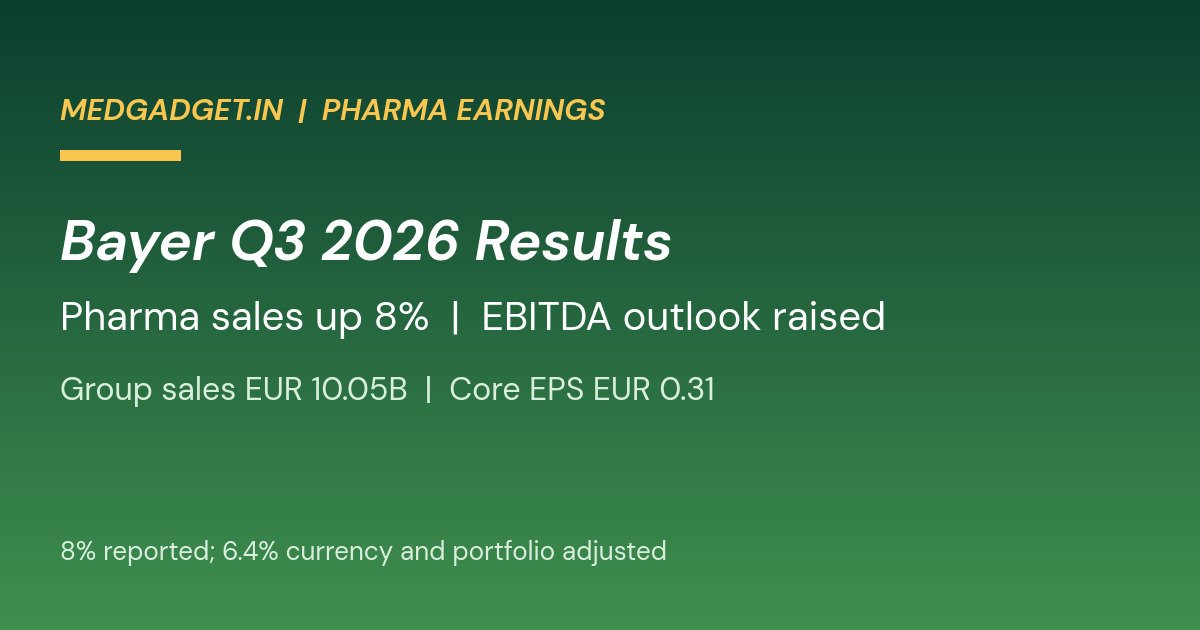
The Bayer Q3 2026 results show a pharmaceutical business gaining momentum inside a group that still faces heavy charges. Bayer reported on 3 November 2026 that third-quarter Pharmaceuticals sales rose 8.0% to €4.680 billion, and it raised its 2026 outlook for group EBITDA before special items, the Pharmaceuticals margin, free cash flow and year-end net debt.
Key takeaways from the Bayer Q3 2026 results
- Group sales were €10.053 billion, up 4.1% reported and 1.9% adjusted for currency and portfolio effects.
- Group EBITDA before special items rose 6.9% to €1.615 billion.
- Pharmaceuticals sales rose 8.0% reported and 6.4% adjusted for currency and portfolio; Pharmaceuticals EBITDA before special items rose 23.6% to €1.292 billion, a 27.6% margin.
- Core EPS fell to €0.31 from €0.49, and net income was a loss of €672 million.
- Free cash flow was negative €293 million, partly because of higher legal settlement payments.
The 8% figure: reported versus adjusted growth
The headline that Pharmaceuticals sales grew 8% is correct as reported, but the company’s underlying measure is lower. Bayer’s release gives 8.0% reported growth and 6.4% adjusted for currency and portfolio effects, so currency added to the headline number. We use both figures throughout so readers can see the difference. The source is Bayer’s Q3 2026 release.
What drove Bayer pharmaceutical sales
- Nubeqa grew 58.3% (currency and portfolio adjusted) to roughly €1 billion in the quarter.
- Kerendia grew 64.9% and passed €1 billion of sales over the 12 months from 1 October 2025. See our report on the FDA expanding Kerendia’s approval.
- Beyonttra sales were roughly five times the prior-year level.
- Xarelto fell 30.7%, as expected after patent expiry, and Eylea fell 23.5%; the 8 mg formulation makes up about 60% of Eylea sales.
In short, newer products are now outgrowing the declines in older ones. Bayer’s chief executive Bill Anderson said the company has reached a turning point in Pharma’s growth trajectory. Asundexian received approval in China for secondary stroke prevention under the name Sunharbo, which Anderson called the biggest news out of the pipeline. Approval status elsewhere is not covered in the release we reviewed.
The raised Bayer 2026 earnings outlook
Bayer improved several 2026 targets. The table below describes the old and new ranges as stated in the release.
- Pharmaceuticals EBITDA margin before special items: 25% to 27%, up from 23% to 25%.
- Group EBITDA before special items (currency-adjusted): €9.8 billion to €10.3 billion, up from €9.6 billion to €10.1 billion.
- Free cash flow: negative €1.5 billion to negative €0.5 billion, up from negative €2.5 billion to negative €1.5 billion.
- Year-end net financial debt: €28 billion to €29 billion, down from €29 billion to €30 billion.
Pharmaceuticals sales growth is now expected toward the upper end of its guidance range; the prior range is not stated in the release. Other group targets were confirmed. Note the nuance in the headline: Bayer raised its EBITDA and cash-flow outlook, but the company did not raise a core EPS target in the material we reviewed, and Q3 core EPS fell year on year.
Where Bayer fell short: Crop Science, Consumer Health and cash
- Crop Science: sales €3.884 billion, down 2.4% adjusted; EBITDA before special items down 41.3% to €101 million, a 2.6% margin.
- Consumer Health: sales €1.445 billion, flat adjusted; EBITDA before special items down 4.4% to €347 million.
- Net financial debt: €31.083 billion at 30 September, down €2.564 billion from 30 June, mainly because of a €3.0 billion payment from Apollo for a minority stake in a new entity.
Special charges were €407 million net, mainly a €215 million impairment on the Claritin brand and litigation-related expenses. The release separately mentions a €307 million impairment on the Xofigo brand; we could not reconcile how the two items fit together, so we cite both as stated.
Timeline of Bayer’s 2026 pharma momentum
- September 2026: FDA expands Kerendia approval for chronic kidney disease associated with type 1 diabetes.
- October 2026: see our report on Bayer’s GLP-1 plan for India.
- 3 November 2026: Q3 results and raised outlook.
- Awaited: a court decision on a class settlement in glyphosate litigation.
Litigation in the Bayer financial results
Bayer said it won the first glyphosate trial since a 7-2 US Supreme Court ruling, with CEO Anderson noting that all 12 jurors sided with the company, and that it awaits a decision on the class settlement. Litigation remains a driver of cash outflows and special charges, as the negative free cash flow shows. We do not assess legal outcomes.
Market context: the global pharmaceutical industry
According to Acumen Research And Consulting, the global pharmaceutical market was valued at USD 1.5 trillion in 2022 and is projected to reach USD 2.8 trillion by 2032, a compound annual growth rate of 6.4% for 2023 to 2032. Asia-Pacific is expected to be the fastest-growing region at above 7.1% a year, anti-diabetic drugs are projected to grow at 6.7% a year, and over-the-counter drugs are expected to grow fastest by prescription type.
The report page was last updated in November 2023, and one highlight says the market will increase by USD 2.8 trillion when it means reach that size. These figures are market-wide and not specific to Bayer.
Our analysis
In our assessment, the Bayer Q3 2026 results confirm that Pharmaceuticals is carrying the group: its EBITDA margin of 27.6% compares with 2.6% in Crop Science. The raised outlook rests on that division, while core EPS, cash flow and litigation remain weak points. We would watch whether Nubeqa and Kerendia growth can keep outpacing the Xarelto and Eylea declines. This is analysis, not investment advice.
What is not disclosed
- The previous Pharmaceuticals sales growth range.
- A core EPS outlook change, if any.
- How the Xofigo and Claritin impairments reconcile to total special charges.
- The timing of the glyphosate class settlement decision.
Risks and caveats
- Outlook figures are company estimates and are currency-adjusted where stated.
- Litigation outcomes could change cash flow and charges.
- The Pharmaceuticals growth rate depends on whether reported or adjusted figures are used.
- Market figures are third-party estimates.
What to watch next
- The court decision on the glyphosate class settlement.
- Further regulatory decisions on asundexian beyond China.
- Continued Nubeqa and Kerendia growth against Xarelto and Eylea erosion.
- Bayer’s full-year 2026 results.
General background
Bayer operates three divisions: Pharmaceuticals, Crop Science and Consumer Health. For more coverage see our Pharmaceutical section and the company’s corporate website.
Questions readers are asking about the Bayer Q3 2026 results
Did Bayer raise its 2026 outlook?
Yes, for group EBITDA before special items, the Pharmaceuticals margin, free cash flow and net debt.
How much did pharmaceutical sales grow?
8.0% reported and 6.4% adjusted for currency and portfolio effects.
Why did core EPS fall?
Bayer said operating gains were partly offset by non-cash charges from interest rate changes.
FAQ
What are Nubeqa and Kerendia?
Prescription medicines in Bayer’s portfolio for prostate cancer and for chronic kidney disease, respectively.
Why are Xarelto sales falling?
Because of patent expiry, as Bayer expected.
What is the debt position?
Net financial debt was €31.083 billion at 30 September 2026.
How we reported this: figures come from Bayer’s Q3 2026 release; market figures are attributed to Acumen Research And Consulting. Last updated 3 November 2026. This is news reporting and not investment or medical advice.