

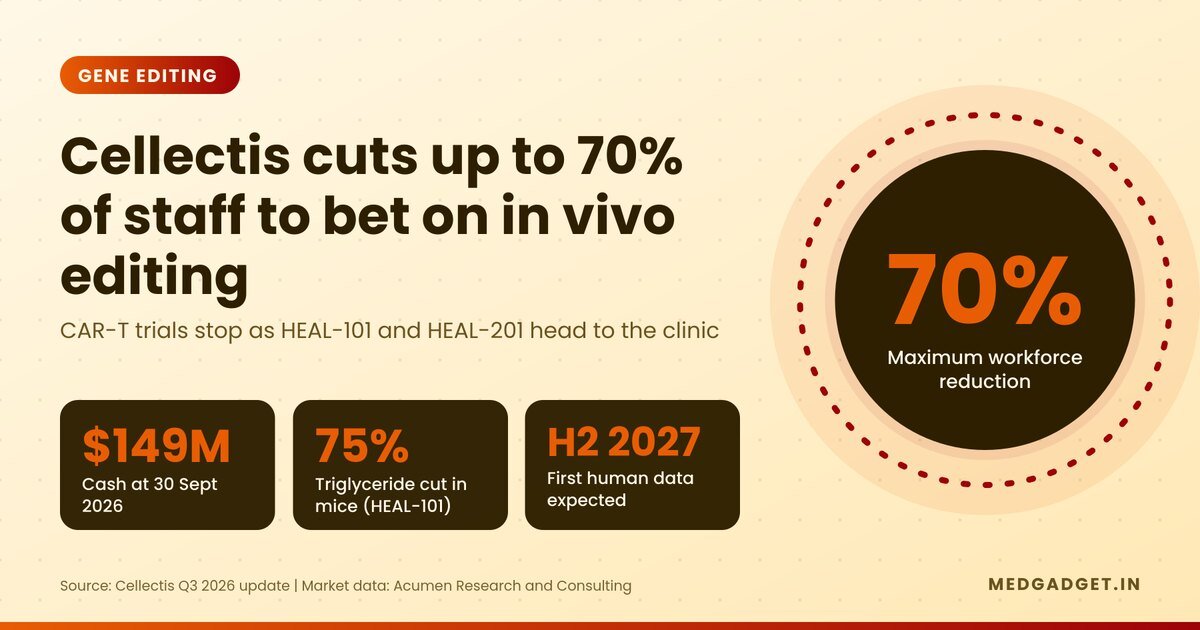
Cellectis layoffs could reach up to 70% of the gene-editing company’s global workforce over 2026 and 2027, the Paris-based biotech disclosed with its third-quarter results on 12 November 2026, as it abandons its allogeneic CAR-T programmes and rebuilds itself around in vivo gene editing for common chronic diseases. With 229 full-time staff at the end of 2025, that could mean roughly 160 jobs, according to BioSpace.
Key takeaways on the Cellectis layoffs
- Cellectis expects to cut up to 70% of headcount from pre-transition levels, subject to consultation with its French works council and US and French labour law.
- Enrolment has stopped in its two clinical CAR-T programmes, lasme-cel and eti-cel, and sites are being closed out; treated patients will continue protocol follow-up.
- The new pipeline is led by HEAL-101, an in vivo base editor that switches off the APOC3 gene to lower triglycerides, with first human data expected in the second half of 2027 from an investigator-initiated trial in China.
- HEAL-201, an epigenetic editor that silences PCSK9 to lower cholesterol, is set for a similar China trial with data in the first half of 2028.
- Cash of $149 million at 30 September should last into the second half of 2028 once the restructuring is complete.
From off-the-shelf CAR-T to one-time liver editing
Cellectis made its name in the 2010s with TALEN gene editing and “off-the-shelf” CAR-T cells made from healthy donors rather than each patient’s own blood. Its board approved the pivot in September 2026, and the third-quarter update put numbers on the cost. The company says progress with its two HEAL candidates, plus a judgement about where its editing tools can have the most impact, drove the decision.
The shift mirrors a wider move in the field. Ex vivo cell therapy requires collecting, engineering and infusing cells, with expensive manufacturing and, often, chemotherapy conditioning. In vivo editing instead packages the editing instructions as mRNA in lipid nanoparticles (LNPs) that travel to the liver after a single intravenous infusion. If it works, a one-time treatment could replace years of daily pills or regular injections for conditions such as high triglycerides and high LDL cholesterol, which affect far larger populations than blood cancers.
What the preclinical data show
| Programme | Target and approach | Key preclinical result | Next clinical step |
|---|---|---|---|
| HEAL-101 | APOC3, in vivo base editing, severe hypertriglyceridemia | About 65% mean editing in humanised-liver mice; APOC3 down 67% and triglycerides down 75% in a disease model | Investigator-initiated Phase 1 in China; data H2 2027 |
| HEAL-201 | PCSK9, in vivo epigenetic silencing, severe hypercholesterolemia | More than 90% reduction in plasma PCSK9 in humanised-liver mice | Investigator-initiated Phase 1 in China; data H1 2028 |
Cellectis says HEAL-101 edited about 90% of APOC3 copies in human liver cells in the lab without cutting both DNA strands at the target site, and that editing stayed confined to the liver in the tissues it analysed. HEAL-201 uses an epigenetic approach, switching the gene off by modifying how it is packaged rather than changing the DNA letters, which in principle could make the effect reversible or tunable. These are animal and cell results. They do not establish safety or benefit in people.
The financial picture
| Metric | Q3 2026 | Q3 2025 |
|---|---|---|
| Revenue | $3.8 million | $35.2 million |
| Operating result | Loss of $57.5 million | Income of $8.0 million |
| Net result | Loss of $61.5 million | Income of $0.6 million |
| Cash and deposits (30 Sept 2026) | $149 million | $211 million at 31 Dec 2025 |
Revenue fell mainly because research activity under the AstraZeneca collaboration slowed. Nine-month R&D spending included a one-off $26.6 million impairment and $6.2 million in termination benefits. By our calculation, cash fell by about $62 million in nine months, or roughly $7 million a month, before the full savings from the restructuring kick in. Shareholders’ equity turned negative at minus $17.6 million.
What happens to the partnerships
The AstraZeneca research collaboration, which aims at up to 10 cell and gene therapy products, continues. Cellectis also remains linked to cema-cel, an allogeneic anti-CD19 CAR-T it licensed to Servier, which sublicensed it to Allogene; Allogene says the pivotal ALPHA3 trial in large B-cell lymphoma should finish enrolling by the end of 2027. So Cellectis is leaving the clinic for CAR-T, but not the economics.
Why China trials, and the India angle
Both HEAL programmes will enter humans through investigator-initiated trials in China, a route many Western biotechs now use because it can produce early human data faster and more cheaply than a full US IND. The trade-off is that such data may need to be repeated under FDA or EMA standards later. For Indian readers, the move is a reminder of how fast the competition for early-phase gene-editing trials is shifting toward Asia. India has its own cell therapy programmes, including CAR-T therapies made domestically, and regulators are building frameworks for gene therapy trials, but China currently dominates first-in-human editing studies. Our coverage of the safety debate around CAR-T in autoimmune disease shows why sponsors are rethinking ex vivo approaches.
Market context: gene editing
Acumen Research and Consulting estimates the global gene editing market at USD 18.3 billion in 2024 and projects USD 73.7 billion by 2033, a 16.9% compound annual growth rate. Acumen segments the market by technology into CRISPR, TALEN, zinc-finger nucleases and others, with CRISPR holding the largest share, with North America the biggest region and Asia-Pacific the fastest growing. Cellectis is effectively trying to move from a niche corner of that market, TALEN-edited cell therapy, into the much larger cardiometabolic space where several CRISPR and base-editing companies are already in the clinic.
What to watch
- Completion of the French works council consultation, which sets the actual size and timing of job cuts.
- Start of the HEAL-101 China trial and any first safety data in late 2027.
- Whether partners such as AstraZeneca expand or narrow their collaboration.
- Cash burn once the restructuring is complete, against the guided runway into H2 2028.
FAQ
How many jobs is Cellectis cutting?
Up to 70% of its pre-transition global headcount over 2026 and 2027. With 229 employees at the end of 2025, that could be around 160 roles, depending on the French consultation process.
Is Cellectis stopping CAR-T therapy?
Yes for its own clinical programmes: lasme-cel and eti-cel have stopped enrolling. Partner programmes such as cema-cel with Allogene continue.
What is in vivo gene editing?
It means editing genes inside the body, usually by infusing mRNA in lipid nanoparticles that reach the liver, instead of removing cells, editing them in a lab and reinfusing them.
When will Cellectis have human data?
Preliminary HEAL-101 data are expected in the second half of 2027 and HEAL-201 data in the first half of 2028.
Sources: Cellectis third-quarter 2026 results and business update (12 November 2026); BioSpace. Market data: Acumen Research and Consulting. This article is for information only and is not medical or investment advice. More in Bio Technology. Last updated 14 November 2026.