

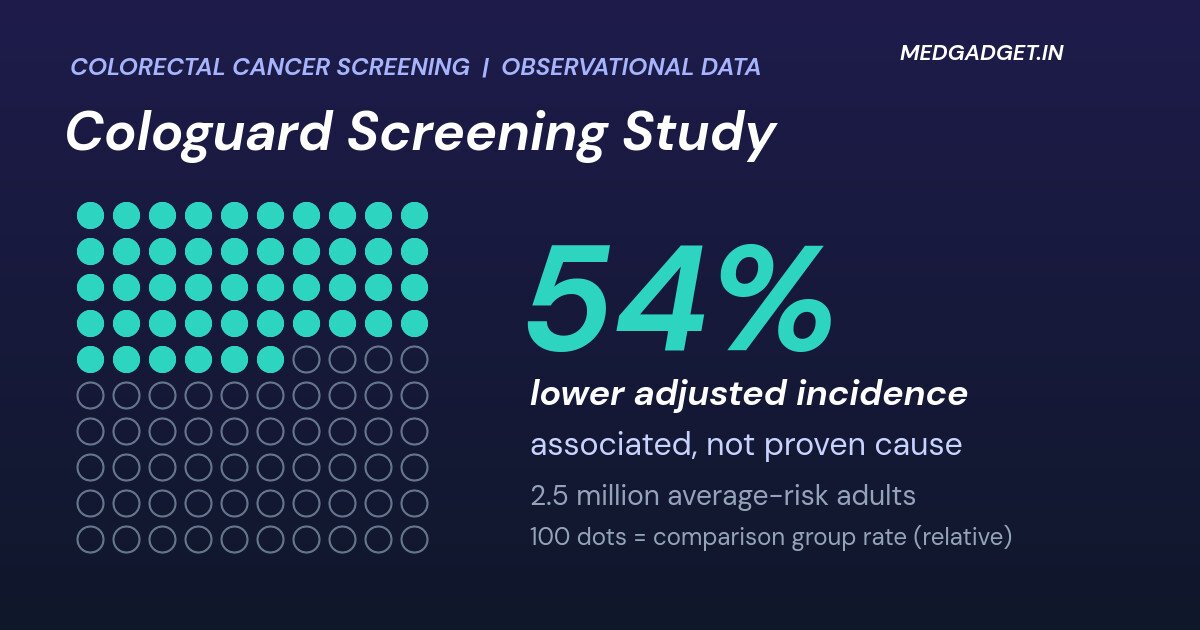
A new Cologuard colorectal cancer screening study reports large differences between people who completed stool DNA screening and people who did not, but it does not show that the test caused them. On 12 October 2026, Abbott said that in a nationwide cohort of more than 2.5 million average-risk adults, completing Cologuard screening was associated with approximately 54% lower adjusted colorectal cancer incidence. A separate case-control study of 5,745 people diagnosed with the disease found prior screening was associated with 45% lower odds of death after diagnosis.
The key word is associated. Both analyses are observational, they were presented at a medical meeting, and Abbott is the manufacturer of the test. This report sets out what the company disclosed, what it did not, and how to read numbers like these without over- or under-selling them.
Cologuard colorectal cancer screening study: the two findings
- Study 1, incidence: a real-world cohort of more than 2.5 million average-risk adults, comparing those who completed multitarget stool DNA (mt-sDNA) screening with those who did not. Result: about 54% lower adjusted colorectal cancer incidence, consistent across sensitivity analyses, according to the company.
- Study 2, death after diagnosis: a population-based case-control study of 5,745 people diagnosed with colorectal cancer, comparing those who completed mt-sDNA testing in the five years before diagnosis with those who did not. Result: 45% lower odds of death after diagnosis, seen across all racial and ethnic groups examined.
- Where: the American College of Gastroenterology 2026 Annual Scientific Meeting in Nashville (9 to 14 October); the company lists 13 Abbott abstracts, two oral and 11 posters.
Abbott’s chief medical officer for screening in its cancer diagnostics business, Paul Limburg, said in the release that such tests must show both high accuracy and adherence, and that the research helps the company understand whether people stay up to date with screening.
What the company did not say about the Cologuard colorectal cancer screening study
The press release and its summaries left out several details that readers would need to judge the work. We found no study years, no data source, no confidence intervals, no named authors and no funding statement. We also found no description of how “adjusted” was done, or whether the comparison group included people screened by other methods such as colonoscopy or stool blood tests. Without these, the 54% and 45% figures can be reported but not fully evaluated. The full abstracts, which the meeting publishes, are the place to check.
How to read the Cologuard colorectal cancer screening study numbers: 54% lower and 45% lower odds
A 54% lower rate means the screened group’s rate was about 0.46 times that of the unscreened group; a 45% lower odds of death means an odds ratio of about 0.55. These conversions are ours. Neither figure tells you an absolute risk: without the underlying rates, we cannot say how many cancers or deaths per 1,000 people were avoided. Odds are also not the same as risk, and the two diverge when an outcome is common.
Case-control designs like Study 2 start from people who already have cancer, so they compare earlier screening among those who died with those who survived. That approach can be affected by lead-time and length-time bias, in which screening finds slower-growing cancers earlier and makes survival look better without changing the course of disease.
Why the Cologuard colorectal cancer screening study shows association, not causation
- Healthy-screener effect: people who complete a mailed home test may differ from those who do not in income, access to care and other health habits, even after statistical adjustment.
- Unmeasured factors: adjustment can only account for what was recorded.
- Comparison group: if “not completed” includes people who were never offered the test, the gap may partly reflect access, not the test.
- Follow-up from screening: a positive stool result leads to a colonoscopy, where precancerous polyps can be removed, so some of any benefit may come from the follow-up procedure, not the stool test alone.
- Sponsor and venue: the work was reported by the product’s maker, and meeting abstracts are not the same as full peer-reviewed papers.
Where the test fits in screening
Cologuard is an at-home multitarget stool DNA test that looks for altered DNA and blood in a stool sample. The company, which says Exact Sciences is now part of Abbott, reports that mt-sDNA has been used more than 23 million times since Cologuard launched in 2014. Its newer version, Cologuard Plus, is described as detecting 95% of colorectal cancers at 94% age-weighted specificity; that is a company figure from its own materials. Screening guidelines from groups such as the US Preventive Services Task Force recommend screening for adults from age 45, and the US Centers for Disease Control and Prevention gives general advice on the options. Abbott says the American Cancer Society lists the test every three years for average-risk adults.
A positive result needs a follow-up colonoscopy. The company’s abstracts at the same meeting include work on unprocessable kits and on out-of-pocket costs for follow-up colonoscopy, which matter because a screening programme only works if people complete every step.
Our assessment of the Cologuard colorectal cancer screening study
In our assessment, this Cologuard colorectal cancer screening study is encouraging but not conclusive. The scale of the cohort is a strength, and the direction of the result fits the broader idea that finding and removing precancerous lesions lowers cancer risk. But the company has released headline numbers without the details that would let outsiders test them. The accurate summary is that screening completion was associated with lower incidence and lower odds of death, not that the test did the work alone. For readers, the practical message is unchanged: if you are 45 or older, talk to your doctor about which screening option suits you, since the best test is the one that actually gets done. For related coverage, see our report on gastrointestinal cancer in young people in India, our piece on Tecentriq for stage III colon cancer, or browse our medical device coverage.
What to watch next in the Cologuard colorectal cancer screening study
- Publication of the full abstracts, with study years, data sources and confidence intervals.
- Peer-reviewed publication of either analysis.
- Independent studies comparing stool DNA, stool blood tests and colonoscopy.
- Data on completion of follow-up colonoscopy after a positive result.
Frequently asked questions
What did the Cologuard colorectal cancer screening study find?
Abbott reports that completing Cologuard screening was associated with about 54% lower adjusted colorectal cancer incidence in more than 2.5 million average-risk adults, and with 45% lower odds of death after diagnosis in a separate 5,745-person study.
Does the Cologuard colorectal cancer screening study prove Cologuard prevents colorectal cancer?
No. Both studies are observational, so they show associations, not proof of cause.
Who ran the Cologuard colorectal cancer screening study?
The company announced them. We found no author or funding details in the release.
Who should be screened for colorectal cancer?
Guidelines recommend screening of average-risk adults from age 45; talk to a doctor about which test is right for you.
Is a positive Cologuard result a diagnosis?
No. A positive result requires a follow-up colonoscopy to confirm.
How we reported this: we relied on Abbott’s 12 October 2026 press release, its earlier screening-guideline release and public guidance from health agencies. We did not read the abstracts. Figures labelled as ours are our own conversions. Last updated: 13 October 2026. This article is news reporting and not medical advice.