

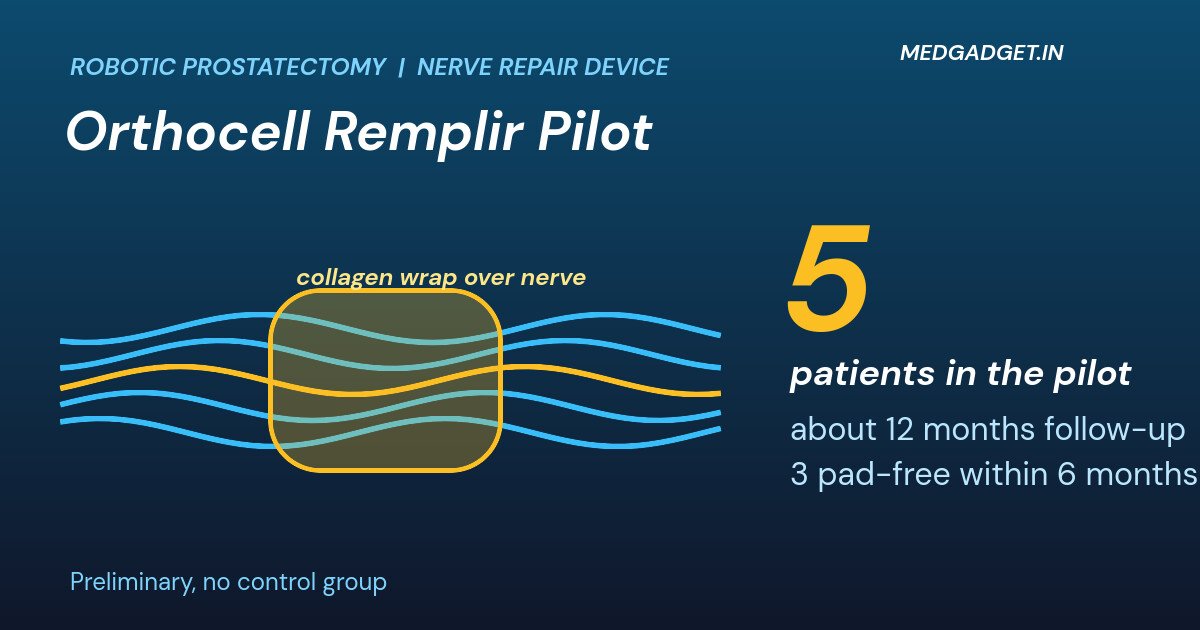
The Orthocell Remplir prostate surgery pilot has produced its first results. On 13 October 2026, Perth-based Orthocell (ASX: OCC) reported an early case series of five patients in whom its Remplir nerve repair device was placed during nerve-sparing robotic prostatectomy, the operation to remove a prostate affected by cancer. The company says surgeons placed the device without technical problems or added operating time, and that no device-related complications were seen during surgery or over roughly 12 months of follow-up.
The headline needs a caution. Five patients with no comparison group cannot show that a device improves recovery, because many men regain urinary control and sexual function over time after this surgery regardless of what is used. The company itself presents the case series as preliminary and as a basis for a larger prospective study. Here is what was reported, what the device is, and what remains unproven.
Orthocell Remplir prostate surgery: what was reported
- Design: an initial case series of five patients described as clinically complex.
- Procedure: nerve-sparing robotic prostatectomy, with Remplir placed over nerve regions.
- Handling: placed without technical issues or added operative time, according to the company.
- Safety: no device-related complications during surgery or about 12 months of follow-up.
- Urinary continence: three patients were pad-free within six months, which the company describes as encouraging given limited nerve preservation and difficult starting conditions.
- Erectile function: among men who had function before surgery, most regained it with medication or second-line treatments; the announcement as we saw it gave no exact count.
The surgeons and hospitals were not named in the summaries we reviewed, and we have not seen the full data. Everything above is the company’s account.
What Remplir is
Remplir is a nerve repair product built on Orthocell’s proprietary collagen platform. The company describes it as mimicking the native structure of the epineurium, the protective sheath around a nerve, to provide a barrier and a supportive environment for healing. It is marketed for peripheral nerve reconstruction. Its main published evidence so far comes from upper-limb nerve repair: an earlier peer-reviewed study reported functional recovery in 23 of 27 nerve repairs (85%) at 24 months, in a different surgical setting from the prostate.
According to the company, Remplir has US clearance, as well as approvals in Australia, New Zealand, Singapore, Canada, Thailand and Hong Kong, with a UK and EU application pending. In the US, devices of this kind are typically cleared through the FDA’s 510(k) premarket notification pathway, which is based on similarity to an existing device for a stated use. The company says no additional regulatory approvals are required for the prostate use in existing jurisdictions. We have not seen the clearance text and cannot confirm that.
Why nerves matter for Orthocell Remplir prostate surgery
The nerves that control erections and help control the bladder run close to the prostate. Surgeons try to spare them during removal of the gland, but cancer position, anatomy and technique can limit how much is preserved. Common side effects of surgery include urinary leakage and erectile dysfunction, as outlined by the US National Cancer Institute. Company-linked coverage cites figures of up to 35% of patients with urinary incontinence at three months and up to 80% with erectile dysfunction at 12 months, depending on risk factors and technique; these are broad ranges, not findings from this pilot.
That is the commercial logic. Orthocell says there are about 12,000 robotic prostatectomies a year in Australia and about 115,000 in the United States, and that prostate surgery could lift the US addressable market for Remplir from about US$1.6 billion to roughly US$2 billion. These are the company’s estimates, not independent figures.
How far Orthocell Remplir prostate surgery has spread
In July 2026, the company said Remplir had been used in more than 250 prostate procedures by 39 surgeons across Australia’s five most populous states, and that clinical performance data would follow a surgeon-led academic paper with 12 months of follow-up, expected in the second half of 2026. Our reading is that the five-patient series may be an early step in that process, but the announcements we saw do not say so. Wider use is not evidence: it shows surgeons are willing to try the device, not that it works.
What the Orthocell Remplir prostate surgery pilot cannot tell us
- Effectiveness: with five patients and no control group, the data cannot show that Remplir improves recovery.
- Cause: three pad-free patients at six months may reflect surgical skill, patient factors or natural recovery; the pilot cannot separate these.
- Safety at scale: an absence of device-related complications in five patients says little about rarer problems.
- Selection: the patients were described as complex, so results may not apply to typical cases.
- Measures: the tools used to assess continence and erectile function were not given.
Our assessment of Orthocell Remplir prostate surgery
In our assessment, the Orthocell Remplir prostate surgery pilot is a reasonable first look at feasibility and nothing more. It suggests the device can be placed during a robotic operation without extending it, which matters to surgeons working to tight theatre schedules. The step that counts is the planned larger prospective study; for credibility it will need a clear comparison group or a pre-stated outcome measure, a fixed follow-up period and independent reporting. Investors may read the news differently, but clinicians should wait for those data. For another view of the nerve-repair market, see our report on Axogen’s $200 million BioCircuit acquisition, and for robotics in surgery see Stryker’s investment in CMR Surgical, or browse our medical device coverage.
What to watch next for Orthocell Remplir prostate surgery
- Design, size and endpoints of the planned prospective study.
- Publication of the case series or the surgeon-led paper in a peer-reviewed journal.
- Regulatory decisions in the UK and EU.
- Any clarification of the regulatory position for prostate use.
Frequently asked questions
What did the Orthocell Remplir prostate surgery pilot find?
In five patients, the company reports successful placement without added operating time, no device-related complications over about 12 months, and pad-free status in three patients within six months.
Does the Orthocell Remplir prostate surgery pilot prove Remplir improves recovery?
No. Five patients without a comparison group cannot establish effectiveness.
What device is used in Orthocell Remplir prostate surgery?
A collagen-based nerve repair device from Orthocell, used here over nerve regions during robotic prostatectomy.
What happens next?
The company plans a larger prospective study of functional recovery after prostate surgery; design details have not been published.
Is Remplir approved in the United States?
The company says it has US clearance for nerve repair. We have not verified whether prostate use sits within it.
How we reported this: we relied on the company’s 13 October 2026 announcement as summarised by distribution services, its July 2026 market update, its published study page and public regulatory information. We did not see the full data. Last updated: 13 October 2026. This article is news reporting and not medical advice.
[…] In our assessment, the Camcevi China approval 2026 is mainly a commercial and convenience story. Leuprolide is an old, well-understood class, and the new element is the delivery format and the length of dosing. That can help patients and clinics, yet it does not show better cancer outcomes than existing hormone injections. The commercial result will depend on pricing, reimbursement and competition from other long-acting GnRH products in China. For more regulatory coverage, browse our pharmaceutical reports, or see our report on early results for a prostate surgery nerve-repair device. […]