

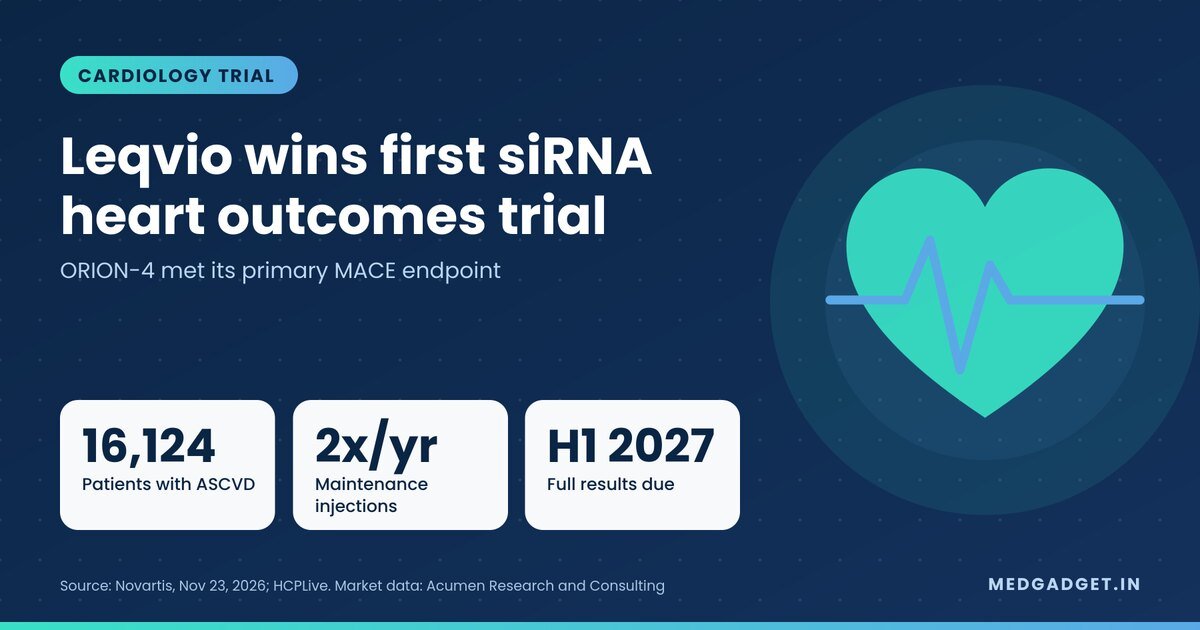
The Leqvio ORION-4 results are in: Novartis said on November 23, 2026 that twice-yearly inclisiran (Leqvio) produced a statistically significant and clinically meaningful reduction in major adverse cardiovascular events versus placebo in more than 16,000 people with established atherosclerotic cardiovascular disease (ASCVD). It is the first completed outcomes trial for any small interfering RNA (siRNA) drug in heart disease. Novartis has not yet released the size of the benefit; full data are due in the first half of 2027.
Key takeaways on Leqvio ORION-4 results
- ORION-4 met its primary endpoint: fewer heart attacks, ischaemic strokes, coronary deaths and urgent coronary revascularisations with inclisiran than with placebo.
- The trial randomised 16,124 patients with prior heart attack, ischaemic stroke or peripheral artery disease, according to the trial registry as reported by HCPLive.
- No hazard ratio, percentage risk reduction or p-value has been disclosed; Novartis described the drug as well tolerated.
- Leqvio is injected by a health professional at day 1, month 3 and then every six months, so two maintenance doses a year.
- Full results are expected in H1 2027, with a second outcomes trial, VICTORION-2 PREVENT, also reading out in 2027.
Why this trial was the missing piece
Leqvio has been on the US market since the FDA approved it in December 2021, and it is now approved in more than 100 countries, including the US, EU, Japan and China. It works by silencing the liver’s production of PCSK9, a protein that removes LDL receptors, so more “bad” LDL cholesterol is cleared from the blood. Earlier ORION trials showed LDL cholesterol falls of roughly 50% to 60%.
What doctors and payers lacked was proof that the LDL drop translates into fewer heart attacks and strokes. The PCSK9 antibodies evolocumab and alirocumab already have such outcomes data, which gave them an edge in guidelines and coverage decisions. ORION-4 closes that gap for inclisiran, at least at the topline level. In July 2025 the US label was also widened to allow use without a statin, alongside diet and exercise, in adults with high cholesterol.
Inside ORION-4: design at a glance
| Sponsors | University of Oxford with the TIMI Study Group; co-sponsored by Oxford and Novartis |
| Patients | 16,124 adults with established ASCVD (prior heart attack, ischaemic stroke or peripheral artery disease), UK and US sites |
| Treatment | Inclisiran 300 mg under the skin or placebo, day 1, month 3, then every 6 months, on top of usual care |
| Planned follow-up | Median of about 5 years (registry) |
| Primary endpoint | Coronary heart disease death, heart attack, fatal or non-fatal ischaemic stroke, or urgent coronary revascularisation |
| Key secondaries | Same composite in patients on high-intensity statins; coronary death or heart attack; cardiovascular death |
| Result disclosed | Primary endpoint met; effect size not yet released |
Lead investigator Louise Bowman of Oxford said the trial shows inclisiran “can reduce the risk of major cardiovascular events in people with established vascular disease.”
The numbers we still do not have
A topline press release is not a full result, and the gaps here are significant for anyone deciding whether to prescribe or pay for the drug:
- Size of benefit. The relative and absolute risk reductions will decide how Leqvio compares with PCSK9 antibodies.
- Secondary endpoints. Whether cardiovascular death fell, and whether patients already on high-intensity statins benefited, has not been reported.
- LDL achieved in the trial. No ORION-4 cholesterol data were given.
- Safety detail. Injection-site reactions and discontinuation rates over several years of dosing are still to come.
What it could change for patients in India and elsewhere
Novartis says up to 80% of people with ASCVD do not reach guideline LDL targets. A big reason is adherence: daily pills get skipped. A drug given in a clinic twice a year sidesteps that problem, which is why cardiologists in high-burden countries, India included, have watched ORION-4 closely. Outcomes data typically strengthen a drug’s place in clinical guidelines and in reimbursement talks with insurers and public health schemes. Cost and access, not efficacy, are likely to remain the main barrier in price-sensitive markets.
For a related look at how newer metabolic drugs are being tested on hard heart outcomes, see our report on GLP-1 drugs and heart failure remodelling.
Market context: RNA drugs move into common disease
Inclisiran, licensed by Novartis from Alnylam, is the most prominent example of RNA-silencing medicine moving from rare disorders into mass-market cardiology. Acumen Research and Consulting estimates the global antisense and RNAi therapeutics market at $4.9 billion in 2023 and projects $22.1 billion by 2032, an 18.4% compound annual growth rate, with North America the leading region. The report page carries an older last-updated date, so treat these figures as indicative. A positive outcomes trial in a population this large is the kind of event that can pull the whole category forward.
Frequently asked questions
What did the ORION-4 trial show?
That inclisiran significantly reduced a combination of heart attacks, ischaemic strokes, coronary deaths and urgent coronary procedures compared with placebo in people who already had cardiovascular disease.
How often is Leqvio given?
A health professional gives an injection at the start, another at three months, and then one every six months.
How much did Leqvio reduce heart attack risk?
Novartis has not disclosed the figure yet. Detailed results are expected to be published in the first half of 2027.
Is Leqvio a statin replacement?
It is mainly used alongside statins. The US label also allows use without a statin in some adults with high cholesterol; treatment decisions should be made with a doctor.
Sources: Novartis media release (November 23, 2026); HCPLive. Market data: Acumen Research and Consulting. More in Clinical Trials. Not medical or investment advice. Last updated November 24, 2026.