

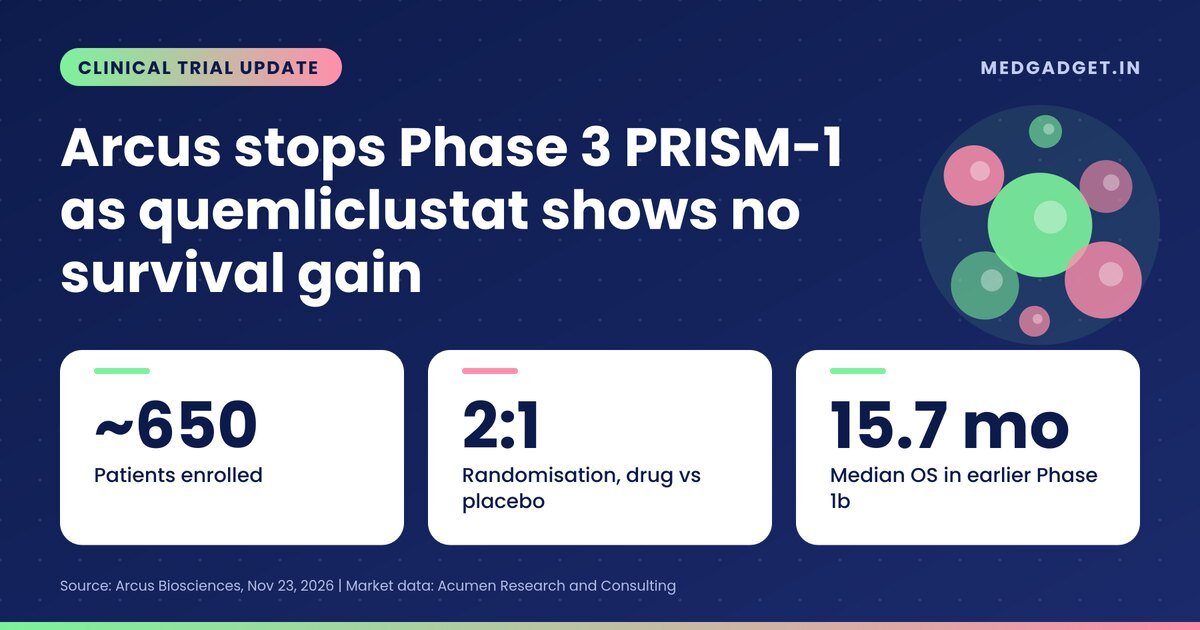
The quemliclustat pancreatic cancer trial PRISM-1 has been stopped. Arcus Biosciences said on November 23, 2026, that a pre-specified interim analysis by the study’s independent data monitoring committee found that adding its CD73 inhibitor quemliclustat to standard gemcitabine and nab-paclitaxel chemotherapy did not improve overall survival enough to meet the efficacy threshold in about 650 people with newly diagnosed metastatic pancreatic cancer. The company is discontinuing the Phase 3 study.
The result removes one of the more closely watched immunology-based approaches to pancreatic ductal adenocarcinoma (PDAC), a cancer where most patients are diagnosed late and new first-line options have been scarce for years.
Key takeaways on the quemliclustat pancreatic cancer trial
- PRISM-1 (NCT06608927) compared quemliclustat plus gemcitabine/nab-paclitaxel with placebo plus the same chemotherapy as first treatment for metastatic PDAC.
- At the interim look, the two arms performed similarly on overall survival, progression-free survival and response rate, so the study missed its survival boundary.
- Arcus reported no meaningful differences in side effects between the arms.
- Detailed survival numbers and hazard ratios have not yet been released.
- PRISM-1 was the only trial of quemliclustat Arcus was running, leaving the programme’s future in doubt.
PRISM-1 at a glance
| Feature | Detail |
|---|---|
| Phase | 3, global, randomised, double-blind, placebo-controlled |
| Patients | About 650 with untreated metastatic PDAC |
| Randomisation | 2:1, quemliclustat arm vs placebo arm |
| Backbone chemotherapy | Gemcitabine plus nab-paclitaxel in both arms |
| Primary endpoint | Overall survival |
| Secondary endpoints | PFS, response rate, duration of response, disease control, safety |
| Outcome | Stopped after interim analysis; no survival advantage |
Why researchers had hoped CD73 would work
Pancreatic tumours are known for building a microenvironment that shuts down the immune system, one reason checkpoint inhibitors have largely failed in this cancer. One contributor is adenosine, a molecule that dampens T-cell activity. The enzyme CD73 is a key step in producing adenosine outside cells, so blocking it was meant to lift that brake and let the immune system attack the tumour.
Early data looked encouraging. In the Phase 1b ARC-8 study, published in Nature Medicine in April 2026, 122 patients given quemliclustat 100 mg with chemotherapy (with or without the anti-PD-1 antibody zimberelimab) had a median overall survival of 15.7 months, compared with 9.8 months in a matched external control group, according to published summaries. A smaller group of 29 patients on quemliclustat plus gemcitabine/nab-paclitaxel alone reached 19.4 months.
The catch is that ARC-8 had no randomised chemotherapy-only arm. Comparisons with external or historical controls can make a drug look better than it is, especially when supportive care and later-line treatment improve over time. PRISM-1 was designed to settle the question, and so far it has not confirmed the signal.
The survival puzzle in both arms
Arcus chief medical officer Richard Markus said that patients in both arms “reached the longest overall survival observed to date” in a global first-line metastatic pancreatic cancer study. If confirmed in the full data, that is notable in itself. It may reflect better patient selection, stronger supportive care, or access to newer second-line drugs after progression, but none of these explanations has been confirmed. Until Arcus publishes the numbers, it is impossible to say how long patients lived or why the control arm did so well.
A strong control arm also makes it harder for any add-on drug to show a benefit, a point worth keeping in mind when reading other first-line trials now under way.
Where this leaves first-line pancreatic cancer treatment
The field’s momentum has shifted to drugs that hit the KRAS mutations driving more than nine in ten pancreatic tumours. Revolution Medicines’ pan-RAS inhibitor daraxonrasib (Rasonque) is already approved for previously treated disease and has reported strong first-line results with chemotherapy; we covered the 60.7% response rate in first-line pancreatic cancer earlier this month. Other KRAS-directed pills, such as Erasca’s ERAS-0015, are earlier in development.
The PRISM-1 failure does not rule out adenosine-pathway drugs entirely; some researchers think they could still help in combination with targeted agents. But it is a clear sign that this mechanism alone, added to chemotherapy, is not enough.
What it means for Arcus
This is the latest in a string of late-stage setbacks for the Hayward, California, company. It previously ended development of the anti-TIGIT antibody domvanalimab in 2025 and the adenosine receptor blocker etrumadenant in 2023, both partnered with Gilead. Investors are now focused on casdatifan, Arcus’s HIF-2 alpha inhibitor in several Phase 3 kidney cancer trials, which helps explain why the share price recovered quickly after an initial drop.
Market context
Pancreatic cancer remains a large and underserved market. Acumen Research and Consulting valued the global pancreatic cancer therapeutics market at $3,582 million in 2021 and projected it to reach $6,575 million by 2030, growing at a compound annual rate of 7.2%, with North America the largest region and Asia-Pacific the fastest growing. That report was last updated in 2022, so treat the figures as indicative; they predate the arrival of RAS inhibitors, which are likely to reshape spending in this disease.
What we still do not know
- The actual median overall survival in each arm and the hazard ratio.
- Whether any subgroup, for example by tumour CD73 level, benefited.
- When and where Arcus will present the full results.
- Whether Arcus or a partner will test quemliclustat in any other setting.
For more trial readouts, visit our Clinical Trials and Oncology sections.
FAQ
Why was the PRISM-1 trial stopped?
An interim analysis showed quemliclustat plus chemotherapy did not improve overall survival enough over chemotherapy alone to meet the trial’s pre-set efficacy bar, so Arcus discontinued it.
What is quemliclustat?
It is an experimental small-molecule inhibitor of CD73, an enzyme that helps tumours produce immune-suppressing adenosine.
Was quemliclustat unsafe?
No new safety problem was reported. Arcus said side effects were similar between the two groups; the issue was lack of added benefit.
What should patients in the trial do?
Participants should speak with their trial investigators, who will advise on stopping the study drug and continuing care.
Sources: Arcus Biosciences announcement (November 23, 2026) as reported by pharmaphorum and OncoDaily; ClinicalTrials.gov NCT06608927; ARC-8 data in Nature Medicine (April 2026). Market data: Acumen Research and Consulting, Pancreatic Cancer Therapeutics Market report (2022, indicative). Not medical or investment advice. Last updated: November 24, 2026.