

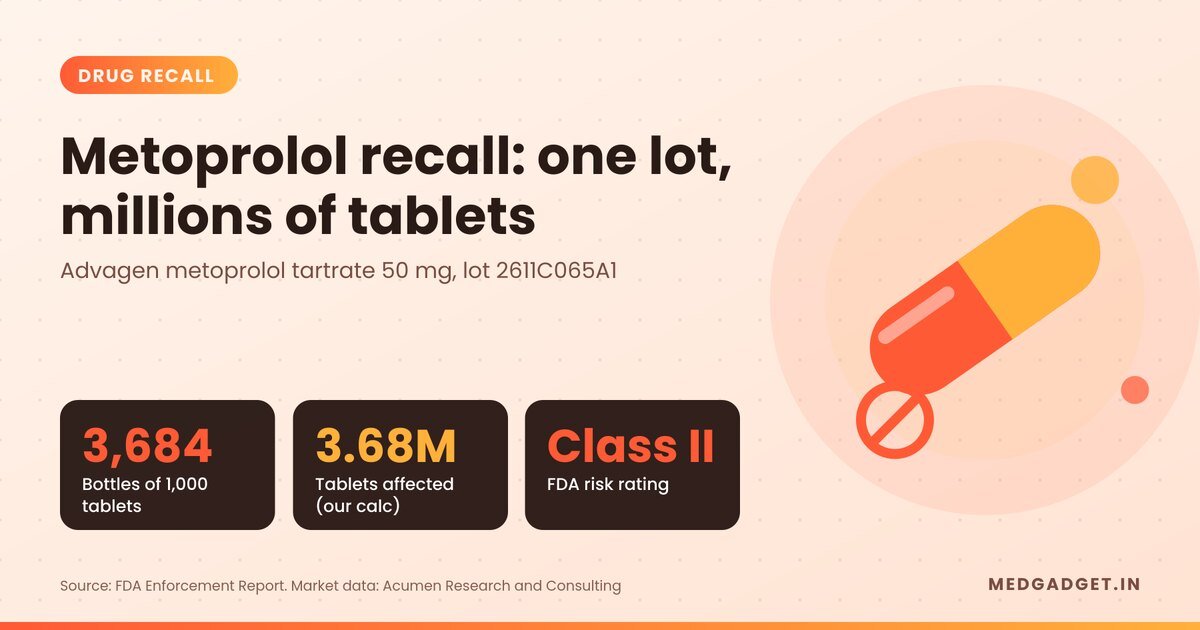
The metoprolol recall announced by Advagen Pharma covers 3,684 bottles of metoprolol tartrate 50 mg tablets, each holding 1,000 tablets, that may contain foreign tablets or capsules. The New Jersey company began the voluntary recall on October 27, 2026, and the US Food and Drug Administration classified it as a Class II recall on November 10, with the entry appearing in the FDA Enforcement Report the next day. The affected lot was distributed nationwide in the United States.
Metoprolol is one of the most widely prescribed heart and blood pressure medicines, so even a single-lot recall draws attention. Here is what the recall covers, who could be affected, and what patients should and should not do.
Key takeaways on the metoprolol recall
- One lot only: metoprolol tartrate tablets USP 50 mg, lot 2611C065A1, expiry May 2028, NDC 72888-210-00.
- By our calculation, the 3,684 recalled bottles held about 3.68 million tablets.
- The reason listed is the presence of foreign tablets or capsules. The FDA record does not say what the foreign pills are.
- Class II means use could cause temporary or medically reversible harm, with serious harm considered remote.
- Patients should not stop metoprolol on their own. Ask a pharmacist whether your supply came from the affected lot.
Recall details at a glance
| Product | Metoprolol tartrate tablets USP, 50 mg |
| Company | Advagen Pharma Limited, East Windsor, New Jersey |
| Pack | Bottles of 1,000 tablets |
| Quantity | 3,684 bottles (about 3.68 million tablets, by our calculation) |
| Lot / expiry | 2611C065A1 / 05/2028 |
| NDC | 72888-210-00 |
| Reason | Presence of foreign tablets/capsules |
| Recall started | October 27, 2026 (voluntary, firm-initiated) |
| FDA class | Class II, classified November 10, 2026 |
| Distribution | Nationwide, USA |
Why a 1,000-count bottle matters
Bottles of 1,000 tablets are pharmacy stock, not something patients take home. Pharmacists count tablets from these bulk containers into individual prescription vials. That has two consequences. First, a patient’s own bottle will not carry the recalled lot number on its label, so the pharmacy is the only practical way to check. Second, a foreign tablet in a bulk bottle could end up in any prescription filled from it, which is why pharmacies have been told to quarantine stock from the lot.
Mix-ups of this kind are usually caught when a pharmacist or patient notices a tablet with a different colour, shape or imprint. Metoprolol tartrate 50 mg tablets carry a specific imprint described on the pharmacy label or in the medication guide; a tablet that looks different should be shown to the pharmacist before it is taken.
What patients should do now
- Keep taking your medicine unless your doctor tells you otherwise. Stopping a beta-blocker suddenly can trigger chest pain, a fast heart rate or, in people with heart disease, a heart attack. The US label carries a boxed warning on abrupt withdrawal.
- Call your pharmacy and ask whether your metoprolol tartrate 50 mg fill came from lot 2611C065A1. Pharmacies keep records linking each fill to the stock bottle used.
- Look at your tablets. If any look different from the rest, set them aside and take them to the pharmacist.
- If you think you swallowed a wrong pill, contact your pharmacist or US Poison Control (1-800-222-1222), and keep the tablet if possible. Seek urgent care for fainting, a very slow or very fast heartbeat, chest pain or trouble breathing.
Note that this recall involves metoprolol tartrate, the immediate-release form. It does not cover metoprolol succinate extended-release tablets, which were the subject of separate recalls earlier in 2026.
How metoprolol is used
Metoprolol is a beta-blocker. It slows the heart and reduces the force of each beat, which lowers blood pressure and the heart’s demand for oxygen. Doctors prescribe it for high blood pressure, to prevent angina and to protect the heart after a heart attack. It is also commonly used to control heart rate in atrial fibrillation and, in some cases, in heart muscle disease; a recent label update for aficamten in hypertrophic cardiomyopathy compared that drug directly with metoprolol, as we reported in Myqorzo MAPLE-HCM Label Update.
Why this matters for generic supply, including India
Most metoprolol dispensed in the US is generic, and a large share of US generic tablets is made by Indian manufacturers or their US-based units. The FDA has not named the manufacturing site for this lot, so we are not attributing it to any plant. But the recall arrives as US regulators sharpen their scrutiny of overseas production: unannounced FDA inspections in India have surged this year, as covered in FDA Unannounced Inspections in India Jump to 87%. Packaging mix-ups and foreign-product contamination are classic findings in such inspections, alongside particulate problems like the one behind the recent vancomycin recall.
Market context
Blood pressure medicines are among the highest-volume drugs in the world, which is why lot-level quality failures reach so many patients. Acumen Research and Consulting’s hypertension drugs market report valued the global market at USD 26.5 billion in 2023 and expects it to reach USD 38.3 billion by 2032, growing 4.2% a year. The report also highlights India’s Hypertension Control Initiative, which aims to bring quality treatment to more than 150 million people, and notes Asia-Pacific is expected to post the fastest growth.
Frequently asked questions
Which metoprolol is being recalled?
Advagen Pharma’s metoprolol tartrate 50 mg tablets in 1,000-count bottles, lot 2611C065A1, expiry May 2028, NDC 72888-210-00. No other strengths or lots are included.
Should I stop taking metoprolol because of the recall?
No. Do not stop on your own. Check with your pharmacist about the lot, and talk to your doctor if you need a replacement supply.
What is a Class II drug recall?
It is the FDA’s middle risk tier: exposure may cause temporary or medically reversible health problems, and the chance of serious harm is considered remote.
Is the recall relevant to patients in India?
The recall covers product distributed in the United States. There is no indication the lot was sold in India.
Sources: FDA Enforcement Report (event 100234); Medical Daily; The Healthy; Cleveland Clinic drug information. Market data: Acumen Research and Consulting. More in our Pharmaceutical section. This article is for information only and is not medical advice. Last updated November 20, 2026.