

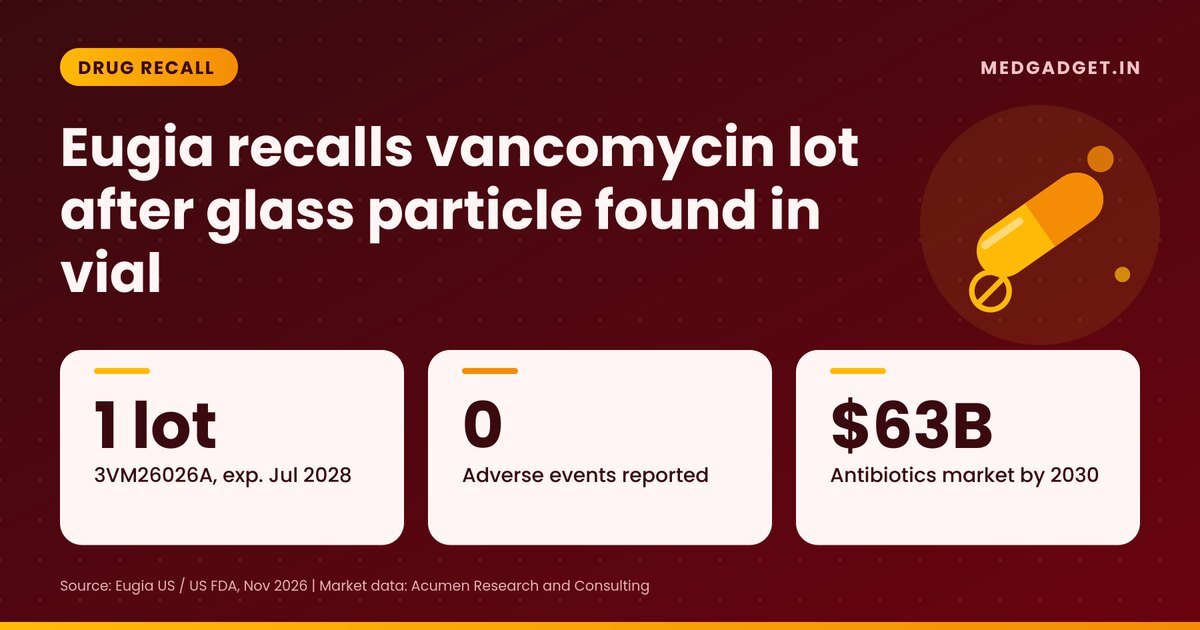
A nationwide vancomycin recall is under way in the United States after Eugia US LLC, the US injectables arm of India’s Aurobindo Pharma, found a glass particle inside a vial of Vancomycin Hydrochloride for Injection USP 1.25 g. The company announced the voluntary recall of one lot, 3VM26026A, on 6 November 2026, and the US Food and Drug Administration posted the notice on 9 November. No adverse events had been reported at the time of the announcement.
The recall reaches down to hospitals and individual users, which means pharmacies and wards that stocked the lot must find and quarantine any remaining vials. Because vancomycin is a frontline drug for serious infections, including in newborns, the event is a reminder of how much hospital antibiotic supply depends on a small number of sterile-injectable makers, many with roots in India.
Key takeaways on the vancomycin recall
- Product: Vancomycin Hydrochloride for Injection USP, 1.25 g per 30 mL single-dose vial, marketed by Eugia US LLC (formerly AuroMedics Pharma).
- Problem: a glass particle was found inside a vial.
- Scope: one lot (3VM26026A, expiry July 2028), shipped to wholesalers across the US between 2 and 15 September 2026.
- Risk: particles injected into a vein can block blood vessels, cause clots including pulmonary embolism, and trigger inflammation or allergic reactions.
- Status: voluntary recall to the user level; no adverse event reports at announcement.
Recalled lot at a glance
| Detail | Information |
|---|---|
| Product | Vancomycin Hydrochloride for Injection USP 1.25 g/vial (30 mL single-dose vial) |
| Lot number | 3VM26026A |
| Expiry | July 2028 |
| NDC (carton / vial) | 55150-471-10 / 55150-471-01 |
| Pack | 10 vials per carton, 10 cartons per shipper |
| Distribution | Wholesalers nationwide, 2 to 15 September 2026 |
| Recall level | Hospital, healthcare facility and user level |
| Adverse events reported | None at the time of announcement |
Why a single glass particle triggers a recall
Injectable drugs bypass the body’s natural filters, so pharmacopoeial standards require them to be essentially free of visible particles. Glass fragments can come from vial breakage, damage during filling, or delamination of the inner glass surface. Once a particle is confirmed in a lot, manufacturers usually cannot rule out others, so recall is the standard response even when the defect rate is very low.
The notice flags particular concern for neonates, infants and patients with impaired organ function, who may be more sensitive to small emboli or inflammatory reactions. Vancomycin is widely used in neonatal intensive care units for suspected late-onset sepsis, which is why the user-level recall matters.
What hospitals and pharmacists should do
- Check stock for lot 3VM26026A and stop dispensing it immediately.
- Quarantine affected vials and contact Qualanex (1-800-505-9291, recall@qualanex.com) for return or replacement.
- Forward the notice to any sub-accounts or sites that received the lot, and inform prescribing and nursing staff.
- Report adverse events to Eugia (1-866-850-2876, option 2) or through FDA MedWatch.
- Inspect reconstituted vials visually before use, as standard practice, and use an in-line filter where local protocol requires.
Patients who received vancomycin in hospital recently do not need to take any action unless they have unexplained symptoms such as chest pain, sudden breathlessness or swelling at the infusion site, in which case they should contact a doctor. Other vancomycin brands and other Eugia lots are not part of this recall.
The India angle: Aurobindo’s injectables business
Eugia is the specialty and sterile-injectables business of Hyderabad-based Aurobindo Pharma, one of India’s largest generic exporters to the US. The US entity named in the notice is based in East Windsor, New Jersey. The FDA notice does not identify the manufacturing site of the recalled lot.
Single-lot particulate recalls are not unusual in the sterile-injectables sector, and Eugia has issued earlier particulate-related recalls on other products, including acyclovir sodium injection, according to FDA’s recall database. For Indian manufacturers, the significance lies less in this lot than in the pattern US regulators track: repeat quality signals at injectable plants can lead to inspections, warning letters and import alerts. Our recent report on penicillin manufacturing pressures in Europe shows how fragile antibiotic supply chains have become, and the Health Canada peptides warning is another recent example of contamination risks in injectables.
Market context: antibiotics demand
Vancomycin belongs to a global antibiotics market that Acumen Research and Consulting sized at about US$42 billion in 2021 and projects will reach US$63 billion by 2030, growing at a compound annual rate of 4.6%. Acumen expects Asia-Pacific to post the fastest growth over the forecast period. By our calculation, that forecast adds around US$21 billion in annual sales over the decade, much of it in low-margin generics where a few manufacturers supply most hospital volume.
That concentration is the reason one-lot recalls of widely used antibiotics draw attention from hospital pharmacists: a quality problem at a major supplier can quickly turn into a shortage. There is no indication of a vancomycin shortage linked to this recall so far.
FAQ
Which vancomycin lot is being recalled?
Lot 3VM26026A of Eugia’s Vancomycin Hydrochloride for Injection USP 1.25 g/30 mL single-dose vial, expiry July 2028, NDC 55150-471-10 (carton).
Why was vancomycin recalled?
A glass particle was found inside a vial. Injected particles can block blood vessels or cause clots, inflammation and allergic reactions.
Has anyone been harmed by the recalled vancomycin?
Eugia said it had received no adverse event reports related to the recall when it announced it on 6 November 2026.
Is Eugia part of Aurobindo Pharma?
Yes. Eugia is Aurobindo Pharma’s sterile and specialty injectables business; the US company was formerly called AuroMedics Pharma.
Sources: Eugia US LLC company announcement posted by the US FDA (6 and 9 November 2026); FDA recall database. Market data: Acumen Research and Consulting, Antibiotics Market report. More in Pharmaceutical. This article is not medical or investment advice. Last updated 14 November 2026.
[…] Animal studies on NAD+ precursors generated much of the longevity excitement, but human trials so far have been small and short, typically measuring blood NAD+ levels or modest metabolic markers rather than hard outcomes such as disease or lifespan. That gap between marketing and evidence is one reason regulators want a formal dossier before allowing sale. Consumers should also be wary of unregulated online sources, a pattern seen with other wellness products such as injectable peptides; see Vancomycin Recall: Aurobindo Unit Eugia Pulls Lot After Glass Particle Found in Vial. […]
[…] from an Indian maker were tied to four deaths in the US in 2023. More recent cases, such as the Eugia vancomycin recall over a glass particle, show how a single lot problem can quickly become a US regulatory […]