

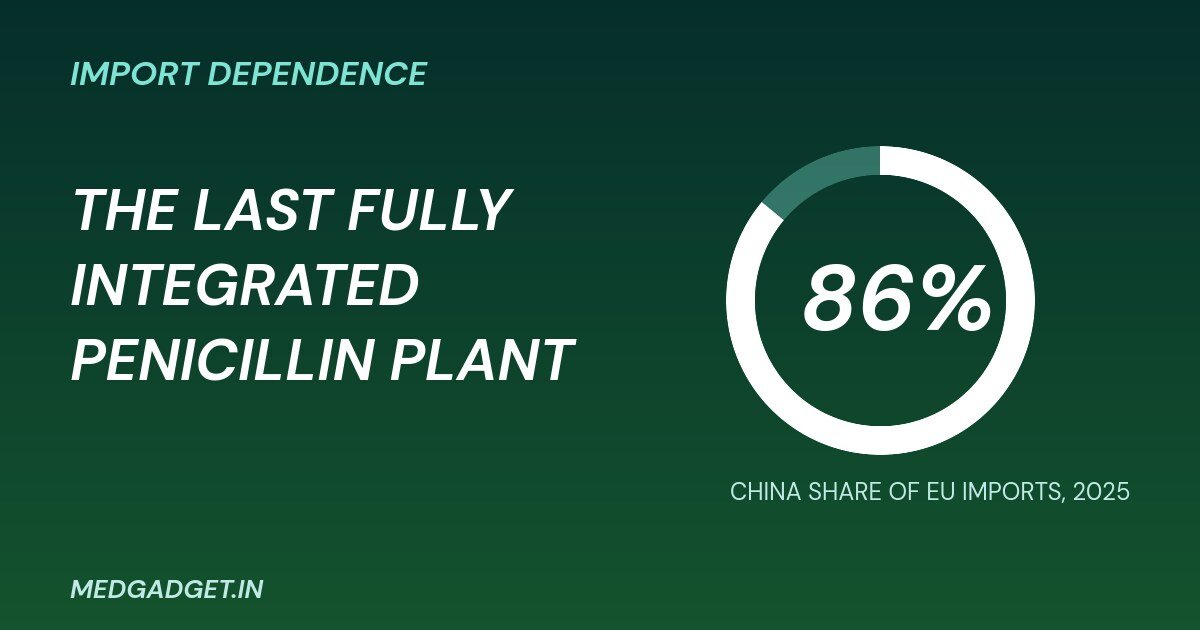
The penicillin manufacturing Europe still has is concentrated at a single site in the Tyrolean Alps, and a wire-service report published on 21 October 2026 says cheap Chinese antibiotic imports are putting that site under pressure. Sandoz describes its Kundl plant in Austria as the only European facility that makes penicillin from start to finish, and the company has asked the European Commission to examine how Chinese amoxicillin ingredients are priced.
Key takeaways on penicillin manufacturing Europe
- Kundl is described as Europe’s last fully integrated penicillin plant and employs more than 2,000 people, according to the report.
- Eurostat figures cited in the report put China’s share of EU imports of penicillins and derivatives, mostly bulk active ingredients, at 86% last year, up from 44% in 2019.
- Sandoz filed an anti-dumping complaint with the Commission in March. The report says a probe is expected but its timing is unclear; the Commission declined to comment.
- Sandoz told UK lawmakers that Kundl’s capacity is not commercially sustainable without higher government payments. That is a company claim.
- The future of penicillin manufacturing Europe relies on is therefore tied to decisions that have not yet been taken, and this article separates the reported facts from the possible outcomes.
Why the Kundl plant matters for penicillin manufacturing Europe
According to the report, Kundl sits on a site shared with Novartis and BASF and makes penicillin through large-scale fermentation in metal vats, a process that is energy-intensive. The report says the plant’s energy use is comparable to that of the nearby city of Innsbruck, which has more than 130,000 residents. Sandoz says it is the only site in Europe that handles the whole chain, including key active ingredients.
The plant has also drawn public money. The report says Sandoz carried out a €200 million expansion about three years ago, including €50 million in public funds, and that the European Commission approved €28.3 million in 2023 for an expansion that raised capacity by 20%. Those figures come from the report and the company, and we have not independently verified the state-aid decisions.
General background: how penicillin is made
The penicillin manufacturing Europe has depended on for decades starts with fermentation. Moulds of the Penicillium family are grown in large tanks, and the penicillin they produce is extracted and purified. Many widely used penicillins, including amoxicillin, are semi-synthetic: manufacturers start from a fermentation-derived intermediate and modify it chemically. The fermentation step is the hardest to replace quickly, because it needs specialised plant, steady energy supply and years of process know-how.
That explains why the question of where fermentation happens matters to supply security. Antibiotics are central to treating bacterial infections, and the World Health Organization stresses their role in the fight against resistance in its antimicrobial resistance fact sheet. A shortage of a basic penicillin can force clinicians onto broader-spectrum alternatives, a point that is general background rather than a claim made in the report.
Reading the import figures
The report cites Eurostat data showing China’s share of EU penicillin and derivative imports rising from 44% in 2019 to 86% last year. By our own arithmetic that is a rise of 42 percentage points, or almost a doubling of the share in six years. We have not seen the underlying Eurostat table, so we cannot say whether the share is measured by value or by volume. The report adds that Europe’s exports of these products are now about one-fifth of their early-2000s peak.
Sandoz says up to 90% of global antibiotic active ingredients are produced outside Europe, mainly in China or in India using Chinese chemicals. That is the company’s assertion. The report quotes Chinese officials as saying trade differences should be resolved through dialogue and that China opposes protectionism, so the pricing allegation is contested in principle even though no formal finding exists yet.
Our analysis: a resilience question with a commercial edge
In our assessment, the penicillin manufacturing Europe could lose is as much a security question as an industrial one. If one plant is the only complete chain on the continent, a closure would leave a single point of failure shifted entirely to imports. The counter-argument is that lower import prices benefit health systems, which buy antibiotics at very low prices already.
Sandoz is also a party with a commercial interest, so its warnings should be read as an advocacy position backed by some verifiable numbers rather than as neutral analysis. The decisive evidence, whether Chinese ingredients really sell below cost, is exactly what an investigation would test. See also our pharmaceutical coverage for related supply-chain reporting.
What is not disclosed about penicillin manufacturing Europe’s main plant
- Kundl’s annual output and the share of European penicillin demand it covers.
- The cost and price data behind Sandoz’s below-cost allegation.
- When, or whether, the Commission will open an investigation.
- How much “higher government payments” Sandoz says would be needed.
- Whether Eurostat shares are by value or volume, in the report as cited.
Risks and caveats for penicillin manufacturing Europe
Nothing in the report amounts to a finding of dumping. The Commission declined to comment, and any decision on duties would come only after an investigation. The report also notes that the EU has pursued other outcomes in trade disputes with China, so duties are one possibility and not a certainty. Penicillin manufacturing Europe-wide could also be affected by energy costs, which the report says averaged nearly 50% higher for energy-intensive industry in the EU than in China in 2025, citing IEA data.
This article relies on a single wire-service account and on company statements. We have not seen the Sandoz complaint, and the company’s own materials were not used for any figure that is not attributed here.
What to watch next
- Any Commission notice opening an anti-dumping investigation into Chinese amoxicillin ingredients.
- Updated Eurostat trade data for penicillins and derivatives.
- Decisions on Austrian or EU support for Kundl’s operations.
- Statements from Sandoz on the plant’s commercial position and on whether penicillin manufacturing Europe’s buyers will accept higher prices.
FAQ
Is Kundl really the last integrated penicillin plant in Europe?
That is how Sandoz and the report describe it: the only site in Europe making penicillin from start to finish, including key ingredients.
Has the EU imposed duties on Chinese antibiotic ingredients?
No duties have been reported. Sandoz filed a complaint in March, and the report says an investigation is expected but its timing is unclear.
What does the Kundl case mean for penicillin manufacturing Europe-wide?
It highlights how concentrated supply has become. Whether policy changes that depends on a decision that has not been made.
How we reported this: we relied on a wire-service report and on the figures and statements it attributes to Sandoz, Eurostat and others. Calculations are labelled as ours. Last updated 23 October 2026. This is news reporting and not advice.