

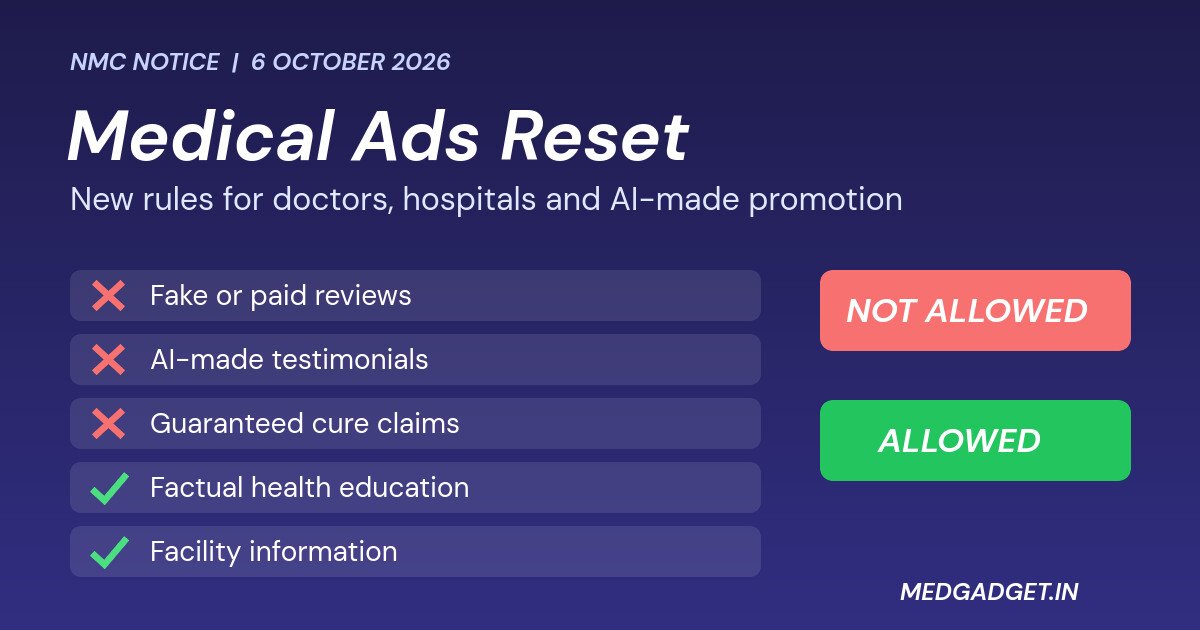
The NMC new guidelines 2026 on medical advertising are now in force, and they are the strictest public statement yet on how doctors and hospitals in India may promote themselves online. In a notice dated 6 October 2026, the National Medical Commission (NMC) issued “Guidelines on Ethical Advertising and Public Communication” covering registered medical practitioners, hospitals and medical institutions. The rules take effect immediately and bar fake or manipulated reviews, patient testimonials solicited for social media, “guaranteed” outcome claims, and misleading AI-generated promotional content.
For the thousands of clinics and hospitals that rely on Instagram, YouTube, Google reviews and influencer partnerships to attract patients, this changes what is safe to post. For patients, it is meant to make online health information more trustworthy. Here is what the guidelines say, what remains allowed, and what we could not confirm.
The NMC new guidelines 2026 at a glance
- Issued by: the NMC’s Ethics and Medical Registration Board.
- Date: 6 October 2026, effective immediately and mandatory.
- Applies to: registered medical practitioners, hospitals and medical institutions.
- Channels covered: television, radio, websites, blogs, social media, messaging apps, podcasts, influencer and sponsored content, and AI-generated promotion.
- Core message: factual information is fine; promotion that misleads, guarantees results or manufactures patient praise is not.
What doctors and hospitals can no longer do
According to the published summaries of the guidelines, the following are prohibited:
- Asking patients for testimonials, endorsements or reviews to use in social media promotion.
- Sharing fake, manipulated or paid reviews, ratings and recommendations.
- Claims of superiority or guaranteed results, including comparative or unverifiable claims such as “best” or “100% success”. The “guaranteed” restriction extends to claims about equipment and facilities.
- Using patient photos, videos, records or clinical images for advertising unless the law permits it and consent and safeguards are met.
- Before-and-after depictions and patient success stories. Patient consent does not make these acceptable.
- Promotion that encourages unnecessary tests or procedures.
Practitioners are also expected to avoid naming patients unnecessarily and to crop, blur or black out identifying details in any permitted material.
How the rules treat AI-generated content
The guidelines treat AI-generated promotional content as advertising, which means the same standards apply to it as to any other promotion. In practice, that rules out using AI to produce fake patient testimonials, synthetic clinical outcomes, invented voices or endorsements, or any misleading or unverifiable statement about diagnosis, treatment, outcomes, qualifications, patient experiences or services. One published summary also lists paid placement tactics, such as paying for better search or platform rankings, among the banned practices; another summary of the same notice does not mention it, so we treat that point as unconfirmed.
What is still allowed
- Health awareness and education: participating in public health campaigns, academic discussions and educational content, as long as it does not promote a personal practice, solicit patients or earn money through promotional marketing.
- Factual facility information: stating that equipment, technology, diagnostic facilities or services are available or installed, with no superiority or guaranteed-outcome claims.
- Factual hoardings and billboards for hospitals and practitioners.
Hospitals cannot outsource the risk
A notable feature is that hospitals and medical institutions are responsible for content published on their behalf through advertising agencies, influencers or other third-party platforms, where the institution authorised, sponsored or knowingly allowed it. Handing marketing to an outside agency does not move the responsibility. Posts on electronic media must also show the practitioner’s name, qualifications, registration status and State or National Medical Register number.
What the penalties are, and what we could not confirm
Reports say violations could lead to suspension or removal from the medical register. One press release goes further and lists graded penalties, from a warning and ethics training for a first breach up to removal from the register for one to three years for repeated or serious breaches. We could not confirm those tiers in the notice: the version on the NMC site is a scanned file with no machine-readable text, and the other summaries we reviewed do not list them. Readers should check the official notice before relying on any specific penalty.
In our assessment: why this matters beyond the headlines
India’s doctors have long been barred from advertising under professional conduct rules, but enforcement online has been patchy, and slick social media content, influencer tie-ups and review farming have thrived in the gap. The new guidelines explicitly bring those practices, and AI-generated content, into scope. The effect will depend on enforcement, which is not described in detail in what we could review. It is also worth noting that the line between education and promotion is judgement-based: a doctor’s explainer video is allowed, but the same video that points viewers to a paid consultation may not be.
Related coverage on our site includes the Supreme Court’s move on pharma freebies to doctors and the government’s scrutiny of hospital consumable markups. Browse more in healthcare services news.
A practical checklist for clinics
- Remove any posts that show patient testimonials, success stories or before-and-after images.
- Stop asking patients for reviews to use in promotion, and do not buy or edit reviews.
- Replace “best”, “number one” and “guaranteed” wording with plain facts.
- Add the registration number and qualifications to online posts.
- Review agency and influencer contracts so that nobody produces AI testimonials on your behalf.
This list is our summary of the rules for readers and is not legal advice.
Frequently asked questions
What are the new NMC guidelines on medical advertising?
The “Guidelines on Ethical Advertising and Public Communication”, dated 6 October 2026, set mandatory standards for how doctors, hospitals and medical institutions advertise.
Are AI-generated medical ads banned?
AI-generated promotion is treated as advertising and must meet the same standards. Misleading or unverifiable AI content, such as fake testimonials, is prohibited.
Can doctors still post on social media?
Yes, for factual and educational health information that does not promote a practice or solicit patients.
Can patients give consent to appear in testimonials?
Consent does not make prohibited items such as endorsements, success stories or before-and-after images permissible, according to the guidelines.
When do the rules start?
Immediately from the 6 October 2026 notice.
How we reported this: we checked the NMC website listing of the notice and relied on summaries of its contents as reported on 7 and 8 October 2026. We could not read the scanned notice itself. Last updated: 9 October 2026. This article is news reporting and not legal advice.
[…] related medical news, see our reports on the NMC’s new guidelines on medical advertising and on the Supreme Court panel on pharma freebies to doctors, or browse more healthcare services […]
[…] and records systems. For another regulatory shift affecting Indian doctors, see our report on the NMC’s 2026 guidelines on AI testimonials and fake reviews; for AI that drafts clinical notes, see our report on the NVIDIA Doctolib […]