

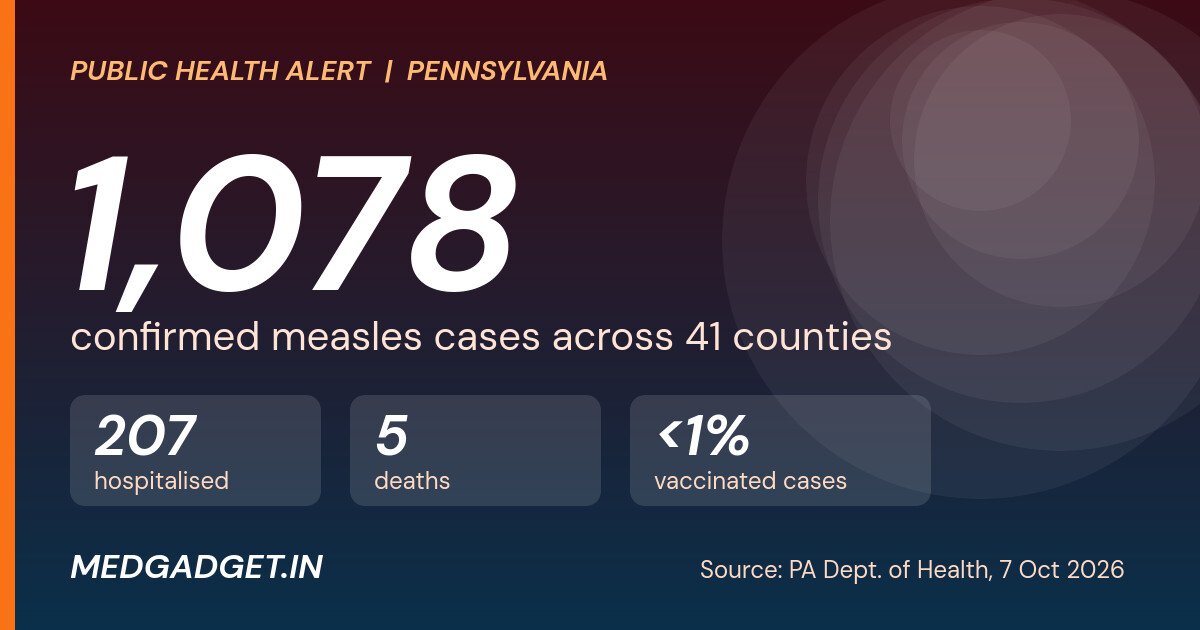
Pennsylvania’s measles outbreak has now reached 1,078 confirmed cases across 41 counties, with 207 people hospitalised and five measles-associated deaths, according to the Pennsylvania Department of Health update dated 7 October 2026. Only four of the cases, under 1%, were in vaccinated people.
The headline number grew by 74 in this update, but the department says the jump does not signal a fresh surge: more than 40 of those cases involve people who fell ill over two weeks ago, are no longer contagious, and were only recently reported and confirmed. That detail changes how the figure should be read.
The numbers at a glance
- 1,078 confirmed cases in 41 of Pennsylvania’s counties in 2026.
- 207 hospitalisations, which the department describes as nearly 20% of identified cases (our calculation: 207 of 1,078 is about 19.2%).
- 5 deaths associated with measles.
- 4 cases in vaccinated people, under 1% of the total.
- 74 cases added in the latest update, over 40 of them late-reported older illnesses.
How to read a 74-case jump
Case totals in an outbreak mix two different things: people who are sick now and people whose illness is only now being confirmed. The department’s own explanation is that this update leans toward the second group. That is reassuring about the current pace of spread, but it is not a sign that transmission has stopped.
For context, our earlier report at 977 cases across 39 counties published on 3 October. Comparing the two totals, the count has risen by 101 cases and by two counties in roughly five days. That is our own arithmetic across several reporting cycles, not a figure published by the state, and it again includes delayed confirmations.
Who is getting sick: the vaccination picture
The department reports just four cases among vaccinated people. Measles vaccine is highly effective but not perfect, and a small number of breakthrough infections is expected in any large outbreak. The overwhelming majority of cases are therefore in people who were unvaccinated or whose status is not documented. The department’s update does not break the cases down by age or name the new counties, so we cannot report those details.
Clinically, the picture is serious. The department notes that measles deaths occur in roughly 1 to 3 of every 1,000 cases in general. Five deaths among 1,078 cases is a higher rate than that range, which in our assessment reflects the severity of this outbreak and the spread of cases among people at higher risk. We note, however, that small counts make death rates unstable, and the state has not published a death-rate analysis.
What the state is doing
Since late April, state health centre staff have given more than 5,700 MMR shots at 198 pop-up clinics in affected communities, with dozens more scheduled. Department nurses have given nearly 9,000 MMR doses statewide this year across pop-up clinics and state health centres.
Statewide demand has moved too. Providers typically give about 25,000 MMR doses a month in Pennsylvania. Doses rose to more than 49,000 in August and more than 56,000 in September, which is more than double the usual pace. Vaccination takes time to translate into protection, so the effect on case counts would lag behind.
If you think you have been exposed
Early symptoms include fever, cough, a runny nose and red, watery eyes, followed by a rash that starts on the head and spreads downward. Symptoms can appear 7 to 21 days after exposure. People are typically contagious from four days before the rash appears to four days after, and the virus can stay infectious in the air and on surfaces for up to two hours.
Anyone who may have been exposed and has symptoms should call their healthcare provider before visiting, so that clinics can prevent further spread, or contact the department’s hotline at 877-PA-HEALTH (877-724-3258). Do not simply walk into a waiting room.
Who needs another MMR dose
- People with two documented MMR doses do not need another.
- Adults with only one documented dose, or no records, should speak to a provider or pharmacist.
- MMR is available through a healthcare provider, a county or municipal health department, a state health centre, a Federally Qualified Health Center, or the Vaccines for Children programme.
Why this matters beyond Pennsylvania
Measles spreads easily and quickly. A single case can infect most unprotected people who share its airspace, which is why local outbreaks of this size attract national attention. National totals and outbreak counts are tracked by the Centers for Disease Control and Prevention (CDC), and travellers and health systems elsewhere watch these updates closely. We have not independently verified any national figure for this article.
For readers following the wider story, see earlier coverage of measles-associated deaths in the state and our broader healthcare services coverage.
Frequently asked questions
How many measles cases are there in Pennsylvania?
The Pennsylvania Department of Health reported 1,078 confirmed cases in 41 counties as of its 7 October 2026 update, with 207 hospitalisations and five deaths.
Is the Pennsylvania measles outbreak getting worse?
The latest 74-case increase includes more than 40 older cases that were recently confirmed. The department says the update does not reflect a current surge, though new cases are still being reported.
Are vaccinated people getting measles in Pennsylvania?
Rarely. Four cases, under 1% of the total, were in vaccinated people.
What are the symptoms of measles?
Fever, cough, runny nose and red, watery eyes, followed by a rash that spreads from the head downward. Symptoms appear 7 to 21 days after exposure.
Where can I get the MMR vaccine in Pennsylvania?
From a healthcare provider, pharmacist, county or municipal health department, state health centre, Federally Qualified Health Center, or through the Vaccines for Children programme.
How we reported this: we used the Pennsylvania Department of Health’s published update and compared it with our earlier report. Age breakdowns, new county names and exposure sites were not in the release. Last updated: 8 October 2026. This article is news reporting and not medical advice; consult a healthcare professional about vaccination.