

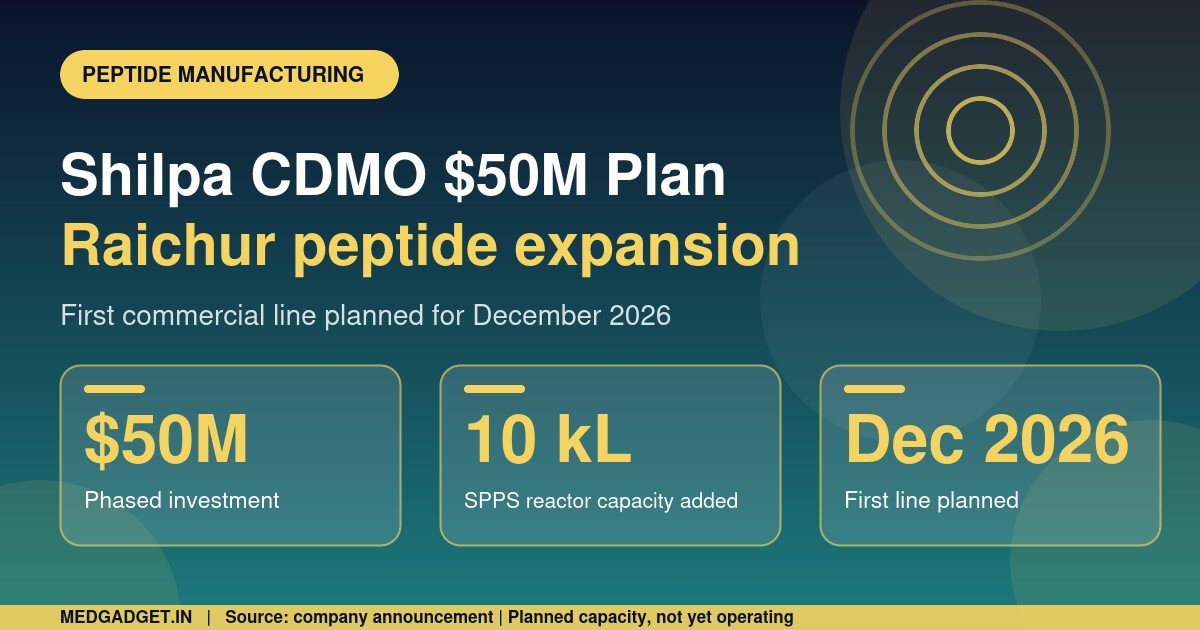
The Shilpa CDMO $50 million investment, announced in early November 2026, will fund a phased expansion of peptide manufacturing at the company’s Unit-I campus in Raichur, Karnataka. The first commercial line is planned to open in December 2026, with commercial supply ramping through 2027. That means the new capacity is not yet operating: the company describes a plan, and customers, volumes and later phases have not been named. This explainer sets out what is being built, why peptides matter and what remains unknown.
Key takeaways on the Shilpa CDMO $50 million investment
- Amount: $50 million, phased over several years, at the Raichur site in Karnataka.
- Timing: the first commercial line is planned to open in December 2026; commercial supply is expected to ramp through 2027. It is not operating yet.
- Capacity: 10 kL of added solid-phase peptide synthesis reactor capacity in total; the first line has 500-litre and 1,000-litre reactors with output of up to 1 metric tonne a year.
- End state: six parallel cGMP lines when complete, one dedicated to cytotoxic peptides; three clinical-phase lines already operate at the site.
- Focus: GLP-1 peptides and more complex molecules such as conjugates and radioligand peptides.
- No customers, programmes or committed volumes have been named.
What is a peptide, and why the demand?
Peptides are short chains of amino acids, the building blocks of proteins. Many medicines are peptides, including GLP-1 drugs used in diabetes and weight management, and newer classes are being developed for cancer and rare diseases. Making them at scale is a specialist chemical process that needs purification, quality control and containment, so drugmakers often rely on contract development and manufacturing organisations, or CDMOs, rather than building their own plants. Shilpa CDMO’s chief executive, Keshav Bhutada, said in the company’s release that peptides are becoming one of the most important areas of pharmaceutical development and that the opportunity extends beyond current GLP-1 demand.
What is being built
| Element | Detail |
|---|---|
| Location | Unit-I campus, Raichur, Karnataka |
| Investment | $50 million, phased over several years |
| First line | 500 L and 1,000 L reactors in one block; up to about 1 tonne a year |
| Added reactor capacity | 10 kL of solid-phase synthesis in total, with 2 kL, 3 kL and 5 kL reactors planned later |
| Purification (first line) | Two 2-metre dynamic axial compression columns, preparative HPLC, nanofiltration and a 1,000 L lyophiliser |
| Final configuration | Six parallel cGMP lines, one for cytotoxic peptides |
| Timing | First commercial line planned for December 2026; later reactors have no stated dates |
cGMP stands for current good manufacturing practice, the quality standard regulators expect for medicines; the US FDA explains the cGMP regulations on its website, and India’s regulator is the Central Drugs Standard Control Organisation.
Three ways to make a peptide
The company says it will offer solid-phase synthesis (SPPS), liquid-phase synthesis (LPPS) and a hybrid of the two. In SPPS, the chain is built step by step on a solid resin, which is efficient for shorter peptides. LPPS builds fragments in solution, which can suit larger volumes. Dipak Kalita, the company’s senior vice president of CDMO services, said that for longer peptides, a move from solid-phase synthesis to a hybrid fragment-based route can make sense as volumes grow. The release also lists linear, cyclic and branched peptides, and those with lipidation, conjugation and radioligand features.
What is not yet in place
The words planned and expected matter here. The first commercial line is due in December 2026, and the later reactors have no timeline. The company says it has more than 100 scientists and manufacturing specialists in peptides, including an R&D team of over 50. The claim that this will be one of India’s largest peptide capacities is the company’s own and was not independently verified.
Timeline
- October 2026: Shilpa CDMO launched as a brand for complex molecules at CPHI Milan, per a trade report.
- Early November 2026: $50 million peptide investment announced.
- December 2026: first commercial line planned to open.
- Through 2027: commercial supply expected to ramp.
- Later: additional reactors, with no dates given.
Market context: peptide synthesis and contract manufacturing
According to Acumen Research And Consulting, the global peptide synthesis market was USD 597.3 million in 2023 and is projected to reach USD 1,173.0 million by 2032, a compound annual growth rate of 7.9% for 2024 to 2032. North America accounted for about USD 226.9 million, roughly 38% by our calculation, Asia-Pacific is projected to grow at more than 8.6%, reagents and consumables held 47% and therapeutics about 69% of 2023 revenue.
The page is stamped as last updated in 2019, which conflicts with its 2023 base year, and its FAQ gives an older forecast of about USD 400 million by 2026 that contradicts the main figures. Some statements in the text look garbled. We treat the numbers as indicative.
For the wider sector, Acumen’s Pharmaceutical Contract Manufacturing Market report gives USD 135.6 billion in 2022 and USD 279.3 billion by 2032, a compound annual growth rate of 6.8% for 2023 to 2032, with North America over 38%. Compounding 6.8% for ten years gives about USD 262 billion by our calculation, and the page words the 2032 total as an increase. The page was last updated in March 2023.
Our analysis
In our assessment, the announcement is a credible but early step. The scale described, up to about one tonne a year from the first line, is meaningful for a CDMO entering commercial supply, and the mix of synthesis routes suits a market moving towards longer, more complex peptides. What decides success is not the equipment list but customers, regulatory inspections and delivery, none of which has been announced. The December 2026 date is a target, not a result.
What is not disclosed
- Customers, programmes or committed volumes for the new capacity.
- Timelines for reactors beyond the first line.
- Regulatory inspection status of the new line.
- Revenue or margin expectations.
Risks and caveats
- The commercial line is planned for December 2026 and is not operating.
- Capacity claims are the company’s own.
- Market statistics are dated and inconsistent.
- This article is news reporting and not investment advice.
What to watch next
- Confirmation that the first line has started operating.
- Announcement of customers or supply agreements.
- Regulatory inspections and approvals.
- Timelines for the additional reactors.
General background
For related coverage, see our reports on a biosimilar manufacturing deal and the Indian pharmaceutical market, and browse the Pharmaceutical section.
Questions readers are asking about the Shilpa CDMO $50 million investment
Is the new peptide line running?
No. The first commercial line is planned to open in December 2026.
Who are the customers?
None has been named.
Why are peptides in demand?
GLP-1 drugs and newer peptide classes for cancer and rare diseases need specialist manufacturing.
FAQ
What is SPPS?
Solid-phase peptide synthesis, building the chain on a solid resin.
What is a CDMO?
A contract development and manufacturing organisation that makes medicines for other companies.
What does cGMP mean?
Current good manufacturing practice, the quality standard for making medicines.
How we reported this: details come from Shilpa CDMO’s announcement in early November 2026 as reported in trade press; market figures are attributed to Acumen Research And Consulting. Last updated 4 November 2026. This is news reporting and not investment advice.