

The South Africa GLP-1 compounding regulations are being rewritten. The South African Pharmacy Council (SAPC), working with the medicines regulator SAHPRA, is developing updated minimum standards and guidelines for compounding, the preparation of medicines by pharmacies, with diabetes and weight-loss injections in the spotlight. SAPC Registrar and CEO Vincent Tlala spoke about the work at a roundtable on counterfeit medicines on 14 October 2026. What is on the table are proposed standards, not rules in force today.
This report sets out the process, the reported timetable, and the difference between what is proposed and what South African law already requires.
South Africa GLP-1 compounding regulations: key takeaways
- Who: the Pharmacy Council, with SAHPRA, which regulates medicines.
- What: updated minimum standards and guidelines meant to clarify what is and is not permissible in compounding.
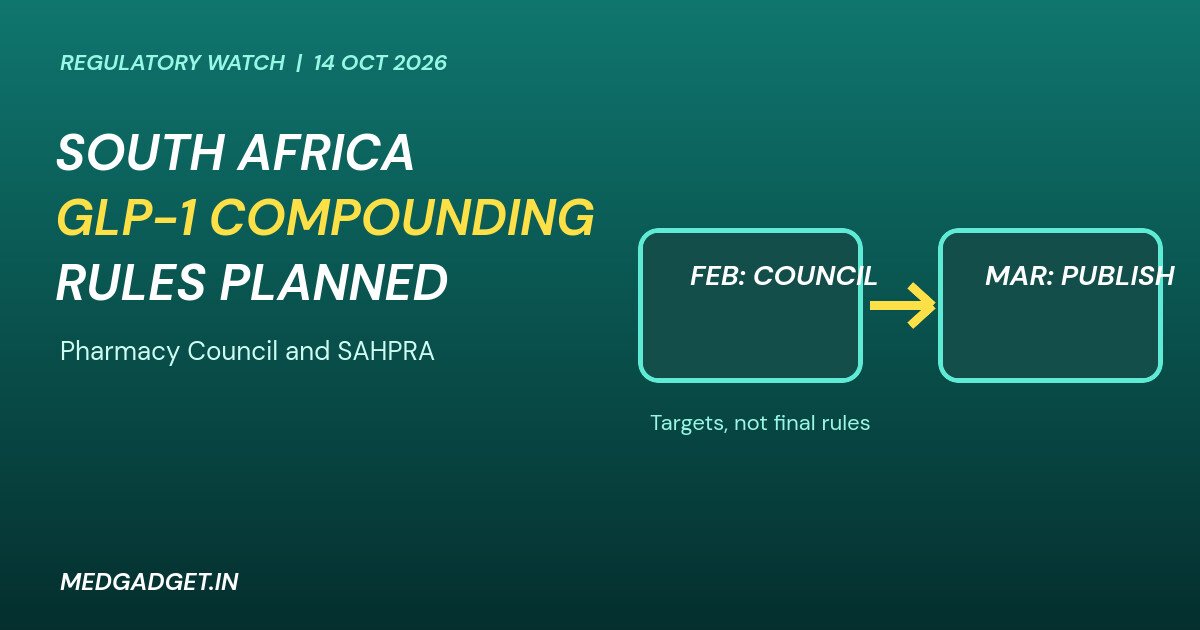
- When: council submission is expected in February and publication in March; the reported timetable gives months, not a year, so on the calendar that means 2027.
- Status: planned, not final. Nothing described here is yet binding.
- Today: compounding is limited to preparing medicines for individual patients on a valid prescription.
What regulators said about the South Africa GLP-1 compounding regulations on 14 October
At the roundtable, Tlala said the council is concerned that some pharmacies compound medicines in anticipation of demand rather than for specific patients. “What we are seeing in the market, and which we are against, is when pharmacies become small-scale manufacturers,” he said. Daphney Fafudi, SAHPRA’s senior manager for market control, said the updated guidelines and revised standards are intended to clarify what is and is not permissible, and she described a “scourge” of compounded products in the weight-loss area. Both officials were speaking about a work in progress, and neither is reported to have given the text of the draft.
How the South Africa GLP-1 compounding regulations are being drafted
Two bodies share the ground. The Pharmacy Council sets standards for pharmacy practice and pharmacists, while SAHPRA regulates medicines themselves, including registration. The reported plan is for the revised standards to go before the council in February and for publication in March, with updated SAHPRA guidelines issued at around the same time. We have not found draft text published for comment in the sources we reviewed, so the detail of the standards is not yet public. Until it is, any description of specific requirements would be guesswork.
South Africa GLP-1 compounding regulations versus existing law
The new work builds on existing law rather than starting from nothing. In a joint action announced on 26 May 2026, the regulators stated that compounding is limited to preparing medicines for individual patients under a valid prescription and cannot be used for large-scale manufacture, advertising or distribution of unregistered medicines, citing the Medicines and Related Substances Act 101 of 1965. SAHPRA’s earlier SAHPRA position statement of November 2024 said compounding with an active ingredient not found in a registered product is illegal under that Act. The officials’ remarks suggest the difficulty is not the absence of rules but differing interpretations of them, which have fed disputes in the industry, including court action involving the compounder iDexis and Novo Nordisk.
Why weight-loss injections are the focus
Demand for GLP-1 medicines, such as Novo Nordisk’s Ozempic and Wegovy and Eli Lilly’s Mounjaro and Zepbound, has driven the growth of compounded versions, and regulators in many countries are watching the trend. South African authorities worry that large-scale compounding could open the door to counterfeit medicines in a high-demand category. In its November 2024 statement, SAHPRA said Ozempic was registered for type 2 diabetes and not for weight management, and that Mounjaro had not been placed on the South African market through its manufacturer’s channels and was not registered for weight management. That was the position at the time; registration status can change, so readers should check SAHPRA’s current register.
Enforcement behind the South Africa GLP-1 compounding regulations
The standards follow visible enforcement. SAHPRA and the Pharmacy Council carried out a joint inspection at iDexis (Pty) Ltd, trading as Sentra Pharmacy, in Silverton, Pretoria, according to the South African Government News Agency account of 26 May 2026. The regulators said the site appeared to make and supply semaglutide, tirzepatide and combination products for broader commercial distribution under the label of compounding, and cited illegal importation of ingredients, no analytical testing for identity, potency or purity, and unsuitable sterile conditions. Products were seized and a recall was ordered. The SAHPRA statement on unlawful GLP-1 manufacturing also referred to reports of adverse events, including hospitalisations. These are the regulators’ findings; the company’s response is not covered here.
What the South Africa GLP-1 compounding regulations could mean for pharmacies and patients
For pharmacies, the stated aim points to a firmer line between preparing a medicine for a named patient and making stock in advance. For patients, the rules as they stand already tie compounding to a prescription for an individual. Because the draft standards are not public, we do not predict what documentation, testing or facility requirements they will contain, and we do not suggest any change to anyone’s treatment.
Risks and caveats on the South Africa GLP-1 compounding regulations
- The content of the standards has not been published, so their scope is unknown.
- February and March are reported targets, and the year is our reading of the calendar.
- Quotes come from remarks at a roundtable and may be refined in the final documents.
- This is news reporting, not legal advice for pharmacies or patients.
In our assessment, the South Africa GLP-1 compounding regulations are best read as a clarification exercise backed by enforcement, not as a ban on compounding; the real test will be how precisely the final text separates patient-specific work from anticipatory production. See also Testosterone Prescriptions for Women Are Surging — So Are Pharmacy Denials and Delays for another compounding story. More in our pharmaceutical coverage.
What to watch next for South Africa GLP-1 compounding regulations
- Submission of the standards to the council, targeted for February.
- Publication, targeted for March, and the updated SAHPRA guidelines.
- Any public consultation or draft text.
- Further inspections, recalls or disciplinary action.
Frequently asked questions
What are the South Africa GLP-1 compounding regulations?
Updated minimum standards and guidelines being developed by the Pharmacy Council and SAHPRA for compounding, including of GLP-1 medicines.
Are they already in force?
No. They are planned, with council submission expected in February and publication in March.
Is compounding illegal in South Africa?
No, but regulators say it is limited to preparing medicines for individual patients on a valid prescription.
Who is leading the work?
The South African Pharmacy Council, working with SAHPRA.
How we reported this: we relied on the regulators’ statements and remarks made at the 14 October 2026 roundtable. The 2027 year is our inference. Last updated: 16 October 2026. This article is news reporting and not legal or medical advice.