

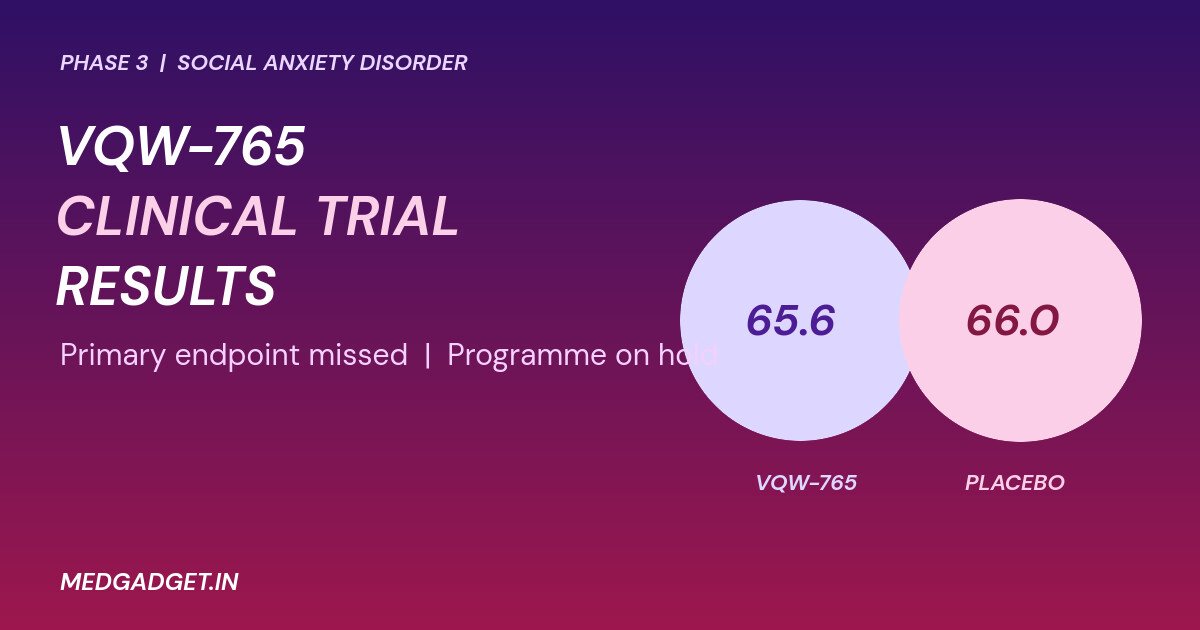
The VQW-765 clinical trial results are in, and they are negative. On 14 October 2026, Vanda Pharmaceuticals said that its Phase 3 study of VQW-765 in adults with social anxiety disorder did not meet its primary endpoint, and that a key secondary endpoint in the full study population was also missed. The company said the drug was safe and well tolerated, consistent with earlier studies, and has put the development programme on hold while it analyses the full dataset. The result says nothing about whether existing treatments for social anxiety work; it concerns one experimental drug.
Here is what the trial tested, what the numbers show, what the company has and has not said, and what the result does and does not mean.
VQW-765 clinical trial results: key takeaways
- Outcome: the Phase 3 study missed its primary endpoint and a key secondary endpoint.
- Size: 546 adults at about 30 sites in the United States.
- Design: a single oral dose of VQW-765 or placebo, followed by a public-speaking stress test.
- Safety: the company says the drug was safe and well tolerated.
- Status: the programme is on hold pending review of the full dataset.
What the study behind the VQW-765 clinical trial results tested
Study 3201 (NCT07221578) was a multicentre, randomised, double-blind, placebo-controlled Phase 3 trial of on-demand treatment for acute anxiety in adults with social anxiety disorder. It enrolled 546 adults aged 18 to 65 with elevated baseline scores on the Liebowitz Social Anxiety Scale and the Public Speaking Anxiety Scale. Participants received a single oral dose of VQW-765 or placebo, randomised one to one, and then took the Trier Social Stress Test, in which a person prepares for and delivers an interview-style presentation to a non-responsive panel. By our arithmetic, an even split would mean about 273 people per arm, though the company does not give arm sizes.
Why a public-speaking test shaped the VQW-765 clinical trial results
Social anxiety is hard to measure in a laboratory, so researchers use a standard stressor. The Trier Social Stress Test creates a repeatable, mildly stressful situation, which lets investigators compare drug and placebo groups under the same conditions. The limitation is that a one-off test measures acute distress at a single moment, not how a person fares over weeks of daily life, which is one reason the result should be read as a verdict on this particular design.
The numbers behind the VQW-765 clinical trial results
The primary endpoint measured distress on a 0 to 100 scale during the performance phase of the stress test in female participants. VQW-765 scored 65.6 against 66.0 for placebo, a difference of minus 0.4 points (95 percent confidence interval minus 5.32 to 4.62; p = 0.8899). In the full population of men and women, the key secondary endpoint showed 64.7 for VQW-765 and 63.8 for placebo, a difference of 0.9 points (confidence interval minus 3.00 to 4.73; p = 0.6605). By our arithmetic, the primary difference is about 0.6 percent of the placebo score. In plain terms, the two groups looked almost the same.
Why Phase 2 looked better than the VQW-765 clinical trial results
The company says an earlier Phase 2 study in people with performance anxiety showed numerically lower stress during the same type of stress test with VQW-765 than with placebo, and it was reported in the published Phase II study in the British Journal of Psychiatry. Study 3201 was designed to confirm those findings, and it did not. Chief executive Mihael Polymeropoulos said the company was “disappointed that Study 3201 did not confirm the earlier Phase II findings.” A promising early signal that does not hold in a larger trial is a common pattern in drug development.
What VQW-765 is
VQW-765 is a small-molecule partial agonist of the alpha-7 nicotinic acetylcholine receptor, a protein found on nerve cells. The company says it binds with much higher affinity than nicotine and is potent and specific for the receptor. It was formerly known as AQW-051 and is licensed to Vanda from Novartis. It was being studied as a single-dose, on-demand treatment taken before a stressful event, rather than a daily medicine.
What the VQW-765 clinical trial results mean for people with social anxiety
Nothing changes for patients today, because VQW-765 was never an approved treatment. Social anxiety disorder is common: the National Institute of Mental Health reports that 7.1 percent of US adults had it in the past year and 12.1 percent at some point in life, based on data collected in 2001 to 2003. The Phase 3 result does not mean the existing treatments are ineffective. Anyone struggling with social anxiety should speak to a health professional about the options already available.
What the company has not said about the VQW-765 clinical trial results
- It has not published the full dataset or said why Phase 3 differed from Phase 2.
- It has not said whether any subgroup or secondary measure showed a benefit.
- It has not given detailed safety data beyond a general statement.
- It has not said whether the programme will resume or end.
Risks and caveats on the VQW-765 clinical trial results
- The figures come from the company’s release, not from a peer-reviewed paper.
- A negative primary endpoint in one design does not rule out every use of the drug, but the company has paused the programme.
- Our percentage and per-arm figures are our own arithmetic.
- The prevalence statistics are from older survey data.
In our assessment, the most important point is how clean the miss was: the groups were almost identical on the primary measure, which makes a statistical rescue look unlikely, although the company’s full review may add detail. See also Rasonque EMA Recommendation: Promising Survival Gains. More pharmaceutical coverage is in our pharmaceutical section.
What to watch next on the VQW-765 clinical trial results
- The company’s review of the full Study 3201 dataset.
- Any decision to resume, redesign or end the VQW-765 programme.
- Presentation or publication of the detailed results.
- Regulatory or trial-registry updates.
Frequently asked questions
Did the VQW-765 Phase 3 trial succeed?
No. It missed its primary endpoint and a key secondary endpoint, according to Vanda.
Was VQW-765 safe?
The company says it was safe and well tolerated, consistent with earlier studies.
Is the programme cancelled?
No. It is on hold while the full dataset is reviewed.
Does this mean social anxiety treatments do not work?
No. The result concerns one experimental drug only.
How we reported this: we relied on Vanda’s release of 14 October 2026, the trial registry entry and NIMH statistics. Percentages and per-arm figures labelled as ours are our own arithmetic. Last updated: 16 October 2026. This article is news reporting and not medical advice.