

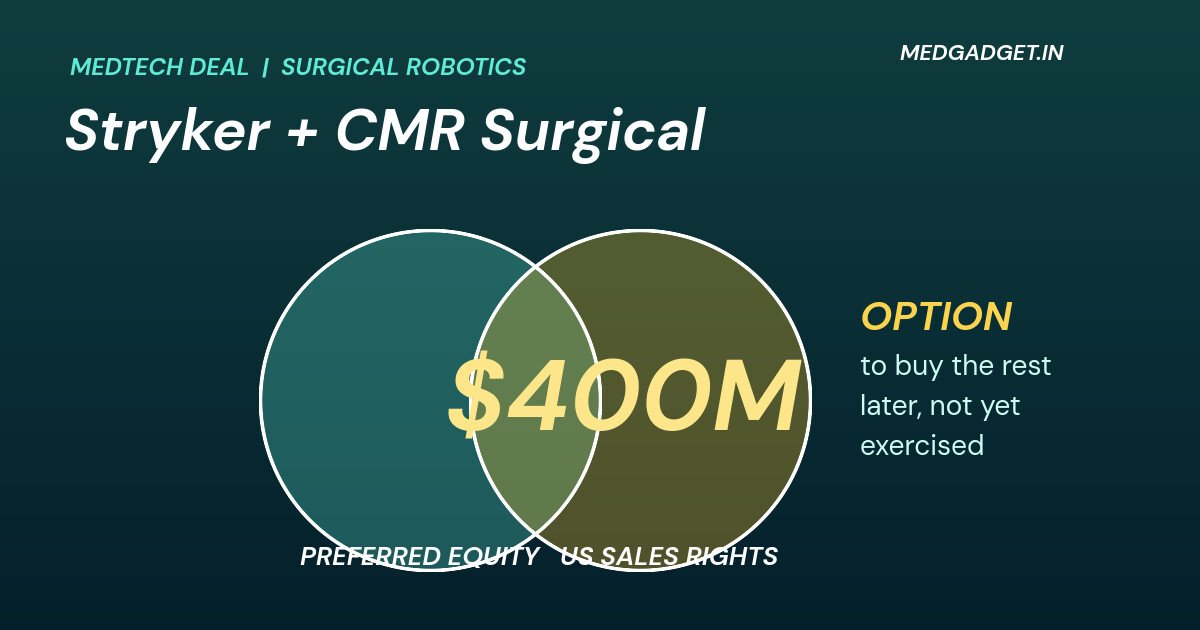
The Stryker CMR Surgical investment is a large bet on soft-tissue robotics, but it is not an acquisition. On 12 October 2026, Stryker and CMR Surgical announced a strategic alliance in which Stryker will put about $400 million (roughly £300 million) into CMR as preferred equity, act as the exclusive US sales agent for CMR’s Versius surgical robots, and hold an exclusive option to buy the rest of the company at a later date.
CMR, founded in 2014 and based in Cambridge, England, stays a separate private company for now and keeps leading development and sales outside the United States. For Stryker, best known for its Mako robot in joint replacement, the Stryker CMR Surgical investment is a way into operating rooms where it has little robotic presence today. This report sets out what was agreed, what the numbers suggest, and what neither company has disclosed.
Stryker CMR Surgical investment: the deal in brief
- Money in: an approximately $400 million preferred equity investment, which the companies say will support innovation and global commercialisation of the Versius portfolio.
- Selling rights: Stryker becomes the exclusive US sales agent for Versius under a commercial agency agreement.
- Buy-out option: Stryker gets an exclusive option to acquire all of CMR’s outstanding equity in future, on terms set out in the agreement.
- Outside the US: CMR continues to lead development and commercialisation.
- Board seat: CMR’s chief executive, Massimiliano Colella, said Stryker’s Andy Pierce, group president for MedSurg and Neurotechnology, will join CMR’s board.
- Conditions: the investment is subject to customary closing conditions, and any later acquisition would need regulatory approvals.
The Stryker CMR Surgical investment is an alliance, not a takeover
Headlines about the deal can blur an important line. Today, Stryker is buying preferred shares and sales rights, not the company. Preferred equity usually carries priority over ordinary shares in a payout, though the specific terms here, such as dividends, conversion or redemption rights, were not disclosed. The option is just that: a right, not an obligation, and no price, window or valuation was published.
In our assessment, the structure of the Stryker CMR Surgical investment lets Stryker test the product, the customers and the commercial fit in the US before committing to a full purchase. It also gives CMR a well-funded backer without a forced sale. Both sides can walk the path in stages, which is a common pattern when a large device maker wants a new technology without taking on all the integration risk at once.
Why soft-tissue robotics drives the Stryker CMR Surgical investment
Stryker’s robotic strength lies in bone. According to 2025 US market figures from the research firm GlobalData, Stryker led orthopaedic robotic systems with a 75.5% share, well ahead of Zimmer Biomet at 10.4%. Across all robotic surgical systems in the US, the same data put Intuitive first at 48.8% with Stryker second at 19.5%, and gave Intuitive 80.6% of general surgery robots. Those figures are third-party estimates, not company statements.
Read together, they show the gap. Stryker is already a major name in surgical robotics because of orthopaedics, yet general surgery, where gallbladder, hernia, colorectal and many urology procedures are done, is dominated by one competitor. Stryker says soft-tissue robotics is a high-growth area that complements its endoscopy, visualisation and enabling-technology businesses, and Pierce called the move a “thoughtful and disciplined entry”.
What is known about the Versius system
Versius is CMR’s modular robot, built so that separate arm carts can be placed around the patient and used in existing operating rooms. The companies describe the second-generation system as supporting a broad range of soft-tissue procedures in hospitals and ambulatory surgery centres. The release names the product as Versius Plus.
On regulation, the press release itself gives no US clearance status. Public reports say Versius was first approved in Europe in 2019 and is now authorised in several Asia-Pacific and Americas markets, and that Versius Plus received FDA clearance in December 2025 for gallbladder removal, with other markets clearing it for colorectal and urologic work. We could not confirm the US clearance scope from the companies’ own statement, so readers should check the FDA 510(k) database before relying on it.
What the Stryker CMR Surgical investment leaves undisclosed
- The percentage of CMR that $400 million buys, and the company’s valuation.
- The price, timing and conditions of Stryker’s buy-out option.
- Preferred equity terms such as dividends, conversion and redemption.
- Which regulatory approvals are needed, and the expected closing date.
- The number of Versius systems installed worldwide.
- The effect on Stryker’s earnings guidance.
Competition: how the Stryker CMR Surgical investment shifts pressure
The immediate effect is on the companies already selling soft-tissue robots. Intuitive’s da Vinci remains the benchmark, and we have covered how it is expanding, including the da Vinci 5 launch in India. Medtronic and Johnson & Johnson are also developing or selling their own systems. A Stryker sales force pushing Versius into US hospitals adds a well-resourced challenger, and hospital buyers who already use Stryker for endoscopy and orthopaedics may hear a bundled pitch.
Still, a new entrant has to win surgeons one case at a time. Training, instrument availability and clinical evidence matter as much as the sales team, and CMR is a relatively late arrival to the US. In our assessment, the real test will be how many US hospitals sign for Versius in the first year after the agreement takes effect. For leadership context at the buyer, see our report on the Stryker chief executive succession.
Our assessment: what to watch after the Stryker CMR Surgical investment
For hospital purchasing teams, nothing changes immediately: closing is still pending, and Versius is sold today through CMR’s existing channels. For investors, the filings are the place to look for the option terms, which may appear in documents on the SEC’s EDGAR system. Similar medtech deal-making is covered across our medical device coverage, including the recent STERIS acquisition of Xodus Medical.
- Closing of the $400 million investment.
- Any disclosure of the option’s price or exercise window.
- FDA clearances that widen Versius Plus beyond its first indication.
- Early US hospital placements once Stryker begins selling.
- Responses from competing robot makers.
Frequently asked questions
Is the Stryker CMR Surgical investment an acquisition?
No. Stryker is investing about $400 million in preferred equity and has an option to buy the rest of CMR later. The option has not been exercised.
What will Stryker sell?
Stryker will be the exclusive US sales agent for the Versius robotic surgery portfolio.
Who sells Versius outside the United States?
CMR Surgical continues to lead development and commercialisation outside the US.
How much is the Stryker CMR Surgical investment worth?
About $400 million, or roughly £300 million, according to the announcement.
When will the deal close?
No date was given. The companies say the investment is subject to customary closing conditions.
How we reported this: we relied on the companies’ joint announcement of 12 October 2026 and on public reporting of Versius regulatory status and US market share. Figures labelled as ours are our own assessment. Last updated: 13 October 2026. This article is news reporting and not investment or medical advice.