

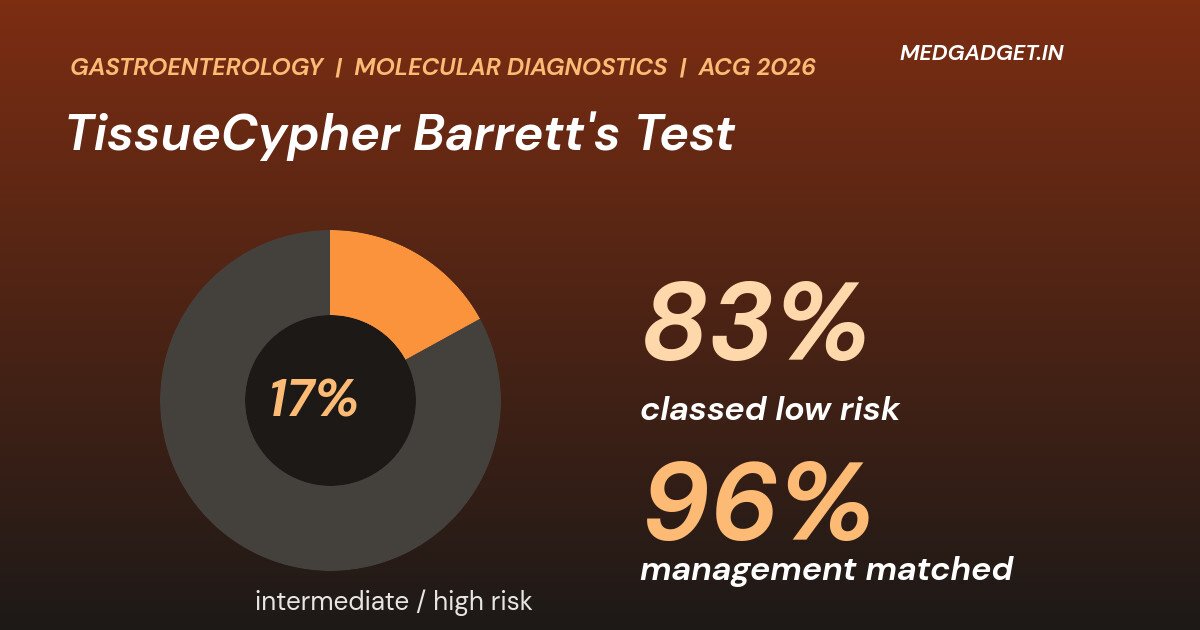
New data on the TissueCypher Barrett’s esophagus test suggest that a molecular read of a routine biopsy can change how doctors plan surveillance. Castle Biosciences presented three studies at the American College of Gastroenterology (ACG) 2026 meeting in Nashville, the most notable a multicenter cohort in which the test placed 83% of patients in a low-risk group and 17% in an intermediate or high-risk group, and clinicians’ management recommendations moved in line with that risk class for 96% of patients. The results come from a company press release and conference presentations, and they describe what doctors recommended, not whether patients lived longer or avoided cancer.
That distinction is the heart of this story. Below we explain what the test does, go through each of the three studies, put the 83% and 96% figures in context, and set out what the research cannot show.
What the TissueCypher Barrett’s esophagus test does
Barrett’s esophagus is a change in the lining of the lower oesophagus, linked to long-standing reflux, that raises the risk of oesophageal adenocarcinoma. Most people with it never develop cancer, which makes it hard to decide who needs closer watching. Today that decision leans heavily on a pathologist’s reading of biopsies, which can be graded as non-dysplastic, indefinite for dysplasia, low-grade dysplasia or high-grade dysplasia (HGD).
According to Castle, TissueCypher analyses protein biomarkers and tissue architecture in routine endoscopic pinch biopsies, using an AI-derived approach it calls spatialomics, to estimate a patient’s five-year probability of progressing to HGD or oesophageal cancer. The company says it is for patients with non-dysplastic Barrett’s, indefinite for dysplasia or low-grade dysplasia. These descriptions are the company’s own, as is its statement that the test is backed by more than 17 peer-reviewed publications covering over 8,000 patients.
The three studies behind the TissueCypher Barrett’s esophagus test
- Multicenter cohort (Emory University, poster P5192): compared TissueCypher with the Progression in Barrett’s (PIB) score, which uses clinical and pathology factors.
- Case report 1 (University of Kansas, P3056): a patient with non-dysplastic disease received a 62% five-year progression risk; repeat endoscopy six months later found high-grade dysplasia that had been missed, and the patient had radiofrequency ablation.
- Case report 2 (Emory, P5296): a patient with conflicting biopsy reads had an indefinite-for-dysplasia sample rated high risk, at a 47% five-year probability; radiofrequency ablation two months later found HGD, and later biopsies showed complete eradication of the intestinal metaplasia.
Reading the TissueCypher Barrett’s esophagus test cohort numbers
The headline pair, 83% low risk and 17% intermediate or high risk, needs a comparison to mean much. The same cohort was also scored with PIB, which placed only 31% of patients in the low-risk group and 69% in the intermediate or high-risk group. The two methods showed only slight agreement, with a Cohen’s kappa of 0.04, a statistic where 0 means agreement no better than chance. By our reading, the tests are sorting patients very differently, so at least one of them is misclassifying many people, and this study cannot say which.
The 96% figure counts patients whose management recommendation moved in a way consistent with the TissueCypher result. The release says five-year surveillance was recommended for 38 patients and endoscopic eradication therapy for eight, five of whom had no dysplasia on biopsy. The cohort’s total size was not given in the summaries we reviewed, so we cannot say how many patients 96% represents. Those two groups alone add up to 46 patients, which is our own sum and not a reported cohort size.
TissueCypher Barrett’s esophagus test: changed management is not better outcomes
The company’s own wording is cautious: the findings suggest that molecular risk assessment may provide information beyond conventional biopsy evaluation. A recommendation to survey a patient less often, or to treat earlier, is only a decision. To show benefit, a study would need to follow patients for years and show fewer cancers, fewer unnecessary procedures or earlier treatment that improves survival. This research did not do that.
The two case reports are illustrations. In each, the test flagged high risk and later endoscopy found HGD, which is the result clinicians would hope for. But single stories cannot show how often the test is right, how often it raises false alarms, or what happens to the majority of patients it calls low risk. In the low-risk group, the question is whether the longer surveillance interval is safe, and only follow-up data can answer that.
Limits of the evidence for the TissueCypher Barrett’s esophagus test
- The studies were presented as conference posters, and the release does not say whether they were peer reviewed.
- Two of three are single-patient case reports.
- The cohort report gives recommendations, not documented patient outcomes.
- The cohort’s size and design were not described in the summaries we reviewed.
- The source is the test’s manufacturer, and its release carries standard warnings that later studies may not confirm the findings.
Where the TissueCypher Barrett’s esophagus test fits in precision diagnostics
Tests that read tissue to estimate individual risk are part of a wider move towards precision diagnostics. A related example in our archive is the Lunit and Discovery Life Sciences partnership on AI-assisted pathology, and for broader cancer context see our report on gastrointestinal cancer in young people in India. Readers can find background on the condition from the US National Institute of Diabetes and Digestive and Kidney Diseases, and more device and diagnostics news in our medical device section.
Our assessment of the TissueCypher Barrett’s esophagus test
In our assessment, the data are interesting but preliminary. The big gap between TissueCypher and PIB shows that how a patient is sorted depends heavily on the tool, and the case reports show the test can flag patients whose pathology looked reassuring. Even so, the evidence that matters, long-term outcomes in a defined group managed with and without the test, is not in this release. Doctors and patients should treat it as a signal and discuss it with a gastroenterologist.
What to watch next on the TissueCypher Barrett’s esophagus test
- Publication of the cohort in a peer-reviewed journal, with full size and design.
- Outcome data showing what happened to patients in each risk class.
- How guideline bodies respond to molecular risk tools.
- Company disclosures through the SEC EDGAR system.
Frequently asked questions
What does the TissueCypher Barrett’s esophagus test measure?
It analyses protein biomarkers and tissue architecture in biopsy samples to estimate a five-year probability of progression to high-grade dysplasia or oesophageal cancer.
What did the new TissueCypher Barrett’s esophagus test study find?
The test classed 83% of patients as low risk and 17% as intermediate or high risk, and management recommendations followed the risk class for 96% of patients.
Does the TissueCypher Barrett’s esophagus test study prove improved survival?
No. It measured changes in recommendations, not cancer outcomes.
Who presented the data?
Castle Biosciences, with investigators from Emory University and the University of Kansas, at the 2026 ACG annual meeting.
How we reported this: we relied on the company’s press release of 12 October 2026 and summaries of it. We did not see the posters themselves. Figures labelled as ours are our own sums. Last updated: 13 October 2026. This article is news reporting and not medical advice.