

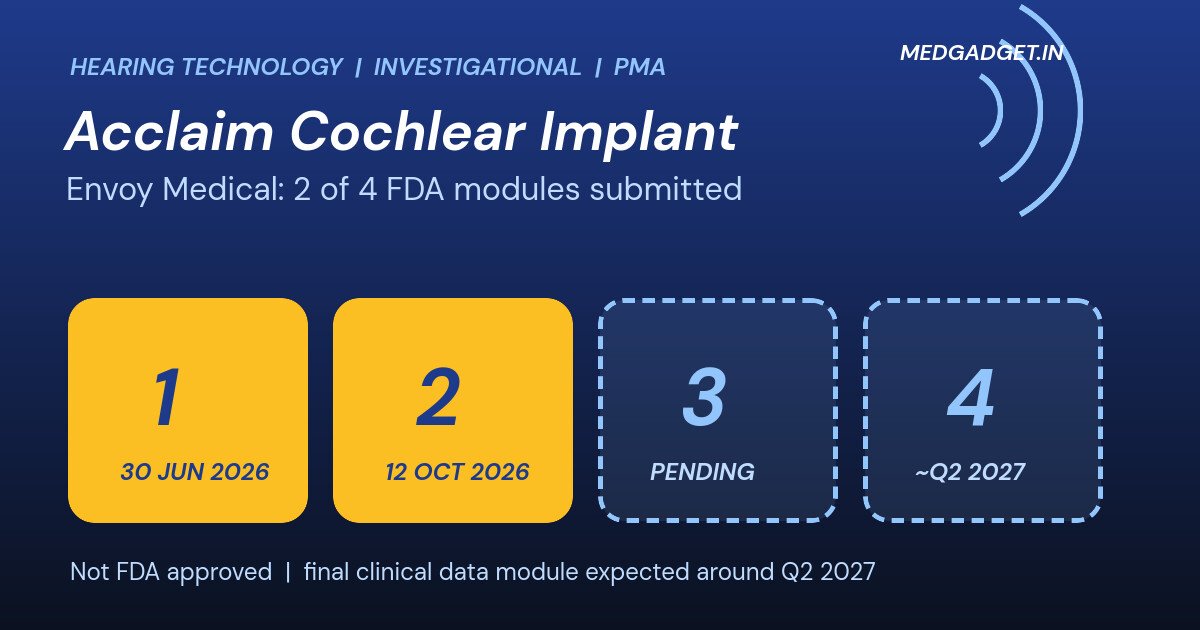
The Envoy Medical Acclaim cochlear implant has moved one step further through US regulatory review, but it is still a long way from the market. On 12 October 2026, Envoy Medical said it had submitted the second of four planned modules of its premarket approval (PMA) application to the FDA. The new module mainly contains engineering information, and the company expects to finish its remaining submissions, including final clinical trial data, around the second quarter of 2027. The device is investigational and has not received FDA marketing approval.
For readers who follow hearing technology, the milestone matters because Acclaim is designed to be fully implanted, with no externally worn parts. This report explains what was filed, how a modular application works, what the company has and has not said about the device and its trial, and what could still go wrong.
Envoy Medical Acclaim cochlear implant: what was filed
- Submission: module 2 of 4 in a modular premarket approval application.
- Content: mainly engineering information.
- First module: submitted on 30 June 2026.
- Remaining work: two more modules, the last of which will include final clinical trial data and complete the application. The company targets that final clinical submission around the second quarter of 2027.
- Intended use: adults with severe to profound sensorineural hearing loss who are not adequately helped by hearing aids and are judged suitable by a physician.
- Status: investigational; limited by US law to investigational use.
How the Envoy Medical Acclaim cochlear implant’s modular PMA works
Premarket approval is the FDA’s most demanding route for high-risk devices, where the company must show reasonable assurance of safety and effectiveness. A modular, or rolling, application lets a company send finished sections to the agency in stages instead of waiting to assemble one large package. According to the company, this lets the FDA review submitted sections while clinical data collection continues, and gives Envoy chances to get feedback before the last piece arrives.
Two cautions apply. First, sending a module is not the same as the FDA accepting the full application or approving the device. Second, the clock that matters starts once the application is complete. Federal law sets a 180-day review target for PMAs, though real timelines are often longer, and Envoy has not offered an approval date. In our assessment, any launch before 2028 would depend on an unusually smooth review.
Why the Envoy Medical Acclaim cochlear implant is a big engineering task
A conventional cochlear implant has an internal electrode and receiver plus an external processor worn on the head, which picks up sound and sends it through the skin. Acclaim aims to remove the external parts. Envoy says the system uses a sensor designed to work with the ear’s natural anatomy instead of a microphone to capture sound. Its announcement did not describe where the sensor sits, how the device is powered or how it is recharged, so those points cannot yet be assessed.
That is why an engineering module is meaningful. Hermetic sealing, long-term power, biocompatibility and the reliability of electronics that sit inside the body for years are all reviewed as engineering questions, separate from whether patients hear better. The general background on how today’s cochlear implants work is available from the US National Institute on Deafness and Other Communication Disorders.
What Breakthrough designation means for the Envoy Medical Acclaim cochlear implant
The FDA granted Acclaim Breakthrough Device Designation in 2019. Under the agency’s Breakthrough Devices Program, designated devices receive more interactive communication with reviewers and prioritised review, but they still have to meet the same legal standard as any other PMA device. Designation does not mean approval is likely, and it does not shorten the evidence the FDA requires. We make the same point in our coverage of the FDA clearance for the MT027 CAR-T trial, where permission to study a product is also not permission to sell it.
The Envoy Medical Acclaim cochlear implant pivotal trial: what is known
Acclaim is being studied in a US-based pivotal trial, and its data will form the final module. The announcement we reviewed did not give enrolment numbers, endpoints or interim results. Until those appear, there is no basis for judging whether the device improves speech understanding or how long it works. Readers should treat clinical performance as unknown. For hearing rehabilitation, studies of this kind usually measure speech understanding in quiet and in noise, but the company has not said which measures this trial uses, so that is general background and not a description of the study.
Envoy Medical Acclaim cochlear implant: the company behind it
Envoy is listed on Nasdaq under the ticker COCH. It also sells the Esteem fully implanted active middle ear implant, approved by the FDA for adults with moderate to severe sensorineural hearing loss and available in the US since 2010. That track record shows the company has been through FDA review before, though Esteem and Acclaim are different devices treating different degrees of hearing loss.
The company’s own forward-looking statements flag risks that are common at this stage: the timing may not be met, FDA decisions are unpredictable, and it may need more capital to finish the pivotal trial and commercialise the device. For other device stories with regulatory twists, see our reports on the FDA safety alert on Philips Lumify ultrasound and our wider medical device coverage.
Our assessment
In our assessment, the second module is a procedural milestone, not a clinical one. It shows the company is keeping to the schedule it set after the June submission, but it tells readers little about whether the Envoy Medical Acclaim cochlear implant works. The meaningful tests are the trial data and the FDA’s response to the engineering file. If the trial reports well and the FDA accepts the engineering information, Acclaim would join a small group of fully implanted hearing devices; if not, the timetable could slip, as the company’s own disclosures warn.
What to watch next for the Envoy Medical Acclaim cochlear implant
- Module 3 and the timing the company gives for it.
- Public details of the pivotal trial, including endpoints and enrolment.
- Any FDA questions or feedback that the company discloses.
- The final clinical module, targeted around the second quarter of 2027.
- Funding news, since the company says it may need more capital.
Frequently asked questions
Is the Envoy Medical Acclaim cochlear implant FDA approved?
No. It is investigational and limited by US law to investigational use.
What did Envoy submit on 12 October 2026?
The second of four planned modules of its modular PMA application, mainly covering engineering information.
When will the application be complete?
The company expects to finish the remaining submissions, including final clinical data, around the second quarter of 2027.
Who is the Envoy Medical Acclaim cochlear implant for?
Adults with severe to profound sensorineural hearing loss that hearing aids do not adequately address.
Does the Breakthrough designation guarantee approval?
No. It speeds communication with the FDA but does not change the standard for approval.
How we reported this: we relied on the company’s announcement of 12 October 2026 and on public summaries of it. We did not read the PMA itself, which is not public. Figures labelled as ours are our own assessment. Last updated: 13 October 2026. This article is news reporting and not medical advice.