

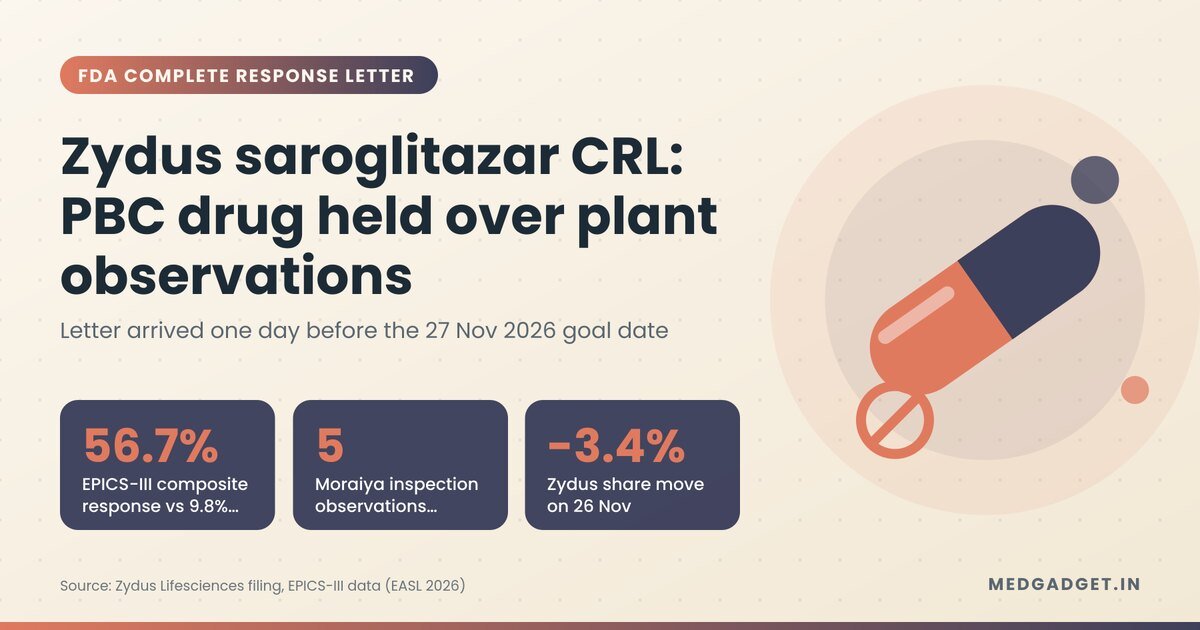
Zydus saroglitazar CRL news broke on 26 November 2026, one day before the drug’s US decision date: Zydus Lifesciences said its US subsidiary, Zydus Therapeutics, received a Complete Response Letter from the US Food and Drug Administration for saroglitazar magnesium in primary biliary cholangitis (PBC). The company tied the letter to the FDA’s ongoing review of its fix for observations raised at an October 2026 inspection of its Moraiya plant near Ahmedabad, not to the trial data. Shares fell 3.4% to ₹1,194.20 on 26 November.
Key takeaways on Zydus saroglitazar CRL
- The FDA issued a Complete Response Letter for the saroglitazar NDA ahead of its 27 November 2026 priority review goal date.
- Zydus links the letter to unresolved observations from an October 2026 inspection of its Moraiya facility, which it says it is addressing.
- In the EPICS-III trial, 56.7% of patients on saroglitazar 1 mg hit the composite biochemical response at week 52, against 9.8% on placebo.
- The company had planned a US launch by March 2027; that timeline now depends on how fast the plant issues are closed.
- Two other Zydus sites, the Ankleshwar API Unit-2 and SEZ II in Ahmedabad, received Establishment Inspection Reports in the same disclosure.
What the FDA letter actually says, and what it does not
A Complete Response Letter means the FDA cannot approve an application in its current form. It is not a final rejection. In its stock exchange filing, Zydus said the letter relates to the regulator’s ongoing assessment of the company’s resolution plan for the Moraiya observations, and that it will work with the agency on the actions needed to keep the review moving.
Indian press reports put the number of observations from the October inspection at five. Zydus has not said publicly that the FDA raised any concerns about efficacy or safety data, and the letter itself has not been published, so that point rests on the company’s description. Readers should treat “manufacturing only” as the company’s framing until more detail emerges.
Manufacturing-linked CRLs have become a familiar hurdle for Indian drugmakers. FDA unannounced inspections of Indian sites rose sharply this year, and a CRL caused by a facility problem can stall even a well-supported application. For context on the agency’s tougher stance, see our coverage of the latest drug approval decisions.
EPICS-III results behind the application
The NDA rested on EPICS-III (NCT05133336), a seamless Phase 2b/3, double-blind, placebo-controlled study in adults with PBC who had not responded well enough to, or could not tolerate, ursodeoxycholic acid (UDCA). After dose selection, patients were randomised 2:1 to saroglitazar magnesium 1 mg once daily or placebo, with 149 patients randomised according to Zydus. The primary endpoint was a composite biochemical response at week 52: alkaline phosphatase (ALP) below 1.67 times the upper limit of normal, at least a 15% ALP drop, and normal total bilirubin.
| Measure (week 52 unless stated) | Saroglitazar 1 mg | Placebo |
|---|---|---|
| Composite biochemical response | 56.7% | 9.8% |
| ALP normalisation | 8.2% | 0% |
| Change in ALP from baseline | -33.5% | +6.5% |
| 5-D Itch score change, week 24 | -5.9 | -2.7 |
| 5-D Itch score change, week 52 | -4.6 | -4.4 |
| Serious adverse events | 6.3% | 11.1% |
By our calculation, the raw gap in composite response is 46.9 percentage points; Zydus has reported a treatment difference of 48.5 points, which likely reflects statistical adjustment. Both figures point the same way, with p<0.001. The itch benefit was significant at week 24 but had faded by week 52, and full ALP normalisation was uncommon. Side effects reported more often with the drug included headache, high blood pressure, upper respiratory infections, abdominal pain and diarrhoea. No serious adverse event was judged treatment-related.
A post hoc analysis shown at ACG in October suggested US patients responded somewhat better than non-US patients (a 60.7 versus 41.6 point gap in composite response), though the investigators described it as exploratory and the US subgroup had only 42 patients.
How saroglitazar works and where it would fit
PBC is a chronic autoimmune liver disease in which small bile ducts are slowly destroyed, causing bile to build up and, over years, scarring that can progress to cirrhosis. It mainly affects women in middle age. UDCA is the standard first treatment, but a sizeable share of patients do not respond fully.
Saroglitazar is a dual PPAR alpha/gamma agonist; the trial’s lead investigator, Raj Vuppalanchi of Indiana University, has described it as acting mainly on PPAR-alpha. That places it in the same broad class as the second-line PBC drugs that reached the US market in 2024: Gilead’s seladelpar (Livdelzi) and Ipsen’s elafibranor (Iqirvo). Zydus has pitched saroglitazar as the first PPAR alpha/gamma agonist with positive Phase 3 data in PBC, and the FDA had granted it orphan drug and Fast Track designations before awarding priority review in May 2026.
The molecule is not new to Indian doctors. Zydus has sold it in India as Lipaglyn since 2013 for diabetic dyslipidaemia and later won Indian approval for non-alcoholic steatohepatitis. A US approval in PBC would be its first in a major Western market and the company’s most important home-grown new drug abroad.
The Moraiya question and the business stakes
Before the letter, Indian brokerage reports cited a planned US launch in March 2027 and peak sales potential of about $200 million. Motilal Oswal sketched scenarios ranging from approval around June or July 2027 if remediation goes smoothly, to a delay of one to two years if it does not. These are analyst estimates, not company guidance.
The same filing carried better news for two other plants. The Ankleshwar API Unit-2 site, inspected 19-23 January 2026, and the SEZ II site in Ahmedabad, inspected 21-28 September 2026 and classified Voluntary Action Indicated, both received Establishment Inspection Reports. The setback comes as Zydus reported second-quarter FY27 revenue up 29.2% to ₹7,910 crore, while net profit fell 26.6% to ₹925.5 crore. Earlier this year the company won a different US decision, covered in our report on the Zydus menopause patch approval.
What is still unknown
- Whether the FDA’s letter mentions anything beyond the Moraiya facility, since it has not been released.
- Whether Zydus will need a re-inspection before resubmitting, and whether the resubmission will be a shorter Class 1 or a six-month Class 2 review.
- Whether Zydus might move production to another approved site to speed things up.
Frequently asked questions
Did the FDA reject saroglitazar?
Not permanently. A Complete Response Letter means the application cannot be approved as it stands. Zydus says the issue is its plan to resolve inspection findings at Moraiya, and it can resubmit once those are addressed.
What is saroglitazar used for?
In the US, Zydus is seeking approval for adults with primary biliary cholangitis who respond inadequately to UDCA, or alone in those who cannot tolerate it. In India, it is sold as Lipaglyn for diabetic dyslipidaemia and fatty liver disease.
When could saroglitazar be approved in the US?
No new date has been set. Analyst scenarios range from mid-2027 to one or two years away, depending on how quickly the FDA accepts the plant fixes.
Why did Zydus shares fall?
Investors had expected a decision by 27 November and a launch by March 2027. The CRL pushes that back, so the stock fell 3.4% to ₹1,194.20 on 26 November.
Sources: Zydus Lifesciences NSE filing (26 November 2026); PharmaShots; Zydus EPICS-III topline release; HCPLive; Healio. This article is for information only and is not medical or investment advice. Last updated 27 November 2026.