

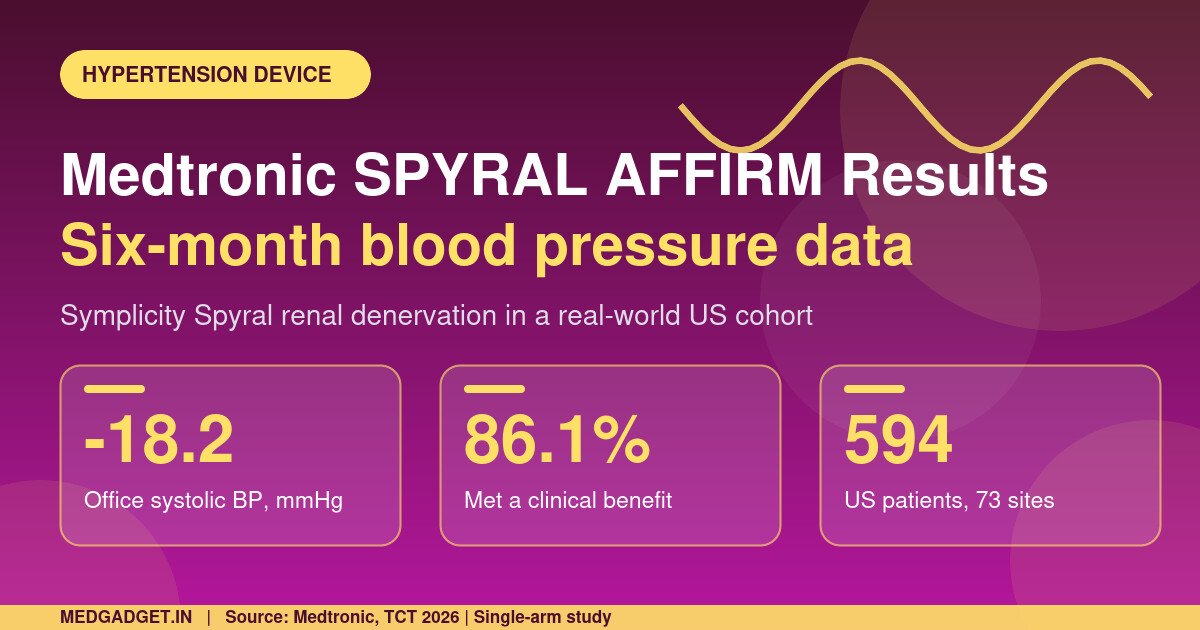
The Medtronic SPYRAL AFFIRM results, presented on 3 November 2026 as late-breaking data at TCT, show a significant fall in blood pressure six months after renal denervation with the Symplicity Spyral system. Office systolic blood pressure dropped by an average of 18.2 mmHg, and nearly nine in ten patients met at least one prespecified measure of clinical benefit. The FDA has also approved an update to the device’s labelling, but the indication for use is unchanged.
Key takeaways from the Medtronic SPYRAL AFFIRM results
- Office systolic blood pressure fell by 18.2 mmHg at six months; home and 24-hour ambulatory readings fell by 9.4 and 9.7 mmHg respectively (all p below 0.0001).
- Medtronic reports that nearly nine in ten patients had a clinical benefit; a conference report puts the figure at 86.1%.
- Antihypertensive medication use did not increase: the average number of drugs was 3.6, unchanged from baseline.
- The US cohort in the report included 594 patients at 73 US sites, according to a conference report; the Medtronic release does not give these numbers.
- The FDA approved a labelling update adding data for isolated systolic hypertension, chronic kidney disease up to stage 3b and type 2 diabetes. The indication for use did not change.
Renal denervation for hypertension, explained simply
High blood pressure, or hypertension, raises the risk of heart attack, stroke and kidney disease. Most people control it with lifestyle changes and tablets, but some still have high readings despite several drugs. Renal denervation is a catheter procedure for such patients. A thin catheter is guided into the arteries that supply the kidneys, and energy is delivered to the nerves running along the artery walls. Those nerves help drive blood pressure up, so calming them can lower readings. No implant is left behind.
Medtronic’s Symplicity Spyral catheter uses a multi-electrode design and, according to the company, is approved for commercial use in more than 80 countries.
The six-month results in a table
| Measure | Change from baseline at six months | p-value |
|---|---|---|
| Office systolic BP (primary endpoint) | -18.2 mmHg (plus or minus 22.0) | Below 0.0001 |
| Home BP | -9.4 mmHg (plus or minus 13.8) | Below 0.0001 |
| 24-hour ambulatory BP | -9.7 mmHg (plus or minus 16.8) | Below 0.0001 |
| Antihypertensive medications | 3.6 (plus or minus 2.0), unchanged | Not reported |
| Composite safety endpoint | 2.1% | Not reported |
The release does not say whether the plus-or-minus values are standard deviations, and it does not specify whether the home and ambulatory figures are systolic. Baseline readings reported at the conference were 169/106 mmHg in the office, 158/101 at home and 151/96 on 24-hour monitoring, and 51% of patients were taking four or more drugs at baseline.
Who was studied, and how
SPYRAL AFFIRM is a prospective, multicentre, single-arm post-approval study designed with the FDA. The six-month US primary endpoint cohort was compared with a prespecified performance goal, though the release does not state the goal or the result against it. A conference report says the mean age was 56.5 years, 45.3% of patients were female, 27.1% were Black and 10.6% Hispanic. Investigators said blood pressure reductions in women, older adults and patients with kidney disease or diabetes were similar in size to the overall group, but no subgroup numbers were given.
The FDA labelling update, in plain terms
The FDA approved an update to the labelling of the Symplicity Spyral multi-electrode renal denervation catheter. It adds clinical data for patients with isolated systolic hypertension, chronic kidney disease up to stage 3b (eGFR of 30 or higher) and type 2 diabetes. Importantly, Medtronic states that the indication for use is unchanged. A labelling update that adds data tells clinicians what the evidence shows in these groups; it does not create a new approved use. The approval date was not stated. Regulatory information is on the FDA medical devices pages.
Timeline
- Earlier in 2026: pooled analysis reporting similar benefit at three years, cited by Medtronic.
- 3 November 2026: six-month SPYRAL AFFIRM data presented at TCT 2026 and published in Circulation: Cardiovascular Interventions.
- Same period: FDA approval of the labelling update; exact date not stated.
What the results do and do not show
The headline drop of 18.2 mmHg is large by the standards of blood pressure treatment, and it occurred without extra medication. But SPYRAL AFFIRM is single-arm, with no sham-control group in the reported data, so some of the fall may reflect factors such as regression to the mean or better adherence. Lead investigator David Kandzari said the reductions are transformative, and also said renal denervation is not currently endorsed as a primary therapy. Lead discussant Clyde Yancy asked whether it should be considered more than an add-on. The data are six-month results; long-term outcomes like strokes and heart attacks are not reported here.
Safety: two numbers that need reconciling
Medtronic reports a composite safety endpoint of 2.1%. A conference report says fewer than 1% of patients had an adverse event. These may measure different things, and neither source gives a full breakdown of events, so we cannot reconcile them. Readers should look at the published paper for definitions.
Market context: renal denervation
According to Acumen Research And Consulting, the global renal denervation market was USD 198.1 million in 2021 and is projected to reach USD 4,464.6 million by 2030, a compound annual growth rate of 41.5%. Europe held over 70% share in 2021, North America was expected to follow, Asia-Pacific is the fastest-growing region, and Symplicity held over 45% of the market.
The report is dated October 2022 and has problems: its stated growth rate matches a nine-year period from 2021 rather than the 2022 to 2030 period it names, it quotes an implausible hypertension rate and it includes an irrelevant news item. Treat its figures as a dated projection, not current market size.
Our analysis
In our assessment, the Medtronic SPYRAL AFFIRM results strengthen the real-world case for Symplicity Spyral in a broader and more diverse group than earlier pivotal studies, with a notable blood pressure fall and no rise in medication. The important qualifiers are the single-arm design, the short follow-up and the manufacturer-supplied summary. The labelling update helps clinicians interpret evidence in specific groups, but it does not make the procedure a first-line treatment or create a new indication.
What is not disclosed
- The prespecified performance goal and the result against it.
- The date of the FDA labelling approval.
- Numerical subgroup results.
- A full adverse-event breakdown.
Risks and caveats
- Single-arm data cannot separate the procedure’s effect from other factors.
- Results are at six months.
- Several details come from a conference report, not Medtronic’s release.
- This article is not medical advice; blood pressure treatment should be decided with a doctor.
What to watch next
- Longer follow-up from SPYRAL AFFIRM.
- Guideline and coverage decisions on renal denervation.
- Controlled comparisons with medication or sham.
- Further detail in the published paper.
General background
Company information is on the Medtronic website, and general guidance on high blood pressure is available from the American Heart Association. For more of Medtronic’s device news, see our report on LigaSure RAS clearance for the Hugo robot and our Medical Device section.
Questions readers are asking about the Medtronic SPYRAL AFFIRM results
How much did blood pressure fall?
Office systolic blood pressure fell by 18.2 mmHg at six months on average.
Is renal denervation approved for new patients now?
The labelling update adds data only; the indication for use is unchanged.
Did patients take more medication?
No. The average number of medications stayed at 3.6.
FAQ
What is renal denervation?
A catheter procedure that uses energy to quiet nerves around the kidney arteries.
Is it a first-choice treatment?
The lead investigator said it is not currently endorsed as primary therapy.
Who is it for?
That is for doctors and regulators to decide; consult a doctor.
How we reported this: details come from Medtronic’s announcement of 3 November 2026 and a conference report on the presentation; market figures are attributed to Acumen Research And Consulting. Last updated 4 November 2026. This is news reporting and not medical advice.