

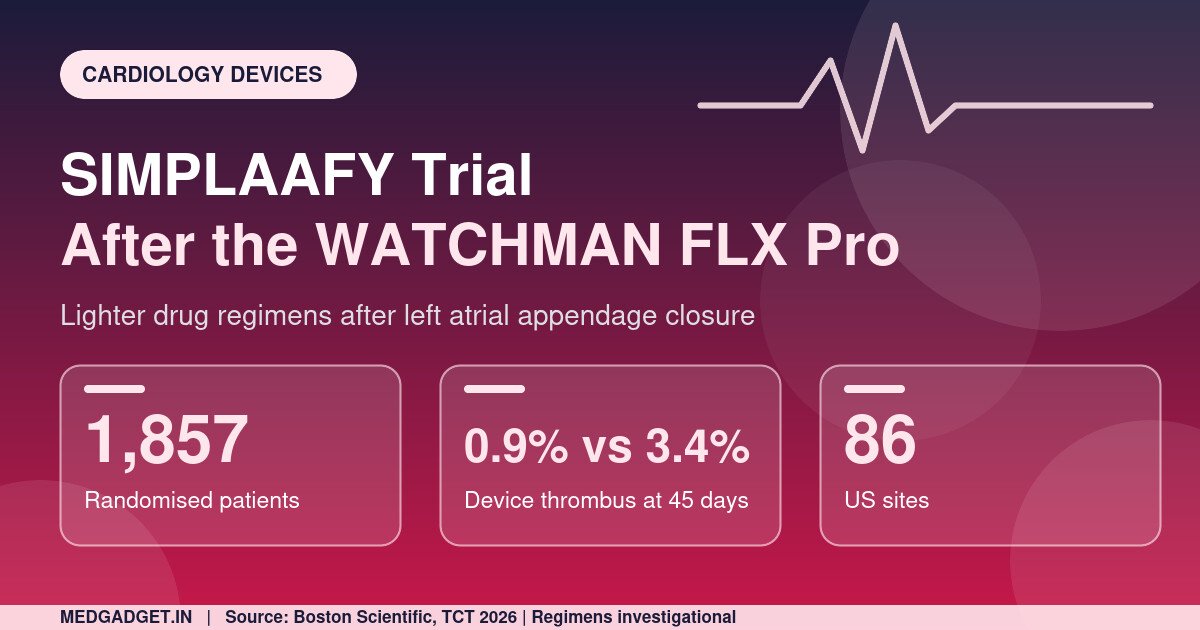
The Boston Scientific SIMPLAAFY trial reported on 2 November 2026 that two lighter drug regimens after implantation of the WATCHMAN FLX Pro left atrial appendage closure device met a noninferiority test against standard dual antiplatelet therapy at six months. The randomised study enrolled 1,857 patients at 86 US sites and was presented at TCT 2026 with simultaneous publication in JAMA. The regimens tested are investigational and are not part of the device’s approved labelling.
Key takeaways from the Boston Scientific SIMPLAAFY trial
- Design: randomised trial of 1,857 patients with non-valvular atrial fibrillation at 86 US sites, all receiving WATCHMAN FLX Pro with HEMOCOAT.
- Arms: aspirin alone; a reduced-dose oral anticoagulant for three months then aspirin; or the comparator, aspirin plus clopidogrel for six months then aspirin.
- Both aspirin alone and the reduced-dose anticoagulant met six-month noninferiority against the comparator, with less bleeding reported.
- Device-related thrombus at 45 days: 0.9% with the reduced-dose anticoagulant versus 3.4% with the comparator (P=0.01).
- Ischaemic stroke was 0.7%, described as equivalent to the comparator; the release does not say which arm that figure refers to.
- The two lighter regimens are investigational, not approved labelling.
Why close the left atrial appendage?
In atrial fibrillation, the upper chambers of the heart beat irregularly, and blood can pool and clot. In non-valvular atrial fibrillation, many such clots are thought to form in the left atrial appendage, a small pouch off the left atrium. If a clot escapes, it can travel to the brain and cause a stroke. Long-term blood thinners reduce this risk but also raise the risk of bleeding. Left atrial appendage closure devices such as WATCHMAN aim to seal the pouch so that long-term anticoagulation may be avoided in selected patients. This is general background; the American Heart Association has patient information on atrial fibrillation.
Why medication after the implant matters
A new implant is a foreign object, and until tissue grows over its surface, clots can form on it. Such a clot is called a device-related thrombus, and it may raise the risk of stroke. Patients therefore receive antithrombotic drugs for a period after implantation. The trade-off is that these drugs can cause bleeding, which is a particular concern in patients who were considered for closure partly because of bleeding risk. SIMPLAAFY asks whether shorter or lighter regimens can protect as well as the dual antiplatelet comparator while reducing bleeding.
The three regimens
| Arm | Regimen | Status |
|---|---|---|
| Aspirin alone | Aspirin only after implant | Investigational |
| Reduced-dose anticoagulant | Reduced-dose NOAC for 3 months, then aspirin | Investigational |
| Comparator | Aspirin plus clopidogrel for 6 months, then aspirin | Reference regimen |
What the results show
The release states that aspirin alone and the reduced-dose anticoagulant each met noninferiority at six months compared with dual antiplatelet therapy, and that both had less bleeding. The bleeding rates, the definition of the primary endpoint and the noninferiority margins were not given in the material we reviewed. The strongest numerical signal reported is device-related thrombus at 45 days, where the reduced-dose anticoagulant arm had 0.9% against 3.4% for the comparator. Follow-up continues to 12 months.
Noninferiority means the new approach was not worse than the comparator by more than a prespecified margin. It does not mean the approaches are identical, and it depends on how that margin was set. Readers should check the JAMA paper for these details, because the company announcement is promotional by nature.
Timeline
- 2023: WATCHMAN FLX Pro receives FDA approval.
- 2026: Boston Scientific starts the Elite AF trial of its next-generation device.
- 2 November 2026: SIMPLAAFY presented at TCT 2026 and published in JAMA.
- Next: 12-month follow-up data.
What this could mean for practice
If the full paper confirms the findings, clinicians may gain more evidence to individualise post-implant treatment, for example choosing aspirin alone for patients at high bleeding risk. Any change in standard practice would still depend on guidelines, regulators and the 12-month data. Boston Scientific says WATCHMAN has been used in more than 800,000 patients. Dr Saibal Kar, a trial co-chair, and Dr Brad Sutton, the company’s chief medical officer for Atrial Fibrillation Solutions, are quoted in the release.
Market context: electrophysiology devices
Acumen Research And Consulting has no report specific to left atrial appendage closure, so we cite its Electrophysiology Devices Market report as an adjacent source. It values the global market at USD 6.3 billion in 2022 and projects USD 17.6 billion by 2032, a compound annual growth rate of 10.9% from 2023 to 2032. North America held over 38% share, Asia-Pacific about 12%, atrial fibrillation represented over 32% of 2022 revenue and hospitals over 54% of end use.
The page was last updated in May 2023, describes the 2032 figure as an increase of USD 17.6 billion (the implied rise is about USD 11.3 billion by our calculation) and lists one company twice. Treat the figures as indicative. The report does not cover closure devices separately.
Our analysis
In our assessment, SIMPLAAFY addresses a real clinical question and uses a design that suits it. Its value will depend on details we cannot yet check: the bleeding data, the noninferiority margins and the stroke rates by arm. For now, the most defensible reading is that lighter regimens look promising and warrant scrutiny, not that practice should change.
What is not disclosed
- Bleeding rates in each arm.
- Noninferiority margins and the exact primary endpoint.
- Which arm the 0.7% ischaemic stroke figure refers to.
- Plans to seek labelling changes.
Risks and caveats
- The tested regimens are investigational and not approved labelling.
- Results rely on a company release; verify with the JAMA paper.
- Market statistics are from an adjacent report with dating issues.
- This is not medical advice.
What to watch next
- 12-month outcomes.
- Guideline responses.
- Any regulatory filing on the regimens.
- Results from the Elite AF trial.
General background
Company information is at Boston Scientific. We also covered Abbott’s SonicForce trial and Medtronic’s SPYRAL AFFIRM data from the same conference. More in our Medical Device section.
Questions readers are asking about the Boston Scientific SIMPLAAFY trial
Can patients now use aspirin alone after WATCHMAN?
The regimens are investigational and not in approved labelling. Treatment choices belong with the patient’s doctor.
Was WATCHMAN FLX Pro just approved?
No. It was approved by the FDA in 2023.
What was the main safety finding?
Less bleeding in both lighter arms, and lower device-related thrombus at 45 days with the reduced-dose anticoagulant.
FAQ
What is a NOAC?
A non-vitamin K oral anticoagulant, a type of blood thinner.
What is HEMOCOAT?
A coating on the WATCHMAN FLX Pro device, mentioned in the release.
Where was it published?
In JAMA, alongside the TCT 2026 presentation.
How we reported this: details come from Boston Scientific’s announcement of 2 November 2026; market figures are attributed to Acumen Research And Consulting. Last updated 4 November 2026. This is news reporting and not medical advice.
[…] Lifesciences’ PASCAL System Shows Positive One-Year Results in CLASP II TR Trial Boston Scientific’s SIMPLAAFY Trial Reports Positive Results for WATCHMAN FLX Pro Post-Implant Tr… Teva and Samsung Bioepis Sign US Commercialisation Deal for Two FDA-Approved Biosimilars […]