


Siemens Healthineers has launched the Accela radiotherapy system, a new platform built around its NeoArc dynamic modulated arc therapy (DMAT) technology, and says it can deliver multi-site stereotactic body radiotherapy (SBRT) in as little as 60 seconds. The company announced the system on 27 September 2026 at the annual meeting of the American Society for Radiation Oncology (ASTRO) in Boston. Accela is not yet for sale: a 510(k) submission to the US Food and Drug Administration (FDA) is pending, according to the Siemens Healthineers press release.
Key Takeaways
- Siemens Healthineers unveiled the Accela radiotherapy system on 27 September 2026, built on NeoArc DMAT technology.
- The company says it can deliver multi-site SBRT in as little as 60 seconds and supports single breath-hold stereotactic treatments.
- Reported specifications include a 2.5 RPM gantry, dose rates up to 40 Gy/min, a new 8 MV flattening filter-free energy setting and a redesigned multileaf collimator.
- FDA 510(k) clearance is pending, and the system is not available for sale. Speed and performance figures are company-reported.
- Seven clinical centres, including Mayo Clinic and Memorial Sloan Kettering, took part in development.
What Is the Accela Radiotherapy System?
The Accela radiotherapy system is a linear accelerator platform for delivering external-beam radiation to tumours. Siemens Healthineers, whose cancer-care business Varian makes radiotherapy systems, describes it as a platform for single breath-hold stereotactic treatments and for multi-site SBRT, in which several tumour sites are treated in one session.
SBRT delivers high doses of radiation in a small number of sessions with tight precision, and is used for tumours in sites such as the lung, liver and spine, and for cancer that has spread to a limited number of places. Because organs move as a patient breathes, treatment time on the table is a major practical limit: the longer it takes, the harder it is for a patient to stay still and for the beam to stay on target.
How the Accela Radiotherapy Platform Works
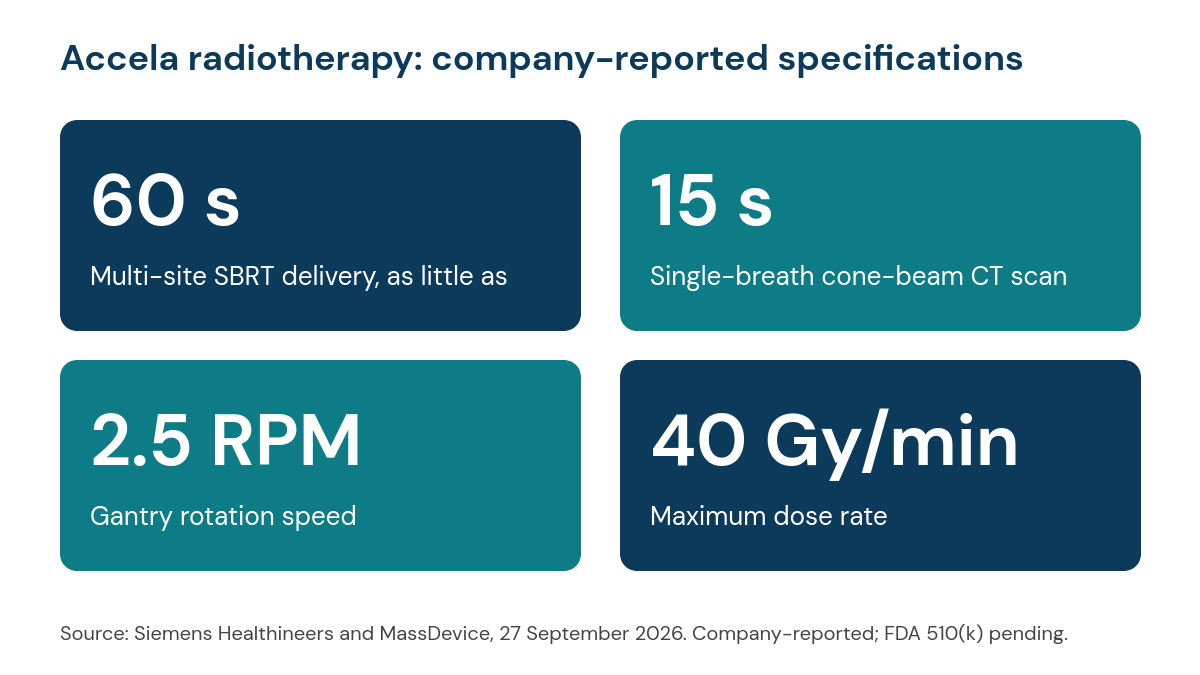
Accela is built around NeoArc, a form of dynamic modulated arc therapy. According to the company, DMAT combines a faster gantry, a newer multileaf collimator and a higher dose rate to shape the radiation dose while shortening delivery. The reported technical specifications are listed below.
- Gantry speed: 2.5 revolutions per minute.
- Dose rate: up to 40 Gy per minute, using a new 8 MV flattening filter-free energy setting.
- Collimator: a newly designed multileaf collimator. MassDevice reports it has 186 leaves.
- Imaging: the largest HyperSight cone-beam CT panel the company has offered, acquiring single-breath scans in about 15 seconds, according to MassDevice.
- Planning: AI-based planning software that lets clinicians balance plan quality against delivery speed.
Accela Radiotherapy at a Glance
| Item | Detail |
|---|---|
| Product | Accela radiotherapy system (Siemens Healthineers / Varian) |
| Announced | 27 September 2026, ASTRO annual meeting, Boston |
| Core technology | NeoArc dynamic modulated arc therapy (DMAT) |
| Headline claim | Multi-site SBRT in as little as 60 seconds |
| Gantry / dose rate | 2.5 RPM / up to 40 Gy per minute, 8 MV FFF |
| Imaging | HyperSight cone-beam CT, single-breath scan in about 15 seconds |
| Regulatory status | FDA 510(k) pending; not available for sale |
What the Speed Claims Mean
The headline claim is multi-site SBRT in as little as 60 seconds. MassDevice reports that time from imaging to radiation delivery can be as low as 90 seconds, and that Siemens Healthineers says Accela reduces delivery times for abdominal SBRT by 87% compared with current technologies. The same report notes that metastasis-directed radiotherapy today can take 30 to 60 minutes per site.
These numbers describe best-case, company-reported performance, and they are not directly comparable: a 60-second delivery time is not the same thing as total time in the treatment room, which also includes set-up, imaging and checks. Independent clinical data on delivery accuracy, plan quality and patient outcomes were not published at launch.
Who Helped Develop Accela?
Siemens Healthineers says Accela was developed with clinical partners including Mayo Clinic, Washington University School of Medicine in St. Louis, University Hospital Zurich, University Hospitals Cleveland Medical Center, the Maastricht Radiation Oncology Institute (Maastro), Mass General Brigham Cancer Institute and Memorial Sloan Kettering Cancer Center. Participation in development is not the same as a purchase commitment.
Dr Dee Khuntia, chief medical officer at Varian, said: “Accela is the kind of leap our field doesn’t see often. It’s faster than previous systems, it’s built on a fundamentally modern architecture, and it introduces a generational shift in treatment planning.” The quote is as reported by MassDevice, and it reflects the company view.
Regulatory Status and Availability
Accela is 510(k) pending and cannot yet be sold in the United States. Siemens Healthineers states there is no guarantee of commercialisation or of any feature being available. The company has not announced pricing, launch dates by country or availability in India, so hospitals and distributors should treat the system as a future option rather than a current product. AuntMinnie also reports the pending FDA status.
Why It Matters for Cancer Care
Faster delivery could matter in several ways. Shorter sessions may be easier for patients who find it difficult to lie still or hold their breath for long, and may allow more patients to be treated on one machine. Treating several sites in a single session could also help patients with limited metastatic disease, a group where radiotherapy is increasingly used alongside drug therapy, as in the setting of our coverage of the Datroway and ivonescimab Phase III plan in triple-negative breast cancer and the FDA approval of the Inluriyo plus Verzenio combination.
Radiotherapy is also adopting more software and AI, in the same way as imaging and screening, which we have followed in our reports on AI mammography technology from AIIMS Delhi and the AI in healthcare market forecast.
What Is Not Yet Known
- Clinical evidence: no peer-reviewed results on accuracy, toxicity or outcomes were released with the launch.
- Regulatory timing: the FDA decision date and the status in other markets, including India, are not stated.
- Cost and access: pricing, service models and hospital buyers were not disclosed.
- Real-world speed: how the 60-second figure translates into total appointment time remains to be shown.
Our Assessment
In our assessment, Accela is an early product announcement rather than a clinical milestone: the performance claims come from the manufacturer and the system is pending clearance. If the speed and accuracy hold up in practice, it could shift how hospitals plan SBRT workloads. Until independent data and regulatory decisions arrive, the numbers should be read as targets.
Frequently Asked Questions
What is the Accela radiotherapy system?
It is a radiotherapy platform from Siemens Healthineers built around NeoArc dynamic modulated arc therapy for fast stereotactic treatments.
How fast can Accela deliver SBRT?
The company says multi-site SBRT can be delivered in as little as 60 seconds, and that single breath-hold stereotactic treatments are supported.
Is Accela approved by the FDA?
No. A 510(k) is pending and the system is not available for sale.
What is NeoArc DMAT?
It is Siemens Healthineers dynamic modulated arc therapy technique, combining a faster gantry, higher dose rate and a redesigned multileaf collimator to shorten delivery.
Which centres helped develop it?
Seven are named, including Mayo Clinic, Washington University School of Medicine, University Hospital Zurich and Memorial Sloan Kettering Cancer Center.
How we reported this: information comes from the Siemens Healthineers press release dated 27 September 2026 and trade coverage by MassDevice and AuntMinnie. Performance figures are company-reported and not independently verified. Last updated 3 October 2026. This article is for information only and is not medical advice.
[…] related health coverage, see our reports on a new triple-combination COPD inhaler and a new radiotherapy system for cancer care, or browse our healthcare services […]
[…] recent device news, see our reports on the FDA clearance of a cuffless blood pressure ring and on Siemens Healthineers’ Accela radiotherapy system, or browse more medical device […]