

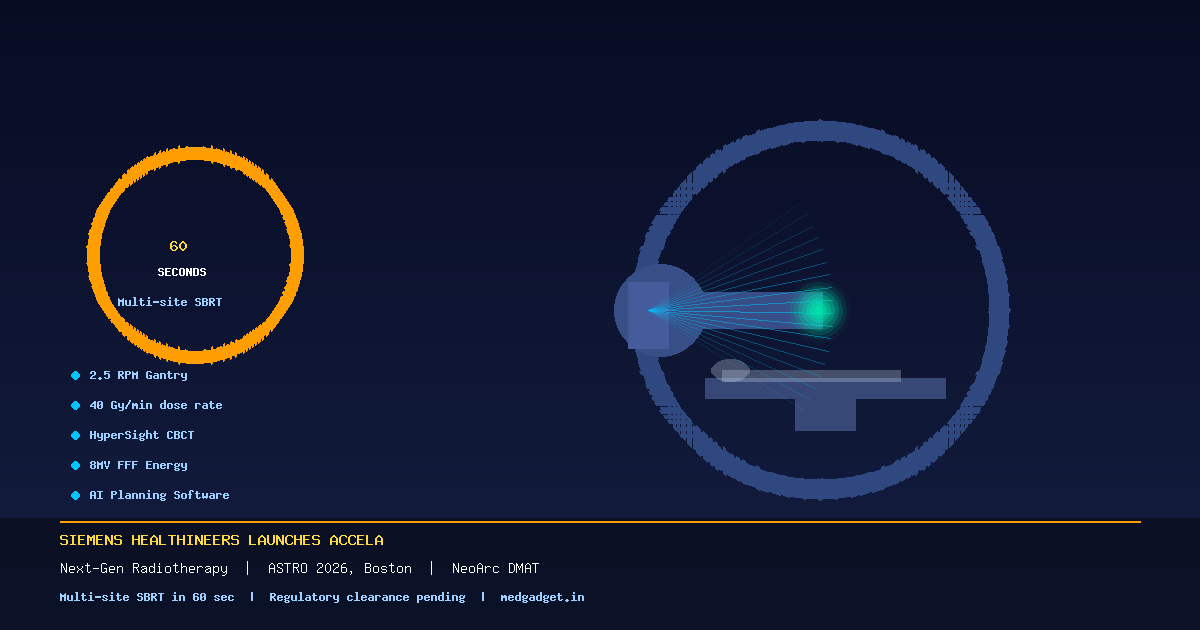
Siemens Healthineers has unveiled Accela, a next-generation radiotherapy platform built around a new treatment technique called NeoArc dynamic modulated arc therapy, at the American Society for Radiation Oncology annual meeting in Boston. The September 27 announcement positions Accela as the company’s most significant advance in radiation oncology hardware since its acquisition of Varian, and the system’s headline specification—the ability to deliver multi-site stereotactic body radiation therapy in as little as 60 seconds—has generated considerable attention across the cancer treatment community.
The 60-Second Claim in Context
Multi-site SBRT—delivering precisely targeted radiation to several distinct tumor locations in the same session—is among the more time-intensive procedures in a radiation oncology department. Compressing certain multi-site treatments from what might otherwise take 15 to 30 minutes into roughly one minute, even for a defined subset of patients, represents a meaningful shift in both patient experience and departmental throughput. Accela also enables single breath-hold stereotactic treatments, meaning the entire dose can be delivered during one inhalation rather than requiring a patient to hold still repeatedly over multiple breathing cycles.
What NeoArc Actually Is
NeoArc, developed by Varian as part of its integration into Siemens Healthineers, is the technical core of the Accela system. The technique combines three hardware elements to achieve faster treatment delivery without compromising conformality—the degree to which the radiation dose shape matches the tumor while sparing surrounding healthy tissue.
The gantry rotates at 2.5 RPM, faster than conventional linear accelerator designs. A redesigned multi-leaf collimator shapes the beam with greater precision. And the system achieves dose rates of up to 40 Gy per minute, well above what standard radiotherapy platforms typically deliver. A new eight-megavolt flattening filter-free energy setting rounds out the hardware configuration. Operating these components together under continuous arc delivery is what produces the speed gains the company is describing.
AI-Driven Planning Software
Speed in the treatment room is only half of the efficiency problem in modern radiation oncology. Treatment planning—the process of designing exactly how much dose to deliver to which parts of the target while protecting nearby healthy tissue—is often the real scheduling bottleneck. Complex stereotactic plans can take hours or days to finalize and require skilled dosimetrist time that is itself constrained at many centers.
Accela’s planning software incorporates AI and optimization algorithms designed specifically to help clinicians navigate the trade-off between plan quality and delivery speed—two goals that have historically required manual balancing. By making that trade-off faster and more transparent, the system aims to reduce planning time alongside delivery time, addressing both parts of the throughput challenge cancer centers face.
HyperSight Imaging Integration
Accela integrates the HyperSight cone-beam CT imaging panel for patient positioning and treatment guidance. Accurate positioning immediately before treatment is critical for stereotactic techniques, where millimeter-level precision matters for both effectiveness and safety. HyperSight verifies that the patient is positioned exactly as planned before the treatment arc begins—a safety check that becomes especially important at the high dose rates NeoArc employs.
A Scientific Rationale Beyond Efficiency
Several clinical investigators involved in Accela’s development have cited a biological rationale for faster, high-dose-rate delivery that extends beyond workflow convenience. Rapid irradiation delivered in very short sessions may produce different biological effects on tumors than the same total dose given more slowly, a phenomenon explored in the FLASH radiotherapy research domain. Siemens Healthineers has not specifically claimed Accela achieves FLASH-level dose rates, but at least one clinical collaborator has suggested that the biological angle makes the approach worth watching beyond its practical scheduling advantages.
Regulatory Status and Availability
A key practical caveat: Accela is currently not cleared for sale in any market. Commercialization and final feature availability remain subject to regulatory clearance in each jurisdiction. Siemens Healthineers has not specified which markets it will pursue first or on what timeline. The ASTRO meeting launch represents a public introduction of the platform’s capabilities and a signal of commercial intent, not an imminent product availability announcement.
Development took place over several years with input from an advisory group of leading cancer research institutions, and a number of those institutions contributed to the clinical data and product evaluations that shaped the system’s design. Whether the 60-second SBRT benchmark holds up across the full range of clinical scenarios will become clearer once clearance is obtained and the system moves into actual clinical sites.