

Indian non-life insurers are considering a major change to retail health insurance under which policyholders would pay 10% of eligible hospital claims themselves, with the patient’s contribution capped at Rs 5 lakh per claim, from 1 January 2027. In return, insurers would lower annual premiums. The proposal, which is under consideration by the General Insurance Council and has not been reported as approved, would make the health insurance 10% co-pay compulsory across most retail policies, according to reports.
Key Takeaways
- Policyholders would bear 10% of admissible inpatient hospitalisation costs, whether the claim is cashless or reimbursed.
- The patient’s share would be capped at Rs 5 lakh per claim. By our calculation the cap only applies to bills above Rs 50 lakh.
- The proposed start date is 1 January 2027, and annual premiums would be lowered in return. The size of the reduction has not been reported.
- The co-pay would reportedly be non-waivable and could not be reduced or recovered from another policy.
- We found no report of IRDAI approval. This is a proposal under consideration, not a rule in force.
What Is Being Proposed?
A co-payment is the share of a claim that the insured person pays and the insurer does not. Under the proposal, a policyholder with an admissible hospital bill of Rs 5 lakh would pay Rs 50,000 and the insurer the remaining Rs 4.5 lakh. The deduction would apply to inpatient claims and would not apply to outpatient (OPD) claims, as reported.
The change would cover retail indemnity products, retail policies issued under group arrangements, the indemnity portion of combi products, internal migrations between plans and portability business. Reports say it would apply to all retail policyholders, including those with high sums insured, and that it could not be waived, reduced or modified in any way, including by claiming the balance from another policy.
How Much Would You Pay? Our Calculations
The table below shows the policyholder’s share at a flat 10% with a Rs 5 lakh cap per claim. These are our own illustrative calculations from the reported terms, not figures published by insurers, and they assume the full bill is admissible.
| Admissible bill | Policyholder pays (10%, max Rs 5 lakh) | Insurer pays |
|---|---|---|
| Rs 1 lakh | Rs 10,000 | Rs 90,000 |
| Rs 5 lakh | Rs 50,000 | Rs 4.5 lakh |
| Rs 10 lakh | Rs 1 lakh | Rs 9 lakh |
| Rs 25 lakh | Rs 2.5 lakh | Rs 22.5 lakh |
| Rs 50 lakh | Rs 5 lakh | Rs 45 lakh |
| Rs 1 crore | Rs 5 lakh (cap applies) | Rs 95 lakh |
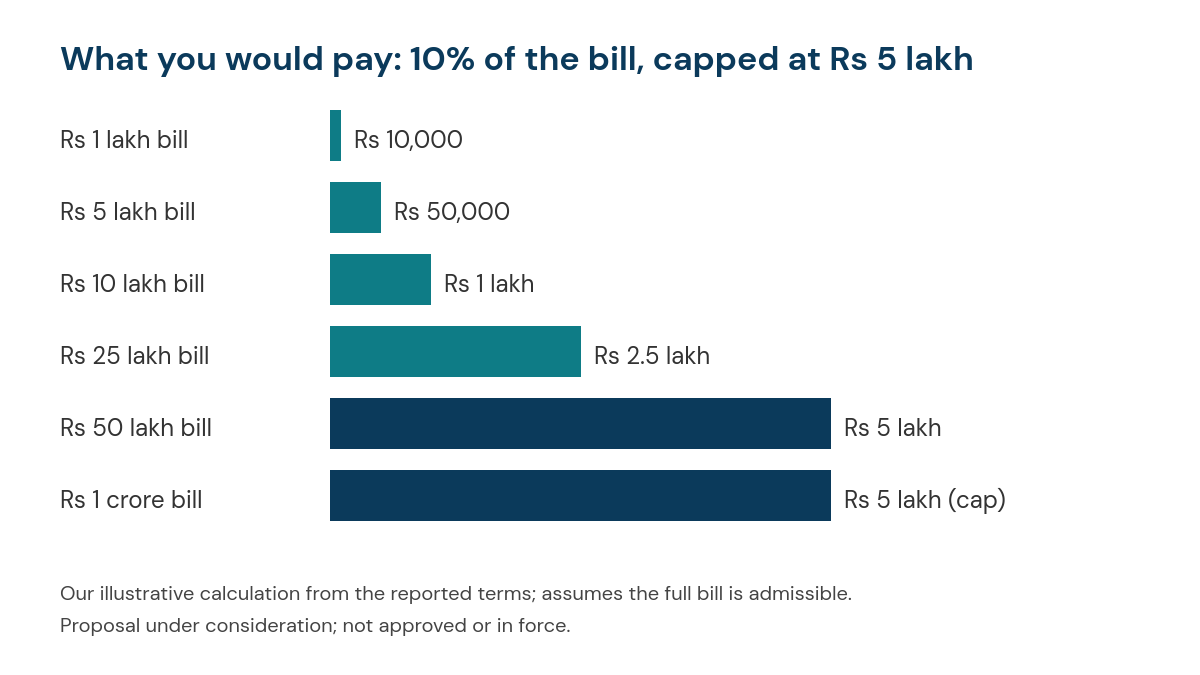
Because the cap sits at Rs 5 lakh, the share is a fixed 10% for most claims and only flattens for very large ones. Most hospitalisation claims in India are far below Rs 50 lakh, so for most families the cap would offer no relief.
Why Are Insurers Considering This?
The stated rationale is to curb what the industry calls moral hazard: reports quote the argument that hospitals may extend stays or prescribe extra tests and procedures when a patient has comprehensive cover, and that policyholders have less reason to question costs when they pay nothing. Insurers also face rising claims, and lower premiums are offered as the trade-off. We have not seen the underlying data supporting those claims.
Hospital costs are also shaped by pricing of devices and consumables, an area we have covered in the parliamentary panel’s call for wider medical device price control and the trade-margin talks for hospital consumables. Digital insurers are also entering the market, as in the Angle Health’s funding round for an AI-led health insurer.
What It Could Mean for Policyholders
- Lower premiums, higher out-of-pocket costs: a family would save on premium but face a deduction on every inpatient claim.
- Older and chronically ill patients: frequent or costly admissions would add up. Reports do not say whether seniors or emergencies would be treated differently.
- Cashless claims: hospitals may have to collect the 10% share at admission or discharge.
- Existing co-pay clauses: how the new share would interact with co-pay already built into some plans has not been explained.
- Choice of plan: some customers may prefer a plan with a higher sum insured to absorb the 10% share.
What Is Not Yet Known
- Whether the Insurance Regulatory and Development Authority of India (IRDAI) will approve the change, and under what conditions.
- Which insurers would adopt it, and whether it applies to new policies, renewals or both.
- How much premiums would fall for different age groups and plans.
- Whether emergencies, senior citizens and critical illnesses would be exempt.
- How the rule would apply to employer group cover, which is separate from the retail products named in the reports.
What Policyholders Can Do Now
Nothing changes until insurers publish the terms and regulators allow them. Customers can read their renewal notices closely, compare the premium saving against the likely out-of-pocket share, and note that disputes over claims can be taken to the insurance ombudsman after the insurer’s grievance process. Our assessment is that the proposal makes sense only if the premium reduction is meaningful and clearly disclosed.
Our Assessment
In our assessment, a flat 10% share on all inpatient claims is a significant shift of risk to patients, and the case for it depends on evidence that over-treatment is a major driver of claims. A transparent premium discount, exemptions for emergencies and the elderly, and regulatory scrutiny would decide whether the change reduces costs or simply moves them. Details are reported from proposals and may change before any rule takes effect.
Frequently Asked Questions
What is the proposed health insurance co-pay change?
Non-life insurers are considering requiring policyholders to pay 10% of eligible inpatient claims, capped at Rs 5 lakh per claim, from 1 January 2027, in exchange for lower premiums.
Is it already in force?
No. It is under consideration, and we found no report of regulatory approval.
Will I pay 10% of every hospital bill?
If adopted as reported, you would pay 10% of admissible inpatient costs, up to Rs 5 lakh per claim. OPD claims are excluded.
Can the co-pay be waived or claimed from another policy?
Reports say it could not be waived, reduced or recovered from another policy.
How much cheaper will premiums be?
The reduction has not been reported.
How we reported this: details come from reports on the proposal under consideration by non-life insurers and the General Insurance Council; we did not see an official insurer or regulator statement. Illustrations are our own calculations. This is a developing story and terms may change. Last updated 5 October 2026. This article is for information only and is not insurance or financial advice.