

Can a computer model of a single human cell become as useful to biologists as a flight simulator is to pilots? A coalition that includes Google DeepMind, Meta, Isomorphic Labs and two US government agencies is betting that it can. On 7 October 2026 Biohub announced the expansion of its Biohub Virtual Biology Initiative, with about $1.8 billion in commitments aimed at building open, AI-ready biological datasets and predictive models, including so-called virtual cells. For anyone following AI drug discovery 2026, it is one of the biggest funding signals of the year.
Key Takeaways
- Headline figure: about $1.8 billion in commitments, which equals the sum of the contributions listed by Biohub (our arithmetic): $500M from Biohub, more than $500M from the US Department of Energy, more than $500M of NIH-coordinated federal investment and $300M from Google DeepMind, Isomorphic Labs and Meta combined.
- Not all new money: Biohub describes the NIH figure as prior federal investment that NIH will coordinate, not new funding.
- The goal: open datasets and AI models that predict how cells respond to interventions.
- Partners: the Allen Institute, Broad Institute, Gladstone Institutes, Human Cell Atlas, Human Protein Atlas and Wellcome Sanger Institute, with NVIDIA supplying computing.
- Why it matters: better cell models could cut the cost and time of finding drugs, but the technology is unproven.
What is the Virtual Biology Initiative?
The initiative was first announced in April 2026 to coordinate data generation across institutions so that AI researchers can train predictive models of life. Biohub, a nonprofit research institute based in Redwood City, California, says its aim is to let scientists ask, predict and answer biological questions digitally. The October expansion adds major funders and a formal role for public agencies. You can read the full Biohub announcement.
The core idea is the virtual cell: a computational model that predicts how any cell will behave if a gene is switched off, a drug is added or a signal changes. Biohub calls a virtual cell one of the most important challenges for the next era of science. An NIH official described the target as universal cell models that predict how any cell responds to an intervention.
Where does the $1.8 billion come from?
| Contributor | Commitment as described by Biohub |
|---|---|
| Biohub | $500M founding commitment ($400M for new measurement and engineering technologies, $100M for outside research) |
| US Department of Energy | More than $500M over five years, through its Genesis Mission |
| NIH | More than $500M in prior federal investment, coordinated not newly funded |
| Google DeepMind, Isomorphic Labs, Meta | $300M combined; split not given |
| NVIDIA and Renaissance Philanthropy | Computing support and funding expansion; no amounts given |
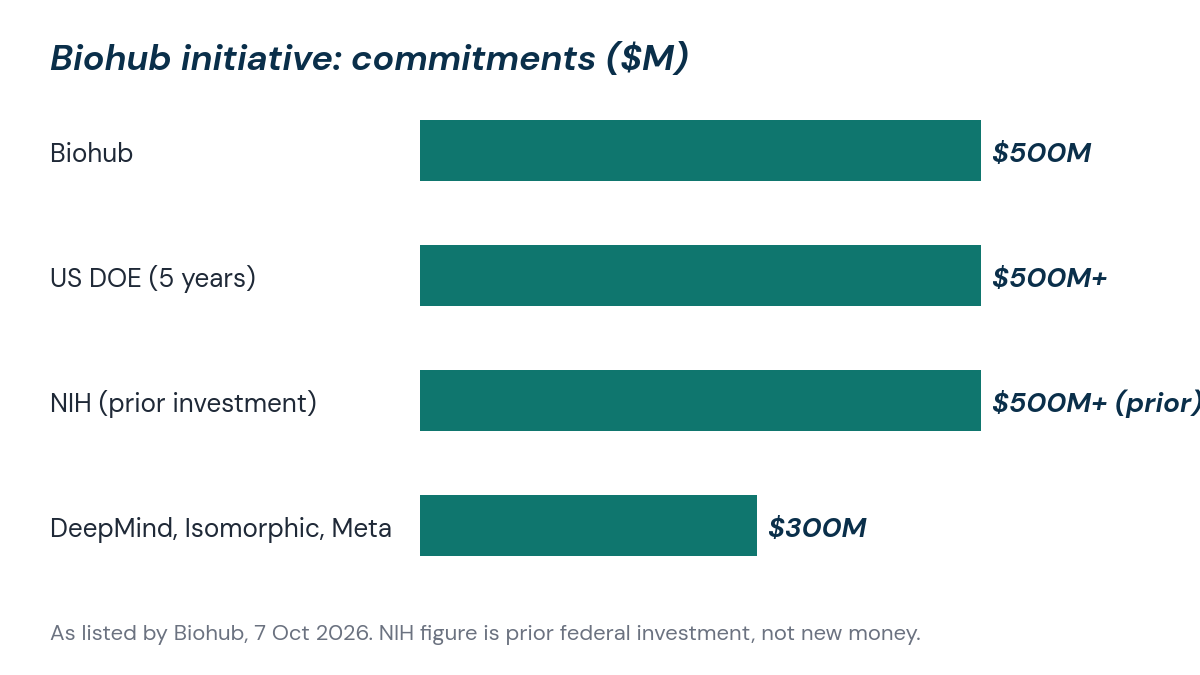
The announcement does not itself state the $1.8 billion total; it appears to equal the four figures above, which sum to $1.8 billion by our own arithmetic. In our assessment, the careful reading is that roughly $1.1 billion is new or newly committed money from Biohub, DOE and the three companies, while the NIH portion is existing federal research spending being aligned to the project. Headlines that call the whole figure fresh investment overstate it.
What will the money actually build?
The plan has two halves: data and models. On the data side, the partners will expand measurements of how cells respond to interventions across many more cell types and conditions than have been studied, and build technologies to study cells at larger scale, higher speed and better accuracy. Examples include cryo-electron tomography, microscopes that can image millions to billions of cells in living tissue, and tools to build and perturb biology at molecular, cellular, tissue and whole-organism levels. DOE will contribute imaging, modelling and computation using exascale supercomputers and national laboratory facilities.
On the model side, Biohub will build the layer that makes datasets work together: shared standards, common identifiers and a single point of access. Existing Biohub-supported resources include CELLxGENE and the CryoET Data Portal. The output is described as an open resource for the research community, which matters because data access has often been the limiting factor for academic AI work in biology.
What did the backers say?
Alex Rives, Biohub’s Head of Science, said an accurate predictive model of biology could dramatically accelerate scientific discovery. Max Jaderberg, President of Isomorphic Labs, said the initiative would generate the data needed to push the industry closer to the next significant breakthrough for biology. Darío Gil, DOE Under Secretary for Science, called the partnership a critical step forward in using AI for public benefit. Pushmeet Kohli of Google DeepMind said the work would lay the foundations researchers around the world need to better model biology. These are the participants’ own views of their project.
What does it mean for drug discovery?
Drug discovery is slow and expensive largely because biology is hard to predict. Most candidates fail in the clinic, often for reasons that early experiments did not reveal. If virtual cells can simulate how a drug changes a cell, researchers could screen ideas digitally and send fewer weak molecules into animals and people. That is the promise behind the term AI biology investment, and it is why pharmaceutical companies are watching closely. For a sense of how industry is already using AI, see our reports on Lilly’s Gate Bioscience collaboration and on AI-assisted enzyme discovery.
There are reasons for caution. A model is only as good as its data, and cells in a dish differ from cells in a person. No virtual cell has yet been shown to predict drug outcomes reliably across tissues. The initiative has no stated end date apart from the five-year DOE funding, and no specific drug target or milestone was announced. In our assessment, the near-term payoff will be better public data and tools rather than approved medicines.
What to watch next
- Whether the first open datasets and standards are released, and how quickly.
- Which additional research institutions or drug companies join.
- How the $300M from the three companies is divided and used.
- Whether independent teams can show the models predict real experiments.
Frequently asked questions
What is the Biohub Virtual Biology Initiative?
It is a Biohub-led effort to generate open, AI-ready biological data and build predictive models of cells and biology.
How much money is behind it?
About $1.8 billion in commitments, though part of that is previously committed federal research spending coordinated by NIH.
What is a virtual cell?
A computer model that predicts how a cell will respond to a gene change, drug or other intervention.
Who is involved?
Biohub, the US Department of Energy, NIH, Google DeepMind, Isomorphic Labs and Meta, with scientific partners including the Broad Institute and the Wellcome Sanger Institute, and NVIDIA providing computing.
Will the data be open?
Biohub describes the output as an open resource for the research community.
How we reported this: this article is based on Biohub’s announcement of 7 October 2026. The $1.8 billion total and the estimate of about $1.1 billion in new money are our own arithmetic from the figures listed there. Statements marked as our assessment are opinion. Last updated 8 October 2026. This is general information only.