

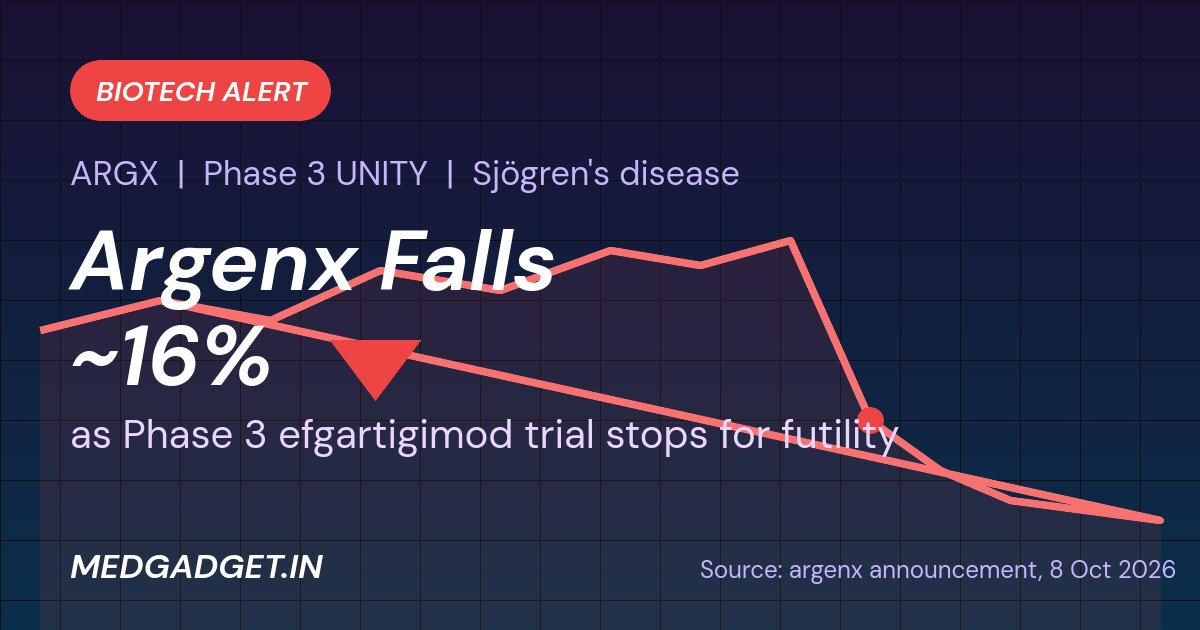
The most expensive moment in drug development is a late-stage miss, and on Thursday 8 October 2026 it was argenx’s turn. The Belgian-Dutch biotech said it will stop its Phase 3 UNITY study of subcutaneous efgartigimod in Sjögren’s disease after an independent committee found the trial was unable to meet its primary endpoint. This argenx Phase 3 trial failure sent the shares sharply lower: market reports put the one-day fall at roughly 16%.
The decision came from an interim analysis, not a final readout. In practice the result is the same for this indication: UNITY will not continue, and efgartigimod will not be filed for Sjögren’s on the back of it. Here is what happened, what it does and does not say about the drug, and what investors and patients should watch next.
At a glance
- Event: argenx is discontinuing the Phase 3 UNITY study of efgartigimod SC (efgartigimod alfa and hyaluronidase-qvfc) in adults with moderate-to-severe Sjögren’s disease.
- Why: an Independent Data Monitoring Committee recommended stopping for futility after an interim analysis.
- Safety: consistent with the drug’s established profile; no new safety signals reported.
- Market reaction: shares fell roughly 16% in reports we reviewed; the exact figure depends on the listing and the time of day.
- Other news the same day: a Phase 2 celiac disease study of FB102 reported positive topline results.
What the UNITY trial was testing
UNITY was a randomised, double-blind, placebo-controlled, multicentre study with an open-label extension. Patients were randomised 1:1 to weekly subcutaneous efgartigimod or placebo. Participants were adults who met the 2016 ACR/EULAR criteria for primary Sjögren’s disease, tested positive for anti-Ro/SSA autoantibodies, and had moderate-to-severe systemic disease activity (clinESSDAI of 6 or more) while on stable standard of care.
The primary endpoint was the change from baseline in systemic disease activity, measured by clinESSDAI, at Week 48. Key secondary endpoints included the share of patients reaching low disease activity (clinESSDAI below 5), STAR responder status, patient-reported symptoms and safety. The trial is listed on ClinicalTrials.gov for readers who want the registered design.
Why a futility stop matters
A data monitoring committee recommends stopping for futility when the numbers suggest the study is very unlikely to reach statistical significance on its main goal even if it ran to the end. It is a judgement about probability, based on the interim data, not proof that the drug has no effect in any patient.
The company has not released enrolment numbers, interim values or effect sizes. Until it does, outsiders cannot tell whether the drug showed a small signal that was too weak to win, or no separation from placebo at all. After the study closes and the database is locked, argenx says it will analyse the data in depth to understand the outcome and inform future Sjögren’s research, and plans to share what it learns with the Sjögren’s community.
Chief Medical Officer Luc Truyen said the company is “disappointed by this outcome”, particularly for patients still waiting for treatments that change the course of the disease.
Sjögren’s disease: why the miss is felt beyond the stock
Sjögren’s is a chronic autoimmune disease best known for dry eyes and dry mouth, but it can also affect joints, lungs, kidneys, nerves and other organs, which is the systemic disease the trial measured. Patient groups such as the Sjögren’s Foundation describe a high unmet need, and the company’s own statement framed the outcome in those terms.
Efgartigimod works by lowering levels of IgG antibodies, a mechanism that has succeeded in several antibody-driven conditions. Sjögren’s involves autoantibodies, which gave the idea a scientific rationale and is one reason the failure draws attention. In our assessment, it is a reminder that a mechanism working in one disease does not guarantee success in a neighbouring one.
The rest of the efgartigimod pipeline
The setback lands against a pipeline with recent wins, according to the company’s announcements. Its Phase 3 ALKIVIA study in autoimmune myositis reported positive topline results on 17 August 2026, new myasthenia gravis and CIDP data were presented on 29 September 2026, and the Phase 2 celiac disease study of FB102 met its primary endpoint on the same day as the UNITY news.
Efgartigimod products are already approved. VYVGART is approved for generalised myasthenia gravis and, in Japan only, immune thrombocytopenia, while VYVGART Hytrulo is approved for generalised myasthenia gravis and chronic inflammatory demyelinating polyneuropathy. Those approvals, not Sjögren’s, drive current revenue.
What to watch next
- The full data package: enrolment, effect sizes and any subgroup signals once the database is locked.
- Pipeline guidance: whether the company updates priorities and timelines for myositis and other programmes.
- Competitors: other developers in Sjögren’s will read the UNITY design and endpoint choices closely.
- Share price: after a one-day drop of this size, markets will weigh how much of the company’s value depended on the Sjögren’s opportunity versus approved products and other programmes.
Late-stage biotech outcomes cut both ways across the sector; for a contrasting readout, see another Phase 3 readout in oncology, and browse our wider pharmaceutical news.
Frequently asked questions
Why did argenx stock fall in October 2026?
The company announced it would discontinue the Phase 3 UNITY study of efgartigimod in Sjögren’s disease after an interim analysis showed it would be unable to meet its primary endpoint. Reports put the drop at roughly 16%.
Did the UNITY trial fail because of safety?
No. The company said safety was consistent with the established profile and no new safety signals were identified. The stop was for futility, meaning lack of efficacy on the primary endpoint.
What is efgartigimod used for?
VYVGART is approved for generalised myasthenia gravis, and in Japan for immune thrombocytopenia. VYVGART Hytrulo is approved for generalised myasthenia gravis and CIDP.
Will efgartigimod be approved for Sjögren’s disease?
Not on the basis of UNITY, which is being discontinued. The company says it will analyse the data to inform future research.
What other efgartigimod studies are running?
Reported programmes include autoimmune myositis, where the Phase 3 ALKIVIA study was positive, and the FB102 celiac disease programme, where a Phase 2 study met its primary endpoint.
How we reported this: we used argenx’s company announcement of 8 October 2026, its clinical trial description and market reports for the share move. The company did not disclose enrolment or interim effect sizes; we have not seen the full data. Last updated: 8 October 2026. This article is news reporting, not investment, financial or medical advice.