

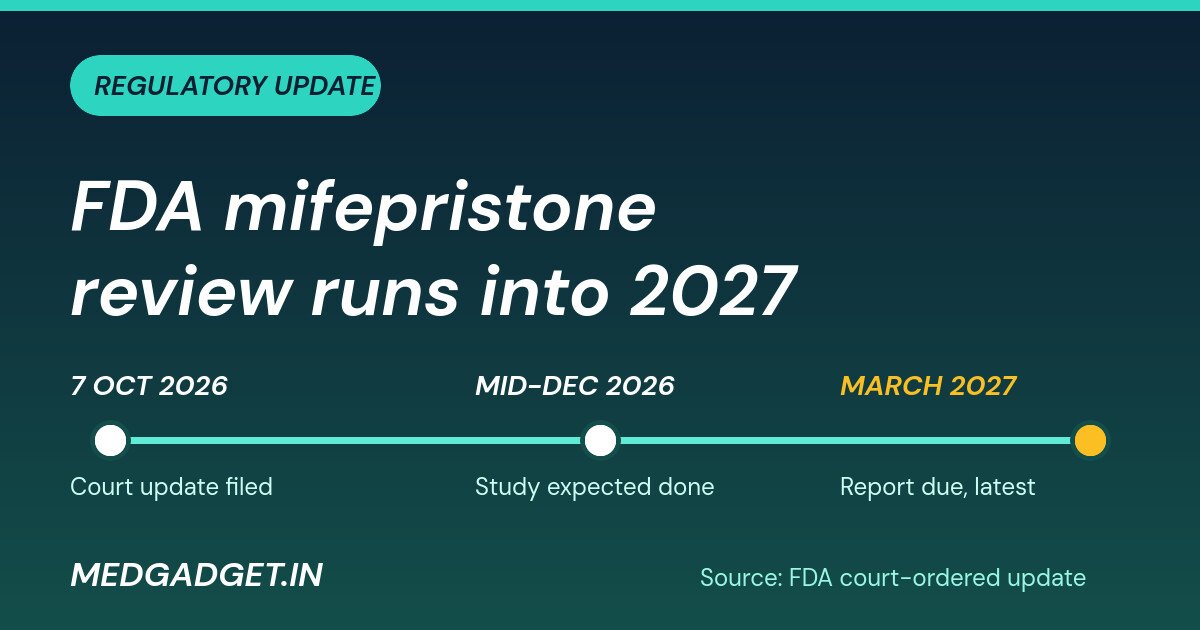
The US drug regulator has told a federal court that its safety review of mifepristone, the first drug in the most common abortion regimen in the United States, will not finish this year. In a court-ordered update filed late on 7 October 2026, the agency said its FDA mifepristone review should reach a report “no later than March 2027”, after which it will decide whether to change how the drug can be used.
Nothing about access to the medicine changed with the filing. The review is ongoing, no new restrictions have been announced, and the agency has not said what it will recommend. Below is the timeline, what the review is examining, the legal context, and how both sides of the debate have responded. We have kept to what the filing and the agency’s statements establish.
The timeline in the filing
- 7 October 2026: the FDA files a court-ordered progress update in a case brought by the state of Louisiana.
- Mid-December 2026: the agency expects to complete its safety study.
- No later than March 2027: a report on the findings is expected.
- After the report: the agency will decide whether to impose new restrictions or other changes.
What is being reviewed
The review was ordered by Health and Human Services Secretary Robert F. Kennedy Jr. The FDA says it is using a statistical data-mining method to look for previously unknown safety concerns. The data come from an electronic database of reports on medical injuries and drug side effects from major health networks and insurers.
The agency is also considering several petitions that propose changes to how mifepristone is prescribed and distributed. The reports we reviewed do not describe the methods, thresholds or reviewers in more detail, and we did not see the full filing, so we cannot assess how rigorous the analysis will be.
Why a Louisiana case is driving the update
The court order that prompted the update arose from a lawsuit by Louisiana, which argues that mail delivery of mifepristone undermines the state’s abortion ban. A federal judge ordered the FDA to report on its progress. The reports we reviewed do not name the court or give a case number, so we do not cite one.
Separately, a three-judge panel of the 5th US Circuit Court of Appeals questioned the merits of Louisiana’s case last month, including whether the state has standing to sue. Other state lawsuits related to mifepristone are also moving through the courts. A ruling in any of them would be a separate legal event from the FDA’s review, and reports say a 5th Circuit ruling would not immediately change access.
Background: how the drug is regulated
The U.S. Food and Drug Administration first approved mifepristone in 2000, and the agency has repeatedly reaffirmed its safety and effectiveness while easing some restrictions, including dropping an in-person dispensing requirement. A 2021 decision allowed telehealth prescribing and mail delivery during the COVID-19 pandemic, and the Biden administration made that permanent in 2023. Opponents say those changes undermine state abortion bans. The two-drug regimen of mifepristone followed by misoprostol is the most common form of abortion in the country.
How the two sides are reacting
Opponents of the pill are unhappy with the delay. Gavin Oxley of Americans United for Life criticised the timeline as a lack of “true leadership”, saying the administration is “clearly uninterested” in addressing harms from the drug.
Supporters of access have previously described the review as politically driven; we did not find a statement from them attached to this particular filing, so we do not attribute one. The agency itself has repeatedly said the drug is safe and effective.
In our assessment, the extended timeline means the policy question stays open through the winter, and any change would likely arrive after the report. Because the review sits inside an active court dispute, any FDA decision could draw fast legal challenges from one side or the other.
What this means in practice
- Patients and clinicians: current rules still apply. Anyone with questions about prescribing or access should check with a licensed provider and the current FDA labelling, since state laws vary.
- States: litigation continues; the filing does not change any state’s law.
- Pharma and generic makers: regulatory uncertainty persists until at least March 2027.
- Possible outcomes: the FDA could keep current rules, tighten them, or restrict specific channels such as telehealth or mail delivery. Commentators have noted that a full withdrawal of approval would be extraordinary. None of these has been announced.
For related regulatory timelines, see another FDA review extension and our wider pharmaceutical regulation coverage. Official updates appear on the U.S. Food and Drug Administration and Department of Health and Human Services sites, and court developments are tracked through the federal judiciary.
Why the timeline matters
A review that ends in mid-December and reports by March gives all sides a fixed horizon to plan around. Clinicians and telehealth providers will be watching for any change to prescribing channels, states on both sides of the debate will be watching for what the agency says about mail delivery, and manufacturers will be watching for any labelling or distribution conditions.
It also shows how closely regulatory work and litigation are now linked. A court asked for a status report, and the agency answered with dates. Whether those dates hold, and whether the report is published in full, will shape how much weight each side gives the findings. We will update this article when the agency publishes its findings or the court schedule changes.
Frequently asked questions
What did the FDA tell the court about its mifepristone review?
That it expects to finish its safety study by mid-December 2026 and to issue a report no later than March 2027.
Has the FDA restricted mifepristone?
No. As of 8 October 2026 the agency has announced no new restrictions, and the review is ongoing.
Who ordered the review?
HHS Secretary Robert F. Kennedy Jr.
What is the FDA reviewing?
It is using data mining on adverse-event reports to look for unknown safety concerns and is considering petitions proposing changes to prescribing and distribution.
Can mifepristone still be prescribed?
Yes, under current federal rules, though state laws differ. Check with a licensed provider.
How we reported this: we relied on the agency’s court-ordered update as described in reporting on 8 October 2026 and on public regulatory background. We did not see the full filing. Last updated: 8 October 2026. This article is news reporting, not legal or medical advice.