

Does adding epcoritamab to R-CHOP work better than R-CHOP alone in newly diagnosed DLBCL? According to a topline announcement from AbbVie and Genmab on 5 October 2026, yes on the main measure: the Phase 3 EPCORE DLBCL-2 trial met its primary endpoint, with a 51% lower risk of progression or death. That is the first time a Phase 3 study has beaten R-CHOP, the chemotherapy-antibody regimen used for roughly 25 years, on progression-free survival in this setting, according to the companies. The data are topline, and the full picture is still to come.
The short answer, and the catch
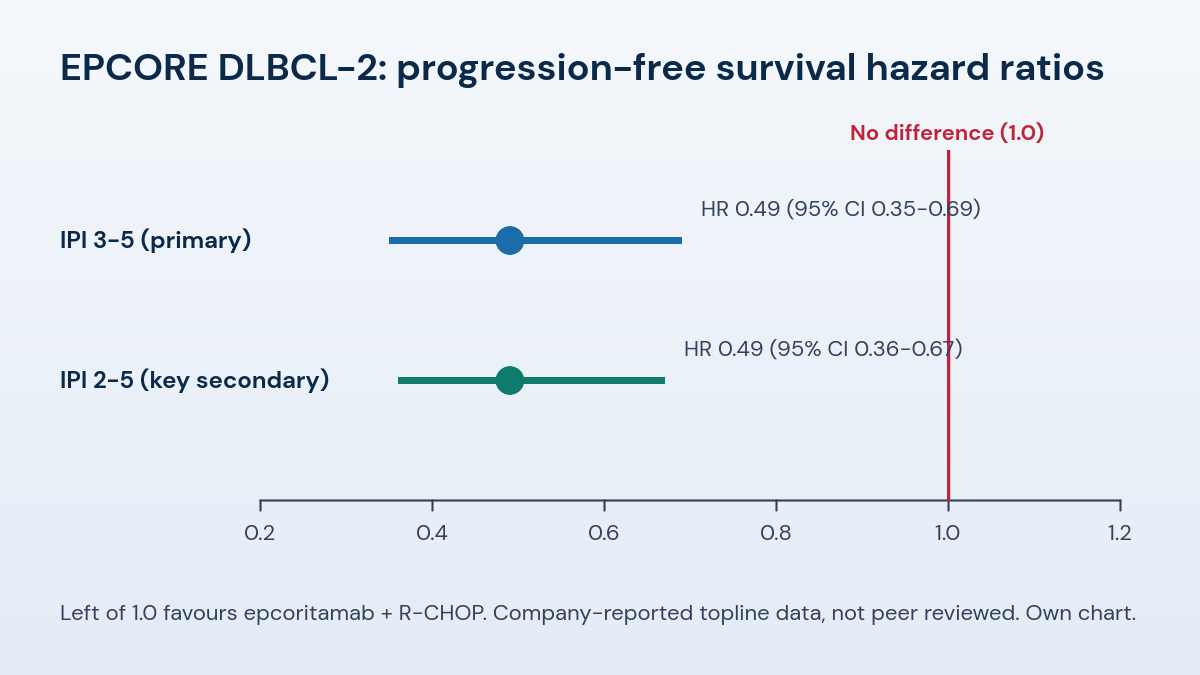
- The result: epcoritamab plus R-CHOP reduced the risk of progression or death by 51% versus R-CHOP alone (hazard ratio 0.49; 95% confidence interval 0.35 to 0.69; p<0.0001) in patients with an International Prognostic Index (IPI) score of 3 to 5.
- The wider group: the same 51% reduction (HR 0.49; 95% CI 0.36 to 0.67; p<0.0001) held in the total population with IPI scores of 2 to 5, a key secondary endpoint.
- The catch: enrolment numbers, overall survival, and specific safety rates have not been released. The companies call the regimen “generally well tolerated,” consistent with earlier safety profiles.
- The status: epcoritamab with R-CHOP is investigational and not approved for newly diagnosed DLBCL. The companies say they will engage global regulators and bring the data to a future medical meeting.
Why a 25-year-old regimen matters
R-CHOP is an acronym for rituximab plus four chemotherapy drugs: cyclophosphamide, doxorubicin, vincristine and prednisone. It was established as standard care nearly 25 years ago, and it still cures many patients, but not all. diffuse large B-cell lymphoma is the most common type of non-Hodgkin lymphoma worldwide, making up roughly 25% to 30% of cases, with about 25,000 new diagnoses a year in the United States, according to the companies. Patients whose disease returns or never responds face far tougher treatment.
That is why oncologists have been trying to improve the first attempt at a cure, not just the rescue options. Several add-on strategies have been tested against R-CHOP over the years, and the companies say EPCORE DLBCL-2 is the first Phase 3 study to show a statistically significant progression-free survival improvement over it. We have not independently verified that claim.
What epcoritamab does
Epcoritamab is a bispecific antibody given by injection under the skin. One arm grabs CD3 on the body’s T cells and the other grabs CD20 on B cells, including lymphoma cells, pulling the two together so the T cells can attack. It is marketed as EPKINLY in the US and Japan and TEPKINLY in the European Union, and the companies say it is approved in more than 65 countries for certain lymphomas, including relapsed or refractory DLBCL and relapsed or refractory follicular lymphoma. Those approvals are in patients who have already had treatment. The new trial moves the drug to the very first line of therapy.
How the trial was built
| Feature | Detail |
|---|---|
| Trial | EPCORE DLBCL-2, Phase 3, randomised 2:1 (NCT05578976), started 8 February 2023 |
| Population | Newly diagnosed DLBCL, IPI score 2 to 5; includes DLBCL NOS, high-grade B-cell lymphoma with MYC/BCL2/BCL6 rearrangements, FL3B, T-cell/histiocyte-rich LBCL and EBV-positive DLBCL |
| Experimental arm | Epcoritamab + R-CHOP for 6 cycles, then epcoritamab alone for 2 cycles |
| Control arm | R-CHOP for 6 cycles, then rituximab for 2 cycles |
| Primary endpoint | Progression-free survival in IPI 3-5: HR 0.49 (95% CI 0.35-0.69), p<0.0001 |
| Key secondary endpoint | PFS in IPI 2-5: HR 0.49 (95% CI 0.36-0.67), p<0.0001 |
| Safety | Described as generally well tolerated; rates not disclosed |
| Not yet disclosed | Enrolment size, overall survival, adverse-event rates |
The hazard ratio is a relative measure. A hazard ratio of 0.49 means the rate of progression or death over the study period was about half as high with the combination, but it does not by itself tell you how many extra patients stay disease-free at, say, two years. That absolute figure is what clinicians will look for when the full data appear.
The question hanging over the data: what about EPCORE DLBCL-1?
Readers following this drug will remember that a different Phase 3 study, EPCORE DLBCL-1, caused confusion earlier this year. That trial tested epcoritamab alone against chemotherapy in relapsed or refractory DLBCL. In July 2026 the companies clarified that overall survival, the sole US primary endpoint, was not met. The two trials ask different questions, in different patients, with different endpoints, so one result does not predict the other. But it is a reminder that a positive progression-free survival readout is not the same as an overall survival benefit, and that is why the missing overall survival data in EPCORE DLBCL-2 matter.
What patients and families should know
Nothing changes today. R-CHOP remains the standard first treatment for most people with newly diagnosed DLBCL, and epcoritamab with R-CHOP is available only in clinical research. Anyone with a diagnosis should discuss options, including clinical trials such as NCT05578976 on ClinicalTrials.gov, with their haematologist or oncologist. For a plain-language overview of how these lymphomas are treated, see the adult non-Hodgkin lymphoma treatment overview from the US National Cancer Institute.
What is still unknown
- How many patients were enrolled, and how they were distributed across IPI groups and subtypes.
- Whether progression-free survival translates into longer overall survival.
- Rates of cytokine release syndrome, neurotoxicity, infections and serious adverse events when epcoritamab is added to chemotherapy.
- Whether regulators will accept progression-free survival as the basis for approval, and the timing of any filing.
Our assessment
In our assessment, this is the strongest evidence yet that a bispecific antibody can move from the rescue setting to the front line. A 51% lower risk of progression, confirmed in a broader secondary population, with p<0.0001 is a robust signal. But topline releases show the best angle of a trial. Until safety, enrolment and survival data are on the table, we would read it as a promising result and not a change in practice.
The deal-making around the sector shows the same appetite for T-cell engagers: see our reports on the Novartis–Abogen T-cell engager licence, the CSL–Alentis partnership and the Lilly–Gate Bioscience collaboration for related partnership news.
Frequently asked questions
What is the EPCORE DLBCL-2 trial?
It is a Phase 3 randomised study (NCT05578976) comparing epcoritamab plus R-CHOP with R-CHOP alone in newly diagnosed DLBCL.
Did EPCORE DLBCL-2 meet its primary endpoint?
Yes. The companies report a statistically significant improvement in progression-free survival, with a hazard ratio of 0.49 in patients with IPI scores of 3 to 5.
Is epcoritamab approved for newly diagnosed DLBCL?
No. Current approvals are for certain relapsed or refractory lymphomas. Use with R-CHOP in newly diagnosed disease is investigational.
What does a 51% risk reduction mean?
It means the hazard of progression or death was about half as high with the combination as with R-CHOP alone. It is not the same as a 51% higher cure rate.
Was overall survival reported?
Not in the topline announcement. The companies have not yet released overall survival or detailed safety data.
When could the combination be approved?
No timeline has been given. The companies say they will discuss the data with global regulators.
How we reported this: details come from the AbbVie and Genmab announcement of 5 October 2026 and related company materials. Efficacy, safety and market statements are company-reported topline findings and have not been peer reviewed. This is not medical advice; talk to your clinician about treatment. Last updated 6 October 2026.
[…] Triple-Combination COPD Inhaler Infigratinib Gets FDA Priority Review for Achondroplasia EPCORE DLBCL-2: Epcoritamab Plus R-CHOP Cuts Risk 51% Lilly Expands Gate Bioscience Deal to Over $870 Million CSL Alentis Partnership: $1.6B […]