

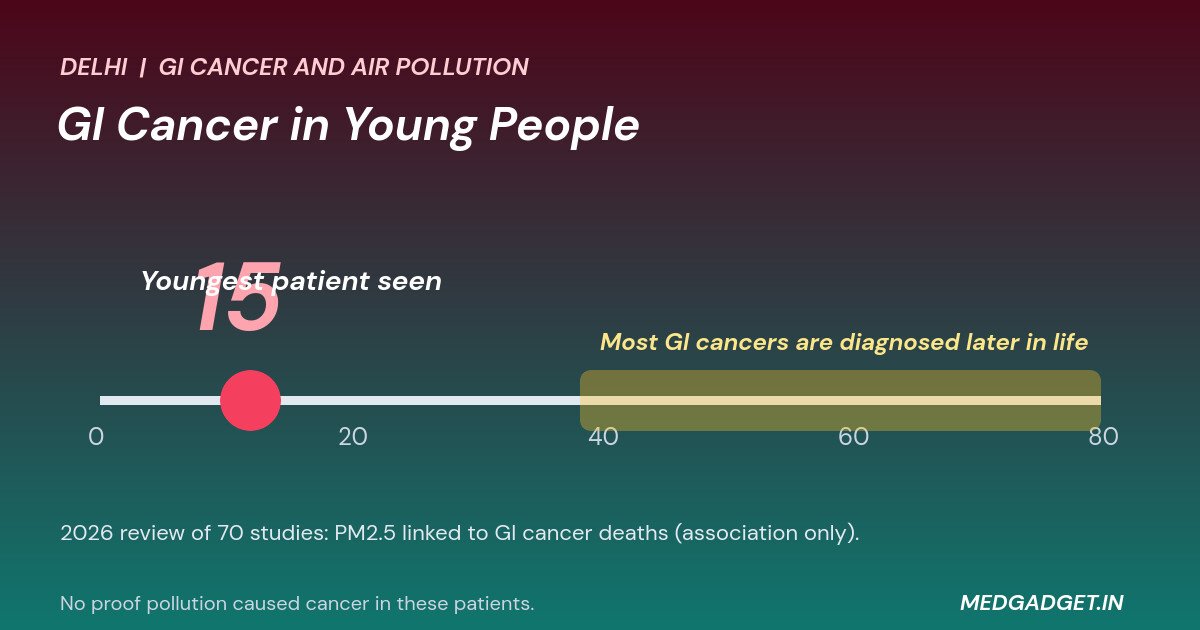
Doctors at Sir Ganga Ram Hospital in Delhi say they are now seeing GI cancer in young people India that was uncommon five years ago, with new patients as young as 15. The finding was shared at a two-day international conference on colorectal and other gastrointestinal cancers held on 10 and 11 October 2026, where specialists also discussed air pollution as a possible factor.
It is important to be clear about what is and is not known. A 2026 scientific review found links between long-term air pollution and gastrointestinal cancer outcomes, but doctors stress that there is no established evidence that pollution caused cancer in these particular young patients. This article sets out what was said, what the evidence shows, and which symptoms need attention.
GI cancer in young people India: key points
- What doctors reported: new gastrointestinal cancer patients as young as 15 in the hospital’s outpatient department, something described as uncommon five years ago.
- The pollution evidence: a 2026 review of 70 studies linked long-term exposure to fine particles (PM2.5) with higher GI cancer deaths, especially colorectal cancer.
- The caveat: these are associations. They do not prove that pollution caused cancer in these patients.
- What experts want: better air monitoring, stronger cancer registries and long-term Indian studies.
- Not reported: how many young patients there are, or the cancer type in the 15-year-old.
What doctors said about GI cancer in young people India
The conference was organised by Sir Ganga Ram Hospital with The Christie NHS Foundation Trust of the UK. Dr Shyam Aggarwal, chairperson of medical oncology at the hospital, said the outpatient clinic now sees new GI cancer patients as young as 15, which was uncommon five years ago. No numbers or percentages of young patients were given, so we cannot say how widespread the pattern is.
Dr Saumitra Rawat, who heads surgical gastroenterology at the hospital, urged doctors to investigate younger patients thoroughly, looking at family history, genetic susceptibility, diet, lifestyle, infections and possible environmental exposures. The Union Health Secretary was chief guest and stressed prevention, early diagnosis, public awareness and access to quality healthcare.
Early-onset gastrointestinal cancer and GI cancer in young people India: the wider trend
Early-onset gastrointestinal cancer, usually meaning cancer diagnosed before age 50, has been rising in several countries. Dr Aggarwal pointed to England, where colorectal cancer in people under 50 rose from 3.9 to 8.4 per 100,000 between 2001 and 2023. By our calculation, that is a little more than a doubling, or about 115%.
India’s figure is lower. Dr Aggarwal gave a rate of 3.5 per 100,000 for people aged 25 to 49, though urban cancer registries suggest it is increasing. These two numbers use different age bands, so they show the direction of travel and should not be compared directly. India’s data are also limited, which is one reason experts want stronger registries.
The air pollution link to GI cancer in young people India: what studies found
Two 2026 studies were cited at the conference. The first, a review in Epidemiologic Reviews covering 70 studies on air pollution and gastrointestinal disease, found that long-term exposure to PM2.5 was associated with higher mortality from GI cancers, particularly colorectal cancer.
The second, in Nature Health, looked at the cancer burden from outdoor air pollution across 952 locations between 2000 and 2020. It linked higher exposure to PM2.5, nitrogen dioxide and ozone with a higher overall cancer risk. It was not specific to gastrointestinal cancers and did not establish direct causation.
The World Health Organization (WHO) fact sheet on outdoor air quality describes air pollution as a major risk to health, and explains that PM2.5 are tiny particles that can enter the bloodstream. Doctors also want attention on ground-level ozone, which forms when nitrogen oxides and volatile compounds react in sunlight and can rise in warm weather, and want it monitored all year.
Does Delhi air pollution cancer risk explain GI cancer in young people India?
Not on current evidence. Dr Rawat said the findings show associations only, and that India must strengthen its own research instead of drawing conclusions from associations alone. The studies cited look at populations over time and at deaths, not at what caused cancer in a specific teenager. Established causes such as tobacco, diet, obesity, family history and inherited conditions remain central to any individual diagnosis.
Our reading is that pollution is a reasonable hypothesis to study, but not a proven cause of the cases described. Readers should treat headlines that link the two directly with caution.
Gastrointestinal cancer symptoms: when to see a doctor
Doctors stress recognising persistent digestive symptoms and seeking medical advice early. According to general guidance from sources such as the National Cancer Institute, symptoms that deserve a medical check include the following. Many have common, harmless causes, but they should not be ignored if they last.
- A change in bowel habits, such as constipation or diarrhoea, that lasts for weeks.
- Blood in the stool or rectal bleeding.
- Persistent stomach pain, cramps or bloating.
- Unexplained weight loss or loss of appetite.
- Unexplained tiredness or signs of anaemia.
- Difficulty swallowing or repeated vomiting.
Colorectal cancer in young adults is easy to miss because it is seldom the first suspicion. A young person with persistent bleeding or weight loss should ask for a proper examination and not wait for the symptoms to go away.
What experts recommend on GI cancer in young people India
- Stronger air-quality monitoring, including ozone, across the year.
- Better cancer registries and long-term Indian studies linking exposure to patient outcomes.
- Reducing emissions and improving air quality as a public-health measure.
- Continued focus on established risk factors, appropriate screening and timely diagnosis.
Our assessment of GI cancer in young people India
In our assessment, the most useful part of this story is the call for data. Doctors in a busy referral hospital are seeing something that feels new, but without registry numbers it is hard to know whether GI cancer in young people India is truly rising or whether referral patterns and awareness are changing. The pollution question is worth asking, as our report on the Lancet’s 17 global health threats shows, but the answer needs studies and not assumptions.
For related cancer coverage, see our report on India’s cap on cancer drug trade margins or browse our healthcare services section.
What to watch next on GI cancer in young people India
- Whether the hospital or Indian registries publish numbers on young GI cancer patients.
- New Indian studies on air pollution and gastrointestinal cancer.
- Any change in screening guidance for younger adults.
- Policy action on air quality and ozone monitoring.
Frequently asked questions
Is GI cancer in young people India rising?
Doctors at Sir Ganga Ram Hospital report seeing more young patients, but national data on the trend are limited.
Does air pollution cause gastrointestinal cancer?
Studies link long-term exposure to higher GI cancer deaths, but these are associations and do not prove that pollution caused cancer in individual patients.
What are early signs of gastrointestinal cancer?
Lasting changes in bowel habits, blood in the stool, abdominal pain, unexplained weight loss and tiredness.
How young were the patients with GI cancer in young people India?
The youngest reported was 15, according to Dr Shyam Aggarwal, though the cancer type was not stated.
Should young people be screened?
The conference stressed established risk factors, appropriate screening and timely diagnosis. Ask a doctor about your own risk, especially if cancer runs in your family.
How we reported this: we relied on remarks reported from the Sir Ganga Ram Hospital conference on 10 and 11 October 2026, on the two 2026 studies as described there, and on public cancer-information pages. We have not read the full studies. Figures labelled as ours are our own calculations. Last updated: 12 October 2026. This article is news reporting and not medical advice.
[…] whether overall survival points the same way. For other recent cancer coverage, see our reports on gastrointestinal cancer in young people in India and on India’s cancer drug margins, or browse more pharmaceutical […]
[…] related coverage, see our reports on the rise of gastrointestinal cancer among young Indians, the Siemens Healthineers Accela imaging launch and the Bristol Myers radiopharmaceutical trial, or […]
[…] Sciences partnership on AI-assisted pathology, and for broader cancer context see our report on gastrointestinal cancer in young people in India. Readers can find background on the condition from the US National Institute of Diabetes and […]
[…] since the best test is the one that actually gets done. For related coverage, see our report on gastrointestinal cancer in young people in India, our piece on Tecentriq for stage III colon cancer, or browse our medical device […]