

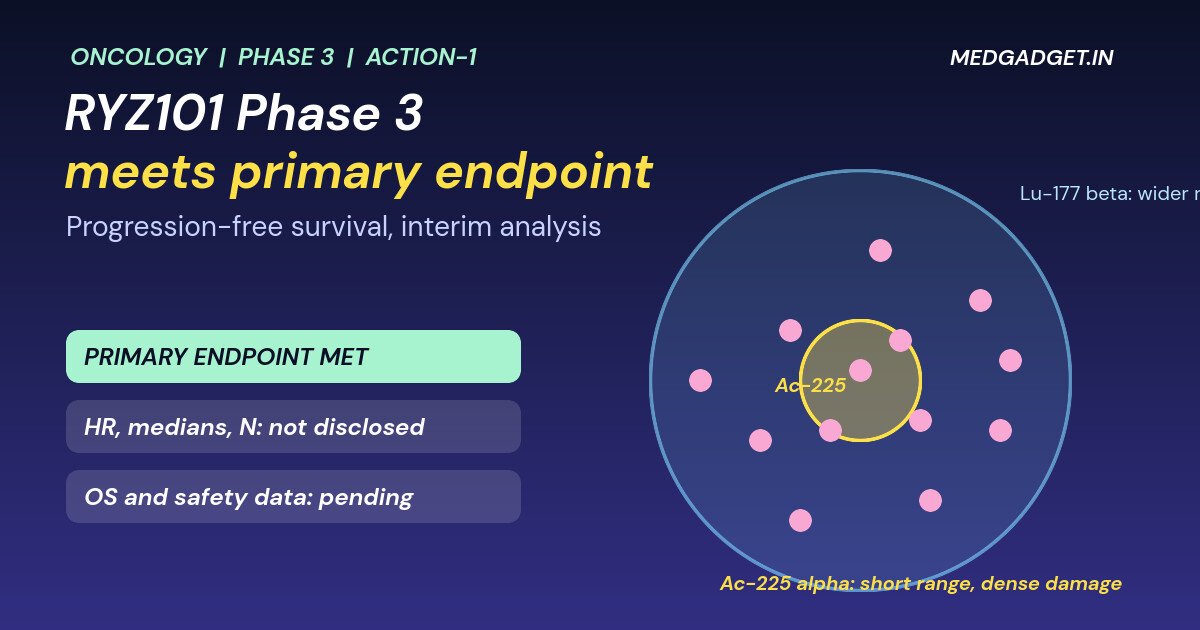
The Bristol Myers cancer clinical trial 2026 result announced on 12 October 2026 is the first Phase 3 readout for an experimental radiation drug called RYZ101. Bristol Myers Squibb said the ACTION-1 trial met its main goal at a planned interim analysis, with a statistically significant improvement in progression-free survival, the time before the cancer grows or the patient dies, in people with advanced neuroendocrine tumours of the gut and pancreas that had stopped responding to earlier radiation therapy.
It is a promising headline from a company with every reason to be pleased. But the company has not released a single number on how big the benefit is. This report explains what the trial tested, what was and was not disclosed, and why the details matter for patients with few options.
Bristol Myers cancer clinical trial 2026: what was announced
- Trial: ACTION-1, a randomised Phase 3 study (NCT05477576) run by RayzeBio, a Bristol Myers Squibb company.
- Drug: RYZ101, which links the tumour-seeking molecule DOTATATE to actinium-225, a radioactive atom that emits alpha particles.
- Patients: adults with somatostatin receptor-positive gastroenteropancreatic neuroendocrine tumours (GEP-NETs) that progressed after lutetium-177 therapy.
- Comparator: the investigator’s choice of standard care, which could be higher-dose or more frequent long-acting somatostatin analogues, everolimus or sunitinib.
- Main result: the primary endpoint, progression-free survival judged by blinded independent central review, was met at a planned interim analysis.
- Regulatory: the FDA granted RYZ101 orphan drug designation for GEP-NETs in August 2026, and the company plans to talk to the agency about next steps.
What the ACTION-1 trial tested in the Bristol Myers cancer clinical trial 2026
GEP-NETs grow slowly but can spread, and most are found after they have already metastasised, according to the company. Many carry a receptor called SSTR2, which the company says appears in 80% to 90% of tumours, and that receptor is what radioligand drugs aim at. Lutetium-177 therapy, which is already approved, uses the same idea. The company says most patients eventually progress on it, and ACTION-1 asks whether an alpha-emitting version can help them next. The National Cancer Institute offers general background on radiation treatment.
The company estimates about 18,000 new GEP-NET diagnoses a year in the United States and fewer than 200,000 people living with the disease. Those are company figures, and the release has nothing on availability outside the US.
How the Bristol Myers cancer clinical trial 2026 drug differs from lutetium-177
Lutetium-177 emits beta particles, which travel further and spread their energy over a wider area. Actinium-225 emits alpha particles, which travel only a few cell widths but deposit far more energy along that short path, causing breaks in both strands of DNA. The company presents this as a reason to expect more cell death. That is a rationale, not a demonstrated result, and alpha emitters raise their own questions about safety that a randomised trial must answer.
An early Phase 1b study of 17 people who had previously had lutetium-177 therapy reportedly found the drug well tolerated, with no treatment-related serious adverse events. Seventeen patients is a very small base, and the data are company-reported.
What the Bristol Myers cancer clinical trial 2026 has not disclosed
- Effect size: no hazard ratio, no median progression-free survival for either arm, no confidence intervals and no p-value.
- Trial size: the number of patients and events was not stated.
- Overall survival: no results yet, and patients continue to be followed for it.
- Safety: the company says safety was consistent with the known profile, but gave no adverse-event data from the randomised trial.
- Peer review: none. Detailed results are promised at a future medical meeting.
The company’s words, including “clinically meaningful,” and the executive description of the result as a “defining moment,” are characterisations, not data. The same applies to the claim that these are the first Phase 3 results for an alpha-emitting radiopharmaceutical in any indication, which comes from the company and the lead investigator and which we have not verified. One further point is that the comparison arm mixes three different treatments, so how much the control arm’s results vary could shape how convincing the gain looks.
Our assessment of the Bristol Myers cancer clinical trial 2026
In our assessment, the Bristol Myers cancer clinical trial 2026 result is an encouraging first step but not yet a basis for judging the drug. A positive primary endpoint at an interim analysis, with blinded central review of scans, is a stronger design than many early oncology announcements. Without an effect size, we cannot say whether patients gain weeks or many months. Interim results can also change as follow-up grows. The key tests will be the size of the benefit, the pattern of side effects such as effects on blood counts and the kidneys, and whether overall survival points the same way. For other recent cancer coverage, see our reports on gastrointestinal cancer in young people in India and on India’s cancer drug margins, or browse more pharmaceutical news.
One report noted that Bristol Myers shares were down about 3% around the time of publication, without linking the move to this news. We would not read anything into that.
What to watch after the Bristol Myers cancer clinical trial 2026
- Presentation of full ACTION-1 data at a major medical meeting, such as those organised by the European Society for Medical Oncology.
- Hazard ratio, median progression-free survival and the size of the trial.
- Overall survival and adverse-event data.
- Any FDA submission and timeline.
- The company’s other RYZ101 studies, including in breast cancer.
Frequently asked questions
What did the Bristol Myers cancer clinical trial 2026 show?
It showed that RYZ101 met its primary goal of improving progression-free survival at a planned interim analysis, according to the company, but no numbers were released.
What is RYZ101 in the Bristol Myers cancer clinical trial 2026?
An investigational radiopharmaceutical that attaches actinium-225 to DOTATATE to deliver alpha radiation to tumours carrying somatostatin receptors.
Who was in the Bristol Myers cancer clinical trial 2026?
Adults with GEP-NETs that had progressed after lutetium-177 therapy.
Is the Bristol Myers cancer clinical trial 2026 drug approved?
No. It is investigational, and the company is planning FDA discussions.
Did the Bristol Myers cancer clinical trial 2026 show a survival benefit?
Not yet. Overall survival results have not been reported.
How we reported this: we relied on the company’s announcement of 12 October 2026 and on the trial registry. Results are company-reported, from an interim analysis, and have not been peer reviewed. Figures labelled as ours are our own calculations. Last updated: 13 October 2026. This article is news reporting and not medical advice.
[…] Pulmonary Fibrosis Phase 3 Trial: 60 mg Wins Bristol Myers Cancer Clinical Trial 2026: RYZ101 Meets Goal Hēlo Thrombectomy FDA Clearance: Blood Return for PE Petrelintide Hits Phase 2 Primary Endpoint […]
[…] investigational new drug process. For other recent oncology trial reports, see our coverage of the Bristol Myers RYZ101 Phase 3 trial, the pulmonary fibrosis Phase 3 trial and rising gastrointestinal cancer among young Indians, or […]