

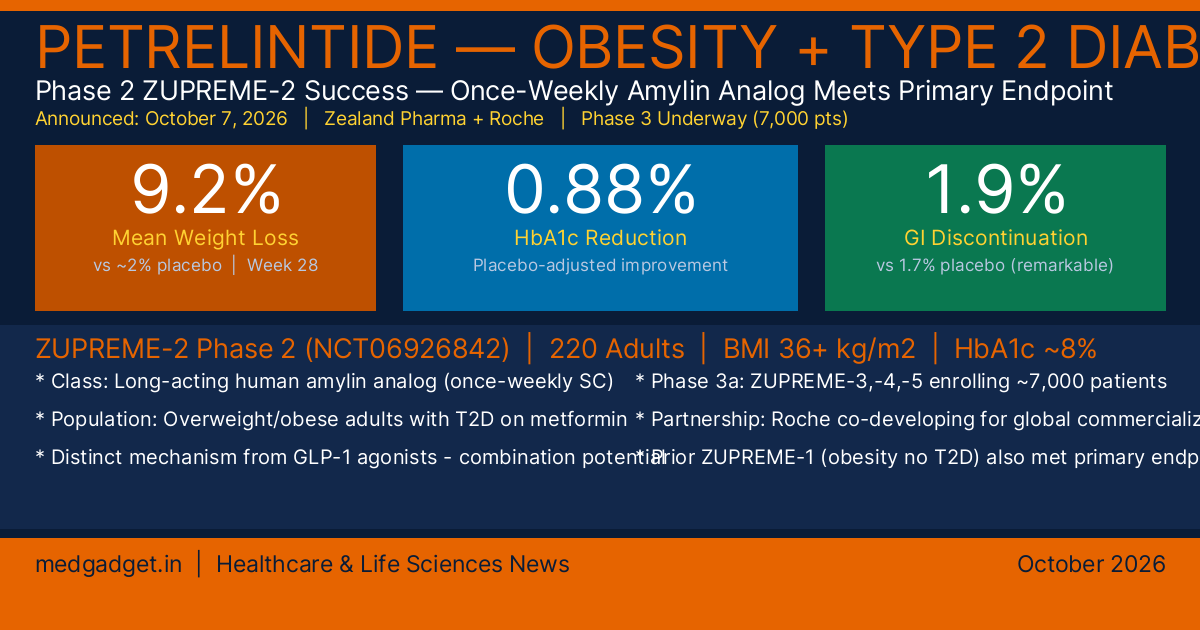
Zealand Pharma announced on October 7, 2026 that its investigational amylin analog petrelintide met the primary endpoint in the ZUPREME-2 Phase 2 trial in adults with overweight or obesity and type 2 diabetes (T2D). The drug achieved up to 9.2% mean weight loss from baseline at Week 28, compared to approximately 2% with placebo — a robust result that further validates petrelintide’s standalone potential as a metabolic therapy.
Zealand Pharma is co-developing petrelintide with Roche in a major collaboration, and a Phase 3a program (ZUPREME-3, -4, -5) across approximately 7,000 patients is now underway.
What Is Petrelintide? A New Class in the Obesity War
While the obesity drug market has been dominated by GLP-1 receptor agonists — semaglutide (Ozempic/Wegovy) and tirzepatide (Mounjaro/Zepbound) — petrelintide takes a different approach. It is a long-acting human amylin analog, designed to mimic the effects of amylin, a pancreatic hormone co-secreted with insulin.
Amylin acts centrally to:
- Slow gastric emptying
- Suppress glucagon secretion
- Promote satiety via brain receptors
- Reduce post-meal glucose spikes
The original amylin analog pramlintide (Symlin) had limited uptake due to multiple daily injections and modest weight loss. Petrelintide, as a once-weekly subcutaneous formulation, overcomes the key limitation of its predecessor. Its co-development with Roche — a company increasingly committed to the obesity space — significantly boosts its development resources and commercial potential.
ZUPREME-2 Trial: Design and Results
ZUPREME-2 (NCT06926842) was a Phase 2, randomized, double-blind, placebo-controlled trial enrolling 220 adults with:
- BMI ≥27 kg/m²
- Type 2 diabetes diagnosed ≥180 days prior
- On stable metformin ± an SGLT2 inhibitor
- Mean baseline BMI: 36.3 kg/m²; mean baseline HbA1c: 8%
Participants received one of three petrelintide dose levels or placebo by once-weekly subcutaneous injection. Dose escalation occurred over up to 16 weeks, with maintenance through Week 28.
Primary Endpoint — Mean % Body Weight Change at Week 28:
- Petrelintide: up to -9.2% mean weight loss from baseline across dose arms
- Placebo: approximately -2.0%
Glycemic Control (HbA1c):
- Placebo-adjusted HbA1c reductions of 0.61% to 0.88% across dose arms
- Meaningful improvement in T2D glycemic control on top of existing metformin/SGLT2i therapy
Safety:
- GI-related discontinuation: 1.9% (petrelintide) vs 1.7% (placebo) — remarkably low
- No unexpected safety signals observed
- Most adverse events were GI in nature, mild in severity, and concentrated during the dose escalation phase
Context: How Does This Compare to GLP-1s?
The 9.2% weight loss figure for petrelintide is meaningful — though it falls below the benchmarks set by leading GLP-1/GIP agonists:
- Semaglutide 2.4mg (Wegovy): ~15-17% weight loss in obesity
- Tirzepatide (Zepbound): ~20-22% weight loss in obesity
- Retatrutide (triple agonist, Phase 3): ~24% in Phase 2
However, the critical differentiator is the combination potential. Amylin works via a completely distinct receptor pathway from GLP-1 agonists. Zealand Pharma and Roche are investigating petrelintide as both a monotherapy and as a combination partner with GLP-1 receptor agonists — a strategy that could deliver additive or synergistic metabolic benefit beyond what either class achieves alone.
Additionally, the very low GI discontinuation rate (1.9%) versus placebo (1.7%) is strikingly better than GLP-1 agonists, which typically carry 5-15% discontinuation rates due to nausea and vomiting. This tolerability advantage could be significant for patients who cannot tolerate GLP-1 therapies.
Phase 3 Program and Roche Partnership
The ZUPREME-3, -4, and -5 Phase 3 trials are now enrolling approximately 7,000 patients across three populations:
- ZUPREME-3: Obesity without T2D
- ZUPREME-4: Obesity with T2D
- ZUPREME-5: Obesity with established cardiovascular disease
Full ZUPREME-2 data are expected to be presented at an upcoming major endocrinology or obesity conference. The Roche collaboration provides Zealand Pharma with global commercial infrastructure and development resources for what could become a significant pipeline asset in the next generation of metabolic therapies.
The Bigger Picture
ZUPREME-2 marks the second consecutive Phase 2 success for petrelintide — ZUPREME-1 (obesity without T2D) was also positive earlier in 2026. Together, these results establish petrelintide as a credible standalone agent in metabolic disease and a highly promising combination partner in the evolving obesity treatment landscape.
At a time when the obesity drug pipeline is one of the most crowded and commercially significant in biopharma history, petrelintide’s novel mechanism, excellent tolerability, and Roche backing give it a meaningful shot at carving out a real market position — either alone or as part of a combination regimen.
Sources: Zealand Pharma press release, ZUPREME-2 trial data (NCT06926842), HCPLive, BioPharm International, October 7, 2026.
[…] dual agonist licensed to Boehringer Ingelheim. For the latest petrelintide data, see our report on petrelintide’s Phase 2 ZUPREME-2 results, and for survodutide see survodutide weight loss in Phase III. The new collaboration is earlier and […]
[…] changes alone. BMF-650 is still far from that comparison. For wider context, see our reports on petrelintide’s Phase 2 results in obesity and type 2 diabetes and Novo’s drug-discovery deal for oral cardiometabolic […]
[…] but the strongest claims will rest on independent replication and the 12-month extension. See also Petrelintide Hits Phase 2 Primary Endpoint in Obesity + Type 2 Diabetes: Up to 9.2% Weight Loss (ZUP… for another type 2 diabetes trial. More in our medical device […]