

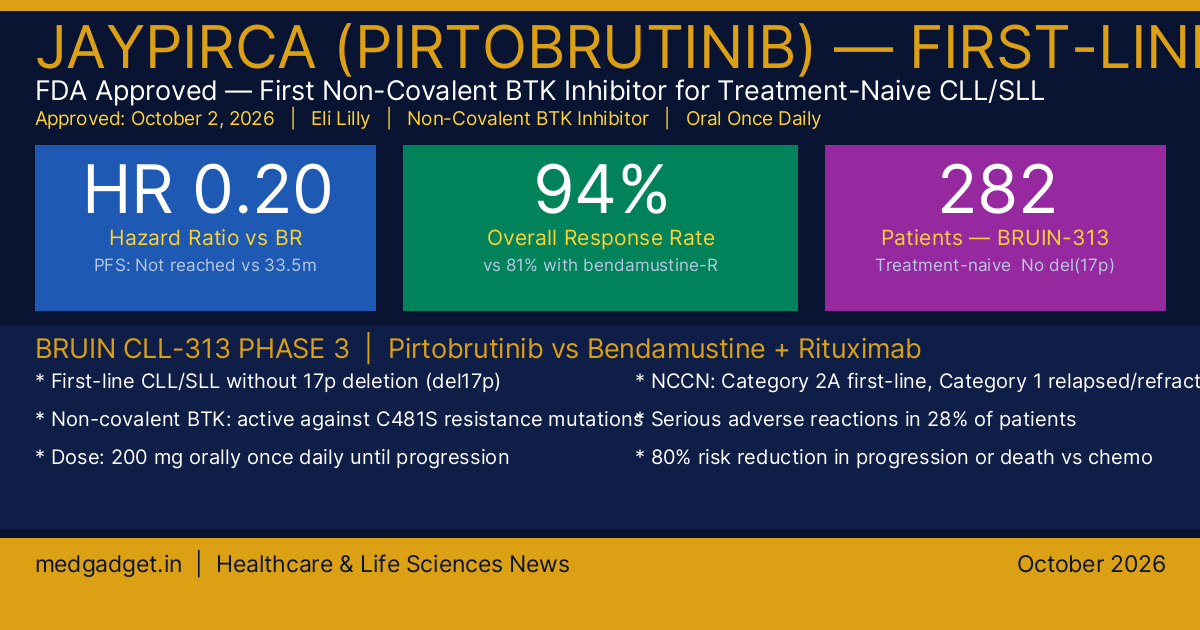
The U.S. Food and Drug Administration (FDA) approved pirtobrutinib (Jaypirca), Eli Lilly’s non-covalent BTK inhibitor, on October 2, 2026, for the first-line treatment of adults with chronic lymphocytic leukemia (CLL) or small lymphocytic lymphoma (SLL) without a known 17p deletion. The expanded approval makes Jaypirca the first and only non-covalent BTK inhibitor available for treatment-naive CLL/SLL patients.
What Is Pirtobrutinib and How Does It Work?
Pirtobrutinib is a non-covalent (reversible) Bruton’s tyrosine kinase (BTK) inhibitor, which distinguishes it fundamentally from earlier approved agents like ibrutinib, acalabrutinib, and zanubrutinib — all of which form an irreversible covalent bond with BTK. Because resistance to covalent BTK inhibitors often arises through mutations at the BTK binding site (particularly C481S), pirtobrutinib’s reversible mechanism allows it to retain activity even when such resistance mutations are present.
This unique mechanism has now proven its worth not just in heavily pretreated patients, but also in treatment-naive CLL — a population that represents an enormous unmet clinical opportunity.
BRUIN CLL-313 Phase 3 Trial: Landmark Results
The approval is supported by the BRUIN CLL-313 Phase 3 randomized trial, which enrolled 282 treatment-naive CLL/SLL patients without 17p deletion. Patients were randomized to pirtobrutinib (200 mg orally once daily) or the chemotherapy doublet bendamustine plus rituximab (BR), which has long been a standard first-line option for CLL patients.
After a median follow-up of 28 months, the results were striking:
- Progression-Free Survival (PFS) hazard ratio: 0.20 (95% CI: 0.11-0.37; p<0.0001) — an 80% reduction in the risk of disease progression or death
- Median PFS: Not reached with pirtobrutinib versus 33.5 months with bendamustine-rituximab
- Overall Response Rate (ORR): 94% for pirtobrutinib (CR 13%, PR 81%) versus 81% for BR (CR 21%, PR 60%)
An HR of 0.20 is among the most impressive PFS benefit ever demonstrated in a randomized first-line CLL study, though it must be noted that BR is not considered the most aggressive comparator available — trials comparing against ibrutinib-based regimens or venetoclax-obinutuzumab would represent a more contemporary benchmark.
Safety Profile
Pirtobrutinib was generally well tolerated in BRUIN CLL-313:
- Serious adverse reactions in 28% of patients
- Dose reductions required in 3.6%
- Permanent discontinuation in 4.3%
- Most common lab abnormalities: decreased neutrophil count and decreased hemoglobin
The prescribing label carries warnings for infections, hemorrhage, cardiac arrhythmias, hepatotoxicity, second primary malignancies, cytopenias, and embryo-fetal toxicity — consistent with the broader BTK inhibitor class.
Clinical Context: Where Does Pirtobrutinib Fit in First-Line CLL?
The CLL treatment landscape for treatment-naive patients is increasingly competitive, with fixed-duration venetoclax-obinutuzumab and continuous covalent BTK inhibitors (ibrutinib, acalabrutinib, zanubrutinib) as primary choices. The positioning of pirtobrutinib in the first-line setting adds a novel option — particularly relevant for:
- Patients who cannot tolerate covalent BTK inhibitors due to cardiovascular side effects (atrial fibrillation, hypertension)
- Future patients expected to need sequential BTK inhibitor therapy
- Patients where continuous oral therapy is preferred over fixed-duration venetoclax-based combinations
The National Comprehensive Cancer Network (NCCN) has already listed pirtobrutinib as Category 2A for certain treatment-naive patients without del(17p), and Category 1 for relapsed/refractory patients previously treated with a covalent BTK inhibitor.
Expanded Indication: What This Means for Lilly
Pirtobrutinib was originally approved by the FDA in January 2023 for relapsed/refractory MCL (mantle cell lymphoma) after 2 or more prior lines including a BTK inhibitor. The October 2026 first-line CLL approval represents a major commercial expansion into a far larger patient population. CLL is the most common leukemia in adults in the United States, with approximately 20,000 new cases diagnosed annually.
Lilly is continuing multiple Phase 3 studies of pirtobrutinib across CLL/SLL settings and other B-cell malignancies.
Key Takeaway
The FDA approval of pirtobrutinib for first-line CLL/SLL marks a pivotal moment for reversible BTK inhibition in oncology. An HR of 0.20 against chemotherapy is a landmark result, and with NCCN endorsement already in place, Jaypirca is positioned to become a meaningful part of the first-line CLL treatment conversation — particularly for patients where continuous oral targeted therapy is the preferred approach.
Sources: FDA approval announcement, BRUIN CLL-313 trial data, NCCN Guidelines, Eli Lilly press release, OncLive, Healio, October 2026.