

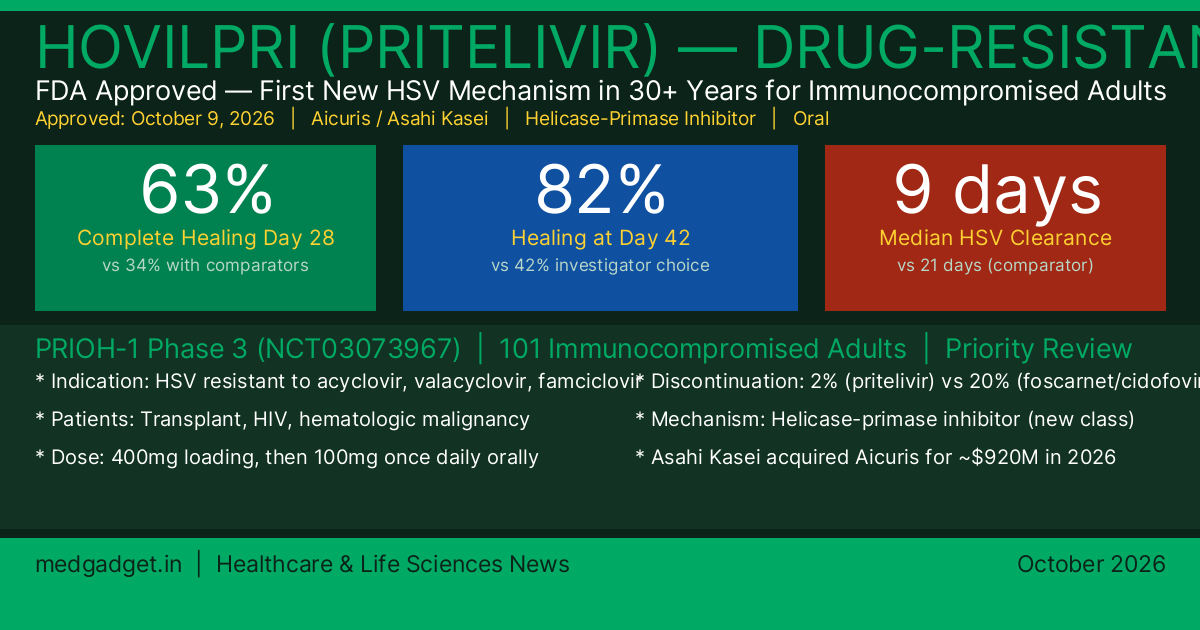
The U.S. FDA approved pritelivir (Hovilpri) on October 9, 2026, for the treatment of mucocutaneous herpes simplex virus (HSV) lesions in immunocompromised adults who did not adequately respond to standard antiviral therapy — including acyclovir, valacyclovir, or famciclovir. The drug was developed by Aicuris Anti-infective Cures, now part of Asahi Kasei Therapeutics, which acquired Aicuris earlier in 2026 for approximately $920 million.
An Unmet Need in Immunocompromised Patients
HSV affects an estimated 3.7 billion people globally with HSV-1 and approximately 490 million with HSV-2. While HSV infection is lifelong and incurable, it is typically manageable with antiviral therapy in immunocompetent individuals. However, immunocompromised patients — including those with hematologic malignancies, organ transplant recipients, and people living with HIV — face a different reality.
In this population, HSV lesions can be severe, persistent, and potentially life-threatening. Furthermore, prolonged antiviral use in immunocompromised hosts creates selection pressure for drug-resistant HSV strains, particularly resistance to acyclovir and its derivatives. When standard antivirals fail, options have historically been limited to nephrotoxic intravenous agents like foscarnet and cidofovir — both with substantial toxicity burdens.
Pritelivir addresses this critical gap.
A Novel Mechanism: Helicase-Primase Inhibition
Pritelivir represents a genuinely new class of antiviral therapy. Unlike acyclovir and its analogs — which work by inhibiting viral DNA polymerase — pritelivir targets the HSV helicase-primase complex, which is essential for viral DNA replication and unwinding. Because this mechanism is entirely distinct from the nucleoside analog pathway, pritelivir retains activity against acyclovir-resistant HSV strains.
This is the first drug with a new mechanism of action to be approved for HSV treatment in approximately three decades, representing a major advance for infectious disease medicine.
PRIOH-1 Phase 3 Trial Results
The FDA approval was based on Part C of the Phase 3 PRIOH-1 trial (NCT03073967), a randomized, open-label, comparator-controlled superiority trial.
- Patients: 101 immunocompromised adults with refractory mucocutaneous HSV (resistant to or intolerant of standard antivirals)
- Randomization: 1:1 to oral pritelivir or investigator’s choice (IV foscarnet, IV cidofovir, topical cidofovir, or topical imiquimod)
- Dosing: 400 mg loading dose followed by 100 mg once daily
Primary endpoint — Complete healing of all lesions by Day 28:
- Pritelivir: 63%
- Comparator: 34%
Extended analysis (patients continuing to Day 42):
- Complete healing: 82.4% (pritelivir) vs 42.0% (investigator’s choice), adjusted difference +40.2% (p<0.0001)
- Median time to undetectable HSV in lesions: 9 days (pritelivir) vs 21 days (comparator)
- Results were consistent across subgroups including hematologic malignancy, transplant recipients, and HIV-positive patients
Safety and Tolerability
One of the most striking aspects of the pritelivir data is its tolerability advantage over the comparator agents:
- Discontinuation due to adverse events: 2.0% (pritelivir) vs 20% (comparator)
- Common treatment-emergent adverse events (≥5%): headache, diarrhea, nausea, decreased appetite, vomiting, and dizziness
- The comparator group’s 20% discontinuation rate reflects the known toxicity burden of foscarnet and cidofovir — particularly renal toxicity
The FDA granted pritelivir Priority Review, reflecting the seriousness of the condition and the lack of adequate alternatives.
Asahi Kasei’s $920M Bet Pays Off
Asahi Kasei Therapeutics acquired Aicuris for approximately $920 million in early 2026, a deal explicitly aimed at gaining access to pritelivir and other Aicuris anti-infective pipeline assets. The FDA approval validates that strategy, giving Asahi Kasei a commercial-stage product for a niche but medically critical indication.
The drug targets a defined patient population — immunocompromised patients with refractory HSV — rather than the broad general population, which limits its commercial ceiling but positions it as an important and likely well-reimbursed specialty medicine.
Clinical Significance
Pritelivir (Hovilpri) is a breakthrough in the management of drug-resistant HSV. For immunocompromised patients who have run out of standard antiviral options, the drug offers:
- A novel helicase-primase inhibitor mechanism with no cross-resistance to acyclovir
- Oral dosing (versus IV foscarnet/cidofovir), dramatically improving patient experience
- A 29-percentage-point improvement in complete healing at Day 28
- Far lower discontinuation rates versus current alternatives
This represents the most meaningful advance in HSV pharmacotherapy in a generation.
Sources: FDA approval announcement, PRIOH-1 Phase 3 trial data, Aicuris/Asahi Kasei press releases, EndPoints News, BioPharma, October 2026.