

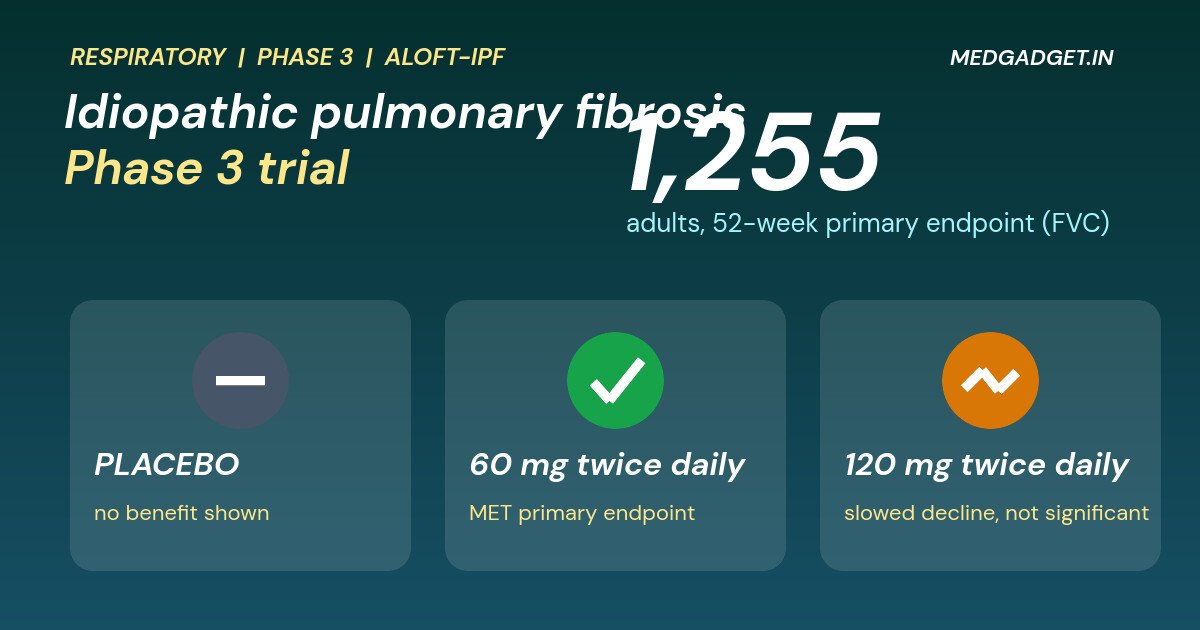
The new idiopathic pulmonary fibrosis Phase 3 trial result is positive, but only at one of the two doses tested. Bristol Myers Squibb announced on 12 October 2026 that its ALOFT-IPF study of admilparant, an oral drug, met its main goal at 60 mg twice daily, with a statistically significant benefit over placebo in lung function at week 52. The higher 120 mg dose slowed lung decline but did not reach statistical significance.
The study enrolled about 1,255 adults, which makes it a large trial in a rare disease. Yet the company has released no figures on how big the benefit is, so it is too early to say whether the drug will matter to patients. This report explains what was found, what the 120 mg result means, and what is still missing.
Idiopathic pulmonary fibrosis Phase 3 trial: results at a glance
- Drug: admilparant (BMS-986278), an oral, selective LPA1 antagonist.
- Design: multicentre, randomised, double-blind, placebo-controlled; about 1,255 adults aged 40 or older with idiopathic pulmonary fibrosis (IPF).
- Arms: 60 mg, 120 mg or placebo, each twice daily, in a 1:1:1 split, for at least 52 weeks.
- Main measure: absolute change in forced vital capacity (FVC) from the start to week 52.
- 60 mg: met the main goal, with a statistically significant improvement over placebo.
- 120 mg: slowed the decline but was not statistically significant.
- Safety: described as well tolerated, with discontinuations due to side effects low and similar to placebo.
What FVC measures in an idiopathic pulmonary fibrosis Phase 3 trial
IPF is a disease in which lung tissue scars and stiffens for reasons that are not known, making breathing harder over time. Forced vital capacity is the amount of air a person can blow out after a deep breath. In IPF it falls as the disease progresses, so slowing the fall is the standard way to judge whether a drug works. The National Heart, Lung, and Blood Institute and the Pulmonary Fibrosis Foundation give general background on the disease.
The company cites about 1.4 million people living with IPF worldwide, a median survival of three to five years after diagnosis and a five-year survival rate of about 45%. These are the company’s own figures, given without sources in the release.
Why the 120 mg result matters in the idiopathic pulmonary fibrosis Phase 3 trial
In many drug trials, a higher dose does at least as well as a lower one. Here, the lower dose won and the higher dose did not, although both slowed the decline. The release does not explain why, and the company has not said whether the gap is due to chance, to how patients were handled at the higher dose, or to something about the drug. A dose that reaches the goal while a higher one does not is hard to interpret, because it can reflect a real plateau or simply a statistical result that fell on either side of the line.
By our arithmetic, an even split of 1,255 people gives roughly 418 per arm. The company has not given arm sizes.
What the idiopathic pulmonary fibrosis Phase 3 trial has not disclosed
- Effect size: no millilitre difference, confidence interval or p-value for either dose.
- Safety detail: no adverse-event rates, serious events or deaths.
- Secondary endpoints: none reported.
- Background therapy: the release does not say whether patients could take the approved IPF drugs nintedanib or pirfenidone alongside admilparant.
- Timing: detailed results will come at a future medical meeting, with no date given.
What earlier data suggested before the idiopathic pulmonary fibrosis Phase 3 trial
The company points to a Phase 2 study in which 26 weeks of 60 mg twice daily was linked to a 62% relative reduction in the rate of lung function decline in IPF. A report on that trial of 278 IPF patients gives the decline in predicted FVC as 1.2 percentage points on the drug against 2.7 on placebo, a difference of 1.4 points with a confidence interval of -0.1 to 3.0, which includes zero. By our simple arithmetic from the rounded figures, the relative reduction works out to about 56%, close to but not the same as the company’s 62%, which probably reflects a different statistical method. Either way, Phase 2 results are a weak guide to Phase 3, and that earlier trial could not by itself prove a benefit.
Where the idiopathic pulmonary fibrosis Phase 3 trial drug sits in the field
The same company is also running ALOFT-PPF, a Phase 3 trial of about 1,057 adults with progressive pulmonary fibrosis other than IPF, with results expected in early 2027. Other treatments are in development too. One report notes a positive trial for an inhaled drug, United Therapeutics’ Tyvaso, with a 130.1 mL difference in FVC at week 52, and an earlier-stage trial of another oral LPA1 antagonist, Contineum’s PIPE-791. Those are different trials with different patients, so they cannot be compared with admilparant.
Our assessment of the idiopathic pulmonary fibrosis Phase 3 trial
In our assessment, the idiopathic pulmonary fibrosis Phase 3 trial is encouraging news for a disease with limited treatments, mainly because a large, double-blind, placebo-controlled study hit its main endpoint at the lower dose. But a headline of success should not hide that the higher dose missed, that the size of the benefit is unknown and that safety detail is thin. The company says it will engage health authorities about planned submissions, and which dose it files will be a key question. For related coverage, see our report on the Bristol Myers RYZ101 cancer trial and on the Yutrepia patent ruling in lung disease, or browse more pharmaceutical news.
What to watch after the idiopathic pulmonary fibrosis Phase 3 trial
- Full ALOFT-IPF data, including the FVC difference and confidence intervals.
- Adverse-event data, especially at 60 mg and 120 mg.
- Which dose the company takes to regulators, and when.
- ALOFT-PPF results in early 2027, and trial listings on ClinicalTrials.gov.
Frequently asked questions
What did the idiopathic pulmonary fibrosis Phase 3 trial find?
Admilparant 60 mg twice daily met the main goal of improving FVC versus placebo at week 52. The 120 mg dose slowed decline but did not reach statistical significance.
How many people were in the idiopathic pulmonary fibrosis Phase 3 trial?
About 1,255 adults aged 40 or older with IPF.
What is the drug in the idiopathic pulmonary fibrosis Phase 3 trial?
An oral drug that blocks the LPA1 receptor, which the company says is involved in lung scarring.
Is the idiopathic pulmonary fibrosis Phase 3 trial drug approved?
No. It is investigational, and the company plans to talk to health authorities about submissions.
Did the trial show how much benefit patients get?
Not yet. The company has not released the size of the effect.
How we reported this: we relied on the company’s topline announcement of 12 October 2026 and on coverage of the same data. Results are company-reported, topline only and not peer reviewed. Figures labelled as ours are our own calculations. Last updated: 13 October 2026. This article is news reporting and not medical advice.
[…] Edema Trial: Goal Met, Safety Flags STERIS Xodus Medical Acquisition: $2.1B Deal Explained Idiopathic Pulmonary Fibrosis Phase 3 Trial: 60 mg Wins Bristol Myers Cancer Clinical Trial 2026: RYZ101 Meets Goal Hēlo Thrombectomy FDA Clearance: […]
[…] MT027 CAR-T Therapy FDA Clearance: Phase 2 Brain Trial Bausch Lomb CEO Resignation 2026: Saunders Out, Appio In Merck Diabetic Macular Edema Trial: Goal Met, Safety Flags STERIS Xodus Medical Acquisition: $2.1B Deal Explained Idiopathic Pulmonary Fibrosis Phase 3 Trial: 60 mg Wins […]
[…] other trials where the headline needed a closer read, see our reports on the idiopathic pulmonary fibrosis Phase 3 trial, the tovinontrine Phase 2 trial in heart failure and the aprocitentan hypertension study, or browse […]