

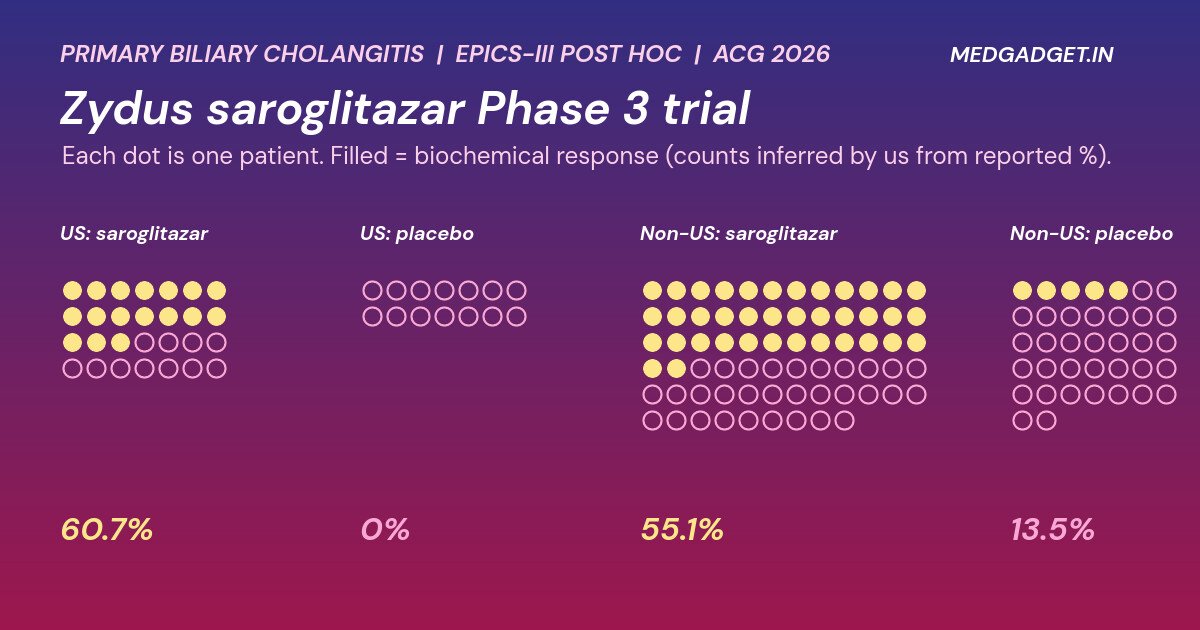
New data from the Zydus saroglitazar Phase 3 trial show the investigational drug beating placebo on a blood-test measure in both US and non-US patients with primary biliary cholangitis (PBC), but the numbers come from small subgroups and from an analysis planned after the trial ended. Zydus Therapeutics presented the post hoc analysis of its EPICS-III study at the American College of Gastroenterology 2026 meeting: biochemical response in 60.7% of US patients on saroglitazar against 0% on placebo, and 55.1% against 13.5% outside the US.
Saroglitazar is still under FDA review for PBC, a rare autoimmune liver disease. This report explains what the subgroup analysis shows, how small the groups are, and why the company itself treats it as supportive, not decisive.
Key facts from the Zydus saroglitazar Phase 3 trial analysis
- US subgroup: 60.7% biochemical response with saroglitazar against 0% with placebo.
- Non-US subgroup: 55.1% against 13.5%.
- Type of analysis: post hoc and exploratory, on data already collected in EPICS-III. It is not a new trial.
- Group sizes (reported at week 52): US, 28 on saroglitazar and 14 on placebo. Non-US (Argentina, Iceland and Turkey), 69 on saroglitazar and 37 on placebo.
- Regulatory status: under FDA review. Safety and effectiveness have not been established.
- Not shown: any evidence of long-term clinical outcomes such as transplant, liver failure or survival.
What the Zydus saroglitazar Phase 3 trial subgroup numbers mean
The percentages are consistent with the group sizes. By our arithmetic, 60.7% of 28 is 17 patients, 55.1% of 69 is 38 and 13.5% of 37 is 5, while none of the 14 US placebo patients responded. Those are our calculations from the reported figures, not numbers the company stated. They show how little it takes to move a percentage: one patient is about 7% of the US placebo arm and about 4% of the US saroglitazar arm. A 0% response in 14 people is also a statistical oddity, since the overall placebo response in the full trial was 9.8%. It is the kind of result that can arise by chance in a small group.
The company does not claim the drug works better in one region. Read this way, the analysis is a consistency check: the direction of benefit looked the same in both groups, which is reassuring, though it does not prove the effect size in either one.
The main EPICS-III result behind the Zydus saroglitazar Phase 3 trial
The headline result was reported earlier, at the EASL Congress in Barcelona on 30 May 2026. EPICS-III was a Phase 2b/3 study that randomised 148 patients two to one to saroglitazar or placebo. The primary endpoint was a composite biochemical response at week 52, which required alkaline phosphatase (ALP) below 1.67 times the upper limit of normal, a fall in ALP of at least 15% from baseline, and bilirubin at or below the upper limit. According to the company, 56.7% of saroglitazar patients met it against 9.8% on placebo, a difference of 48 percentage points (95% confidence interval 35.3 to 60.8, p below 0.001).
ALP fell by a mean of 33.5% with saroglitazar and rose by 6.5% with placebo. On itch, a secondary endpoint, the 5-D Itch score improved more with saroglitazar at week 24 (difference of 3.2 points, p = 0.009), but the difference was not statistically significant at week 52. Those figures are the company’s. The National Institute of Diabetes and Digestive and Kidney Diseases offers background on PBC for general readers.
Safety in the Zydus saroglitazar Phase 3 trial
In the main results, the company reported serious adverse events in 6.3% of saroglitazar patients and 11.1% of placebo patients, with none judged related to treatment by investigators and no treatment-related deaths. Headache, hypertension, upper respiratory infection, abdominal pain, COVID-19, diarrhoea and vitamin D deficiency were more frequent on saroglitazar. For the new subgroup analysis, the company describes the drug as generally well tolerated with adverse events broadly balanced against placebo, but one summary of the data gave no specific rates, discontinuations or subgroup safety figures.
FDA review of saroglitazar after the Zydus saroglitazar Phase 3 trial
According to the company, the FDA granted priority review to the saroglitazar application in May 2026, with a target action date of 27 November 2026. The proposed use is in combination with ursodeoxycholic acid for adults with an inadequate response to it, or alone for patients who cannot tolerate it. Saroglitazar also holds orphan drug and Fast Track designations, and the company plans a US launch by March 2027 if it is approved. The FDA explains priority review as a process that aims to act faster, not to lower the standard of evidence. We have not seen a PDUFA date in the October materials, so the November date comes from the earlier announcement.
Our assessment of the Zydus saroglitazar Phase 3 trial data
In our assessment, the subgroup analysis adds comfort rather than new evidence. The main trial carries the weight in the FDA review, and the question regulators and doctors will ask is about long-term outcomes. Biochemical markers such as ALP are accepted surrogate measures in PBC, but they are not the same as proving that patients live longer or avoid transplant, and the trial did not report such outcomes. The fall to 0% in the US placebo arm should be treated with caution.
What the Zydus saroglitazar Phase 3 trial data leave unanswered
- Whether the biochemical response translates into better long-term outcomes.
- Full safety detail for the US and non-US subgroups.
- Whether the 0% US placebo result reflects chance or a real difference between groups.
- The FDA’s decision, due after the November target date if the schedule holds.
For other trials where the headline needed a closer read, see our reports on the idiopathic pulmonary fibrosis Phase 3 trial, the tovinontrine Phase 2 trial in heart failure and the aprocitentan hypertension study, or browse more pharmaceutical news.
Frequently asked questions
What did the Zydus saroglitazar Phase 3 trial analysis show?
Biochemical response of 60.7% against 0% in US patients and 55.1% against 13.5% outside the US, in a post hoc analysis of EPICS-III.
Is saroglitazar approved for PBC after the Zydus saroglitazar Phase 3 trial?
No. It is under FDA review, with a target action date of 27 November 2026, according to the company.
How reliable are the Zydus saroglitazar Phase 3 trial subgroup results?
They are exploratory and based on small groups, so they support the main trial but do not stand alone.
What is primary biliary cholangitis?
A rare autoimmune disease in which the bile ducts in the liver are gradually damaged.
Does the Zydus saroglitazar Phase 3 trial prove long-term benefit?
No. It measured blood markers, not outcomes such as transplant or survival.
How we reported this: we relied on the company’s announcements, including the main EPICS-III results and the priority review notice, and a separate summary of the subgroup data. Results are the company’s. Figures labelled as ours are our own calculations. Last updated: 13 October 2026. This article is news reporting and not medical advice.
[…] partner on a first-of-its-kind US filing in oncology. We have followed Zydus before, including its saroglitazar Phase 3 data in a rare liver disease, and the wider biosimilars market in our report on the US launch of the FILKRI biosimilar. More […]
[…] but its commercial value depends on launch timing and pricing that are not yet public. See also Zydus Saroglitazar Phase 3 Trial: New PBC Subgroup Data. More in our pharmaceutical news […]