

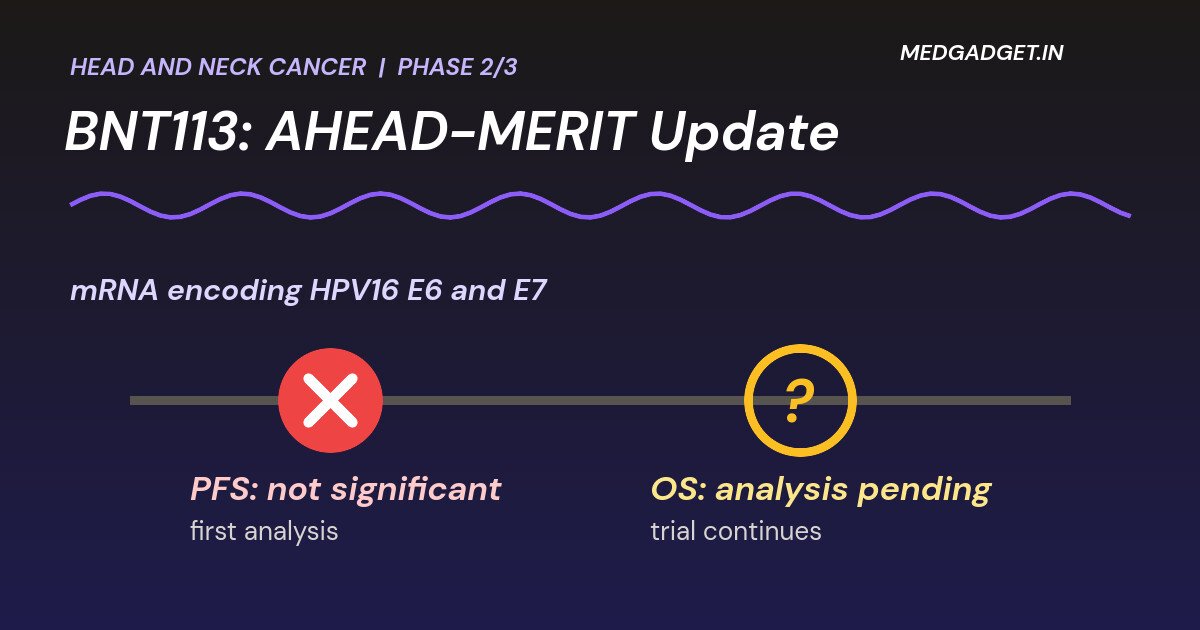
The BioNTech mRNA cancer therapy trial AHEAD-MERIT has missed its first main goal, but it is not over. On 13 October 2026, BioNTech announced that BNT113, an experimental mRNA cancer immunotherapy, combined with the immune drug pembrolizumab did not show a statistically significant improvement in progression-free survival compared with pembrolizumab alone in HPV16-positive head and neck cancer. The independent monitoring committee recommended that the Phase 2/3 study continue to its second primary endpoint, overall survival.
That distinction matters. The trial has not failed overall and BioNTech has not dropped BNT113. Under the study’s pre-specified statistical design, a significant overall survival result could still make the trial positive. But the announcement gave no numbers, so how close the progression result came is unknown. Here is what was reported, what was not, and what happens next.
BioNTech mRNA cancer therapy trial: what was reported
- Result: BNT113 plus pembrolizumab “did not demonstrate a statistically significant improvement” in progression-free survival (PFS) at the first analysis.
- Next step: the Independent Data Monitoring Committee recommended continuing as planned to assess overall survival (OS).
- Blinding: BioNTech said it remains blinded to ongoing trial data.
- Statistical design: a statistically significant OS improvement would establish a positive trial outcome even though PFS was missed.
- Not reported: the hazard ratio, p-value, median PFS, number of patients, safety results and timing of the OS analysis.
Prof Ozlem Tureci, BioNTech’s co-founder and chief medical officer, said the PFS result was not significant “at this first analysis” and that OS would be “critical” to fully assess the approach. She also said the data show BNT113 is engaging its intended mechanism; the release gave no data to support that, so it should be read as the company’s view.
How the BioNTech mRNA cancer therapy trial is designed
- Name and ID: AHEAD-MERIT, NCT04534205.
- Type: Phase 2/3, open-label, two-arm, run at multiple sites.
- Parts: Part A was a non-randomised safety run-in; Part B randomised patients to BNT113 plus pembrolizumab or pembrolizumab alone.
- Patients: first-line treatment of unresectable recurrent or metastatic HPV16-positive head and neck squamous cell carcinoma with PD-L1 combined positive score of 1 or higher.
- Endpoints: PFS and OS as dual primary endpoints; safety, response rate and duration of response as secondary.
- Treatment: up to about 24 months.
Open-label means doctors and patients know which treatment is given, which is common in cancer trials but can affect some measures.
Why the BioNTech mRNA cancer therapy trial continues
Progression-free survival measures how long patients live without their cancer growing. Overall survival measures how long they live. A drug can improve one without the other, and immune-based treatments sometimes show their benefit on survival later than on tumour control, though that is not guaranteed. Because the trial has two primary endpoints, the statistical plan allows an OS win to count as success. BioNTech’s remaining blinded matters: it suggests the company has not seen survival trends and cannot say which way they point.
Where public records differ on the BioNTech mRNA cancer therapy trial
The public trial register entry on ClinicalTrials.gov has been updated over time, and the versions we could read differ from each other and from the company’s description. An older snapshot, last updated in May 2024, listed 285 planned participants and named overall survival and response rate as the main Part B measures, with PFS as a secondary measure; the company now describes PFS and OS as dual primary endpoints. A trial-tracking page shows 358 participants, 142 sites, a status of active and not recruiting, and an estimated primary completion of August 2028. We could not confirm these figures on the official register, so we have treated them as indicative. The company’s release does not state an enrolment number.
What BNT113 is
BNT113 is an investigational mRNA therapy that encodes two proteins, E6 and E7, from human papillomavirus type 16 (HPV16). The idea is to teach the immune system to recognise cancer cells carrying those viral proteins, and to strengthen the effect of a checkpoint inhibitor such as pembrolizumab. HPV16 drives many cancers of the throat, as described by the US National Cancer Institute. BioNTech said BNT113 received Fast Track designation in January 2026; the FDA’s Fast Track programme is meant to speed development and review, and does not indicate that a drug works.
Pembrolizumab alone is already a standard first-line option for PD-L1-positive recurrent or metastatic head and neck cancer, so a new treatment needs to beat it, not simply match it. For more on pembrolizumab, see our report on the first Keytruda biosimilar application accepted by the FDA.
Market reaction to the BioNTech mRNA cancer therapy trial
Market reports put the decline in BioNTech’s US-listed shares in premarket trading at nearly 6%. We could not confirm that figure from the sources we read, and another summary showed a smaller move, so treat it as indicative.
What this means for patients
The result does not change current treatment. BNT113 is not approved anywhere and is available only to people taking part in clinical trials, so pembrolizumab-based care remains what doctors can offer outside a study. Patients already in AHEAD-MERIT should speak to their trial team, who will have received the sponsor’s guidance, instead of drawing conclusions from the headline. The monitoring committee’s recommendation to continue the study also indicates that it saw no safety reason to stop it, although the company did not publish safety data.
Our assessment of the BioNTech mRNA cancer therapy trial
In our assessment, the BioNTech mRNA cancer therapy trial result is a setback, not a verdict. A missed PFS endpoint in a trial that is continuing is a mixed signal: it lowers confidence, but the survival data are still to come, and the company has not released the numbers that would show how close the result was. It would also be a mistake to read this as a judgment on mRNA medicine in general. BNT113 is one candidate, aimed at two viral proteins in one type of cancer. Other mRNA programmes, including Novartis’s mRNA autoimmune licence with Abogen, are in different diseases and use different designs. For more oncology coverage, see our report on epcoritamab with R-CHOP in DLBCL or browse our biotechnology coverage.
What to watch next in the BioNTech mRNA cancer therapy trial
- The full PFS data, likely at a medical meeting or in a publication.
- Timing of the overall survival analysis.
- Any change to the trial design or regulatory plans.
- Safety data for BNT113 plus pembrolizumab.
Frequently asked questions
What happened in the BioNTech mRNA cancer therapy trial?
BNT113 plus pembrolizumab did not significantly improve progression-free survival over pembrolizumab alone in the AHEAD-MERIT Phase 2/3 trial.
Has the BioNTech mRNA cancer therapy trial failed?
No. It is continuing to assess overall survival, which is a second primary endpoint.
Has BioNTech abandoned BNT113?
No. The company said the data support continued evaluation of BNT113 in this trial.
What is BNT113?
An investigational mRNA immunotherapy encoding HPV16 E6 and E7 proteins, tested with pembrolizumab in head and neck cancer.
When will the BioNTech mRNA cancer therapy trial report survival results?
The company has not given a date.
How we reported this: we relied on BioNTech’s 13 October 2026 announcement as published in full by distribution services, and on public trial-register information. We did not see the underlying data. Last updated: 13 October 2026. This article is news reporting and not medical advice.