

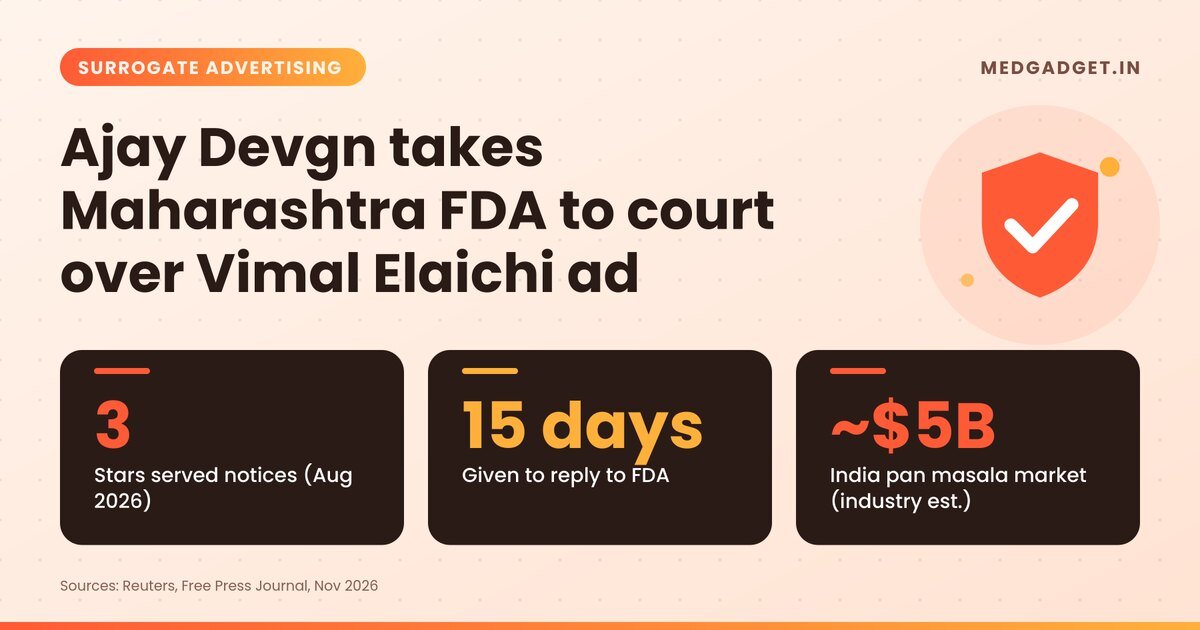
Ajay Devgn’s Vimal ad is now a court fight: the actor has challenged a Maharashtra Food and Drug Administration (FDA) directive in the Bombay High Court after the regulator told him, Shah Rukh Khan and Tiger Shroff in August 2026 to stop promoting Vimal Elaichi, a cardamom product sold under a brand best known for pan masala, which is banned in the state. Reuters reported on 26 November 2026 that it had reviewed Devgn’s non-public filing, dated 15 October, which argues there is no bar on endorsing a product that is not itself prohibited.
Key takeaways on the Ajay Devgn Vimal ad case
- Maharashtra FDA, led by Commissioner Tukaram Mundhe, issued show-cause notices around 11 August 2026 to Devgn, Shah Rukh Khan and Tiger Shroff over a 2024 Vimal Elaichi campaign.
- The regulator says the ad appears to promote the Vimal brand identity, which is mainly linked to pan masala, a product barred from manufacture, storage, distribution and sale in Maharashtra.
- Devgn’s petition, reported by Reuters, argues cardamom is lawful and that endorsing a legal product cannot be treated as an offence.
- No hearing date or interim order has been publicly reported. The responses of Khan and Shroff are under review by the state and have not been disclosed.
- The outcome could set a practical test for what counts as surrogate advertising in India, an issue national guidelines have tried to settle since 2024.
What the Maharashtra FDA actually asked for
According to reports of the notices in the Free Press Journal and other outlets, the FDA asked the three actors to stop taking part in the campaign, remove promotional content from their official social media and other platforms, and explain within 15 days whether Vimal Elaichi is a standalone product or a stand-in for Vimal pan masala. The notices also reportedly sought endorsement agreements, campaign briefs and details of any due diligence the stars did before signing.
The legal hooks cited in those reports are Section 24 of the Food Safety and Standards Act, 2006, which prohibits misleading or deceptive food advertisements, and the Consumer Protection Act, 2019. Under Section 53 of the food safety law, a person who publishes or is party to a misleading food advertisement can face a penalty of up to Rs 10 lakh. One outlet also reported a possible Rs 50 lakh fine and a three-year endorsement ban under consumer law; that figure has not been confirmed by the regulator, so treat it as unverified.
Timeline of the dispute
| Date | Event | Source |
|---|---|---|
| 2024 | Vimal Elaichi ad featuring Devgn, Khan and Shroff released; Hindi version later crosses about 107 million YouTube views | Reuters |
| Around 11 Aug 2026 | Maharashtra FDA issues show-cause notices to the three actors | Free Press Journal, IANS |
| 16-17 Aug 2026 | Notices become public; FDA warns of further action if replies are unsatisfactory | Free Press Journal, Reuters |
| 15 Oct 2026 | Devgn’s petition dated, challenging the directive in the Bombay High Court | Reuters |
| 26 Nov 2026 | Reuters reports the filing; state says it is reviewing Khan’s and Shroff’s replies | Reuters |
Why regulators care: the public health side of pan masala
This is not a celebrity spat dressed up as regulation. Areca nut, the base of pan masala, is classified by the International Agency for Research on Cancer as carcinogenic to humans, and health experts quoted by Reuters link pan masala use to oral submucous fibrosis, a stiffening of the mouth lining that can progress to oral cancer. India carries one of the world’s heaviest burdens of oral cancer, and smokeless products are a major reason.
Maharashtra has banned gutka and pan masala under food safety powers since 2012, renewing the prohibition each year. Reuters notes that in other states tobacco-free Vimal pan masala sachets sell for about Rs 5 and are often sold as twin packs alongside a pouch of unbranded chewing tobacco. That pairing is the core of the regulator’s worry: if the brand name stays visible on prime-time TV through a cardamom product, the banned product benefits from the recall.
Surrogate advertising: where the law stands
Surrogate advertising means promoting a restricted brand through a related, legal product, such as music CDs or soda for liquor labels, or mouth fresheners for tobacco-linked names. Direct tobacco advertising is already banned under the Cigarettes and Other Tobacco Products Act, 2003. The Central Consumer Protection Authority’s 2022 guidelines on misleading advertisements also bar surrogate ads and place due-diligence duties on endorsers.
The gap is in proof. Regulators must show that an ad for a legal item is really building the identity of a prohibited one. Devgn’s filing pushes on exactly that point. PB Agro, which holds the Vimal licence, told Reuters through its lawyer that it does not promote Vimal in Maharashtra and advertises only on national television. Lawyer Anuj Tiwari told Reuters the case will test both the fairness of the department’s process and the standard for what counts as indirect advertising.
What this means for brands, stars and consumers
Reuters cites an industry estimate valuing India’s pan masala market at roughly $5 billion last year, and a screenwriter quoted in its report said endorsements can make up as much as 30% of an actor’s earnings. A ruling either way would reach well beyond one cardamom ad. If the High Court backs the FDA, state food regulators elsewhere could use the same tools against brand-extension campaigns. If it backs Devgn, regulators may need clearer national rules before acting against endorsers.
For consumers, the practical message does not depend on the verdict: cardamom itself is harmless, but pan masala, gutka and areca nut products are linked to serious oral disease. The Maharashtra FDA has also stepped up enforcement in other areas this year, including its Rs 1.38 crore seizure of unapproved NMN supplements, while national food regulator FSSAI has ordered wider testing of packaged drinking water.
What is still unknown
- The bench, hearing date and any interim relief in Devgn’s petition have not been reported.
- The contents of Shah Rukh Khan’s and Tiger Shroff’s replies, and whether either will also go to court.
- Whether the Centre will finalise explicit surrogate advertising rules it has been working on since 2024.
FAQ
Why did Maharashtra FDA send a notice to Ajay Devgn?
The regulator says his Vimal Elaichi ad appears to promote the Vimal brand, which is mainly associated with pan masala, a product banned in Maharashtra, and may mislead consumers.
Is Vimal Elaichi banned in Maharashtra?
No ban on cardamom itself has been reported. The dispute is about whether advertising it under the Vimal name amounts to surrogate promotion of banned pan masala.
What is surrogate advertising in India?
It is promoting a brand whose main product cannot be advertised, such as tobacco or liquor, through a related legal product. CCPA guidelines issued in 2022 prohibit it.
Is pan masala harmful even without tobacco?
Yes. Areca nut is classed as a human carcinogen and is linked to oral submucous fibrosis and oral cancer, according to health experts and IARC.
Sources: Reuters report (via Arab News), 26 Nov 2026; Free Press Journal, 16 Aug 2026. Court filing details as reported by Reuters; the notice text has not been published by the FDA. More in Healthcare Services. This article is for information only and is not legal or medical advice. Last updated 27 November 2026.